School of Arts, Humanities and Social Sciences, Chanakya University, Bengaluru 562110, India.
Jindal School of Government and Public Policy, O.P. Jindal Global University, Sonipat 131001, India.
Int J Environ Res Public Health. 2023 Sep 27;20(19):6842. doi: 10.3390/ijerph20196842.
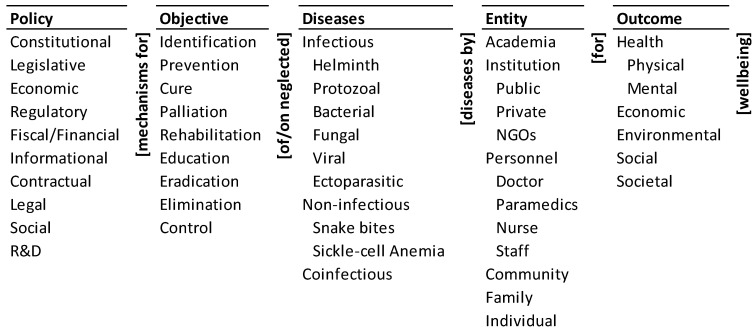
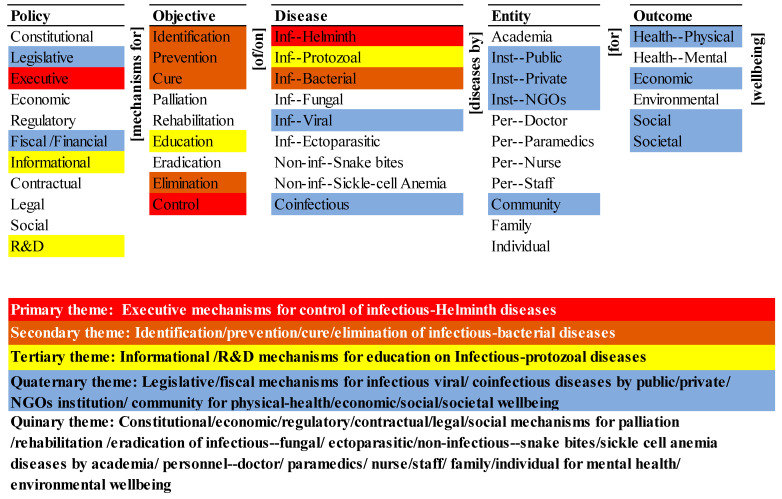
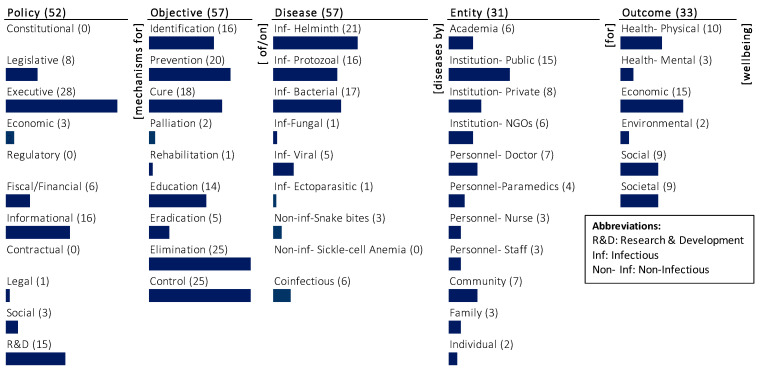
The need for systemic healthcare policies to systematically eliminate NTDs globally and in India has been stressed for more than two decades. Yet, the present policies and the research on them do not meet the need. We present an ontological framework, a research roadmap, and a policy brief to address the gap. The ontology clearly, concisely, and comprehensively represents the combinations of diseases, the objectives regarding the diseases, the entities to address them, the outcomes sought, and the potential policy instruments to invoke. The paper explicates the state of the-policies and state of the research on policies to eliminate NTDs in India. It highlights the significant gaps in the diseases covered, balance in the objectives, comprehensiveness of policies, portfolio of outcomes, and involvement of entities. Last, it presents a set of systemic policies congruent with the ontology to systematically address the gaps. The recommendations are aligned with the present research, policies, practices, and recommendations in India and of the WHO, UN agencies, and other similar bodies. The approach can be generalized to provide roadmaps for other countries facing a similar challenge and for other diseases of similar complexity. The roadmaps, with continuous feedback and learning, can help navigate the challenge efficiently and effectively.
需要制定系统性的医疗保健政策,以在全球和印度有系统地消除被忽视的热带病,但现有的政策和相关研究都无法满足这个需求。我们提出了一个本体论框架、研究路线图和政策简报,以解决这个差距。这个本体论清楚、简洁、全面地呈现了疾病的组合、针对这些疾病的目标、需要解决的实体、所寻求的结果以及可能调用的政策工具。本文详细阐述了印度消除被忽视的热带病的政策现状和政策研究现状。它突出了所涵盖疾病、目标平衡、政策全面性、成果组合以及实体参与等方面的重大差距。最后,它提出了一系列与本体论一致的系统性政策,以有系统地解决这些差距。这些建议与印度目前的研究、政策、实践以及世界卫生组织、联合国机构和其他类似机构的建议相一致。这种方法可以推广到面临类似挑战的其他国家和类似复杂程度的其他疾病,为它们提供路线图。这些路线图可以通过持续的反馈和学习,帮助有效地应对挑战。