School of Public Health and Management, Wenzhou Medical University, Wenzhou, 325035, China.
School of Environmental Science and Engineering, Suzhou University of Science and Technology, Suzhou, 215009, China.
BMC Urol. 2023 Oct 14;23(1):164. doi: 10.1186/s12894-023-01316-4.
Most prostate cancers(PCa) rely on serum prostate-specific antigen (PSA) testing for biopsy confirmation, but the accuracy needs to be further improved. We need to continue to develop PCa prediction model with high clinical application value.
Benign prostatic hyperplasia (BPH) and prostate cancer data were obtained from the Chinese National Clinical Medical Science Data Center for retrospective analysis. The model was constructed using the XGBoost algorithm, and patients' age, body mass index (BMI), PSA-related parameters and serum biochemical parameters were used as model variables. Using decision analysis curve (DCA) to evaluate the clinical utility of the models. The shapley additive explanation (SHAP) framework was used to analyze the importance ranking and risk threshold of the variables.
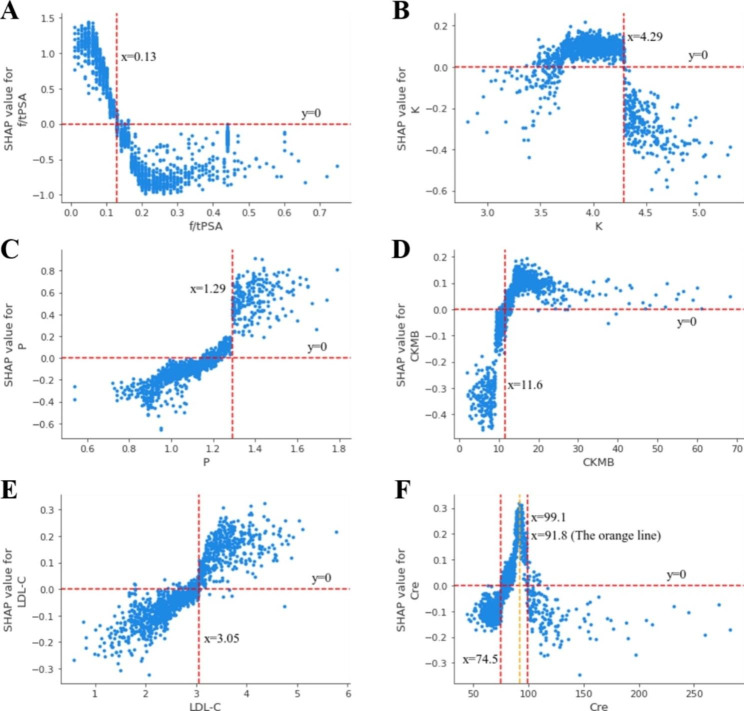
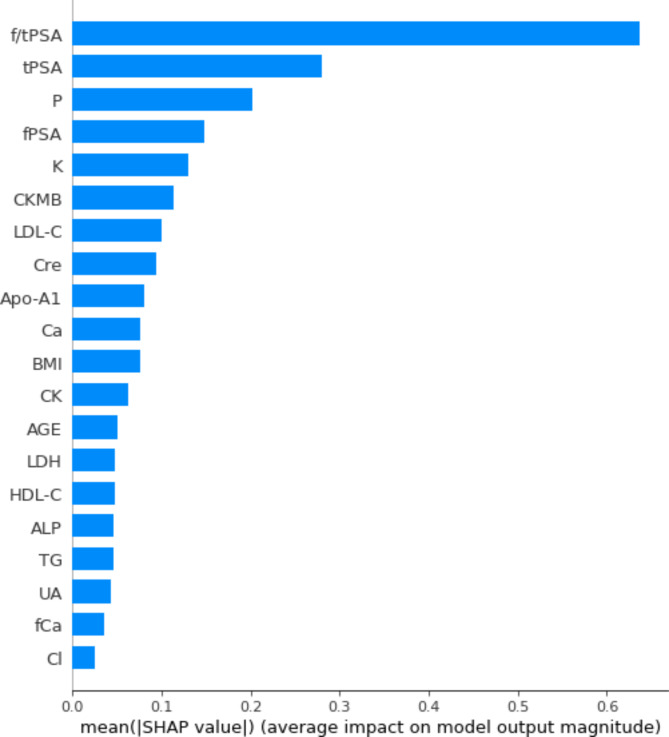
A total of 1915 patients were included in this study, including 823 (43.0%) were BPH patients and 1092 (57.0%) were PCa patients. The XGBoost model provided better performance (AUC 0.82) compared with f/tPSA (AUC 0.75),tPSA (AUC 0.68) and fPSA (AUC 0.61), respectively. Based on SHAP values, f/tPSA was the most important variable, and the top five most important biochemical parameter variables were inorganic phosphorus (P), potassium (K), creatine kinase MB isoenzyme (CKMB), low-density lipoprotein cholesterol (LDL-C), and creatinine (Cre). PCa risk thresholds for these risk markers were f/tPSA (0.13), P (1.29 mmol/L), K (4.29 mmol/L), CKMB ( 11.6U/L), LDL-C (3.05mmol/L) and Cre (74.5-99.1umol/L).
The present model has advantages of wide-spread availability and high net benefit, especially for underdeveloped countries and regions. Furthermore, these risk thresholds can assist in the diagnosis and screening of prostate cancer in clinical practice.
大多数前列腺癌(PCa)依赖于血清前列腺特异性抗原(PSA)检测进行活检确认,但准确性需要进一步提高。我们需要继续开发具有高临床应用价值的 PCa 预测模型。
良性前列腺增生(BPH)和前列腺癌数据来自中国国家临床医学科学数据中心进行回顾性分析。该模型使用 XGBoost 算法构建,模型变量包括患者年龄、体重指数(BMI)、PSA 相关参数和血清生化参数。使用决策分析曲线(DCA)评估模型的临床实用性。使用 Shapley 加性解释(SHAP)框架分析变量的重要性排名和风险阈值。
本研究共纳入 1915 例患者,其中 823 例(43.0%)为 BPH 患者,1092 例(57.0%)为 PCa 患者。XGBoost 模型的表现优于 f/tPSA(AUC 为 0.75)、tPSA(AUC 为 0.68)和 fPSA(AUC 为 0.61)。基于 SHAP 值,f/tPSA 是最重要的变量,前五个最重要的生化参数变量为无机磷(P)、钾(K)、肌酸激酶同工酶 MB(CKMB)、低密度脂蛋白胆固醇(LDL-C)和肌酐(Cre)。这些风险标志物的 PCa 风险阈值为 f/tPSA(0.13)、P(1.29mmol/L)、K(4.29mmol/L)、CKMB(11.6U/L)、LDL-C(3.05mmol/L)和 Cre(74.5-99.1umol/L)。
本研究构建的模型具有广泛适用性和高净收益的优点,尤其适用于欠发达地区和国家。此外,这些风险阈值可协助临床实践中前列腺癌的诊断和筛查。