Department of Health Management and Institute of Health Management, Sichuan Provincial People's Hospital, University of Electronic Science and Technology of China, Chengdu, China.
Chinese Academy of Sciences Sichuan Translational Medicine Research Hospital, Chengdu, China.
Front Public Health. 2023 Sep 28;11:1224338. doi: 10.3389/fpubh.2023.1224338. eCollection 2023.
The study aimed to explore the association between physical activity (PA) and PM2. 5-attributable cardiovascular disease (CVD) mortality trends across the United States (US) at the state level.
We conducted a cross-sectional study using data from the Global Burden of Disease 2019 study for PM2.5-attributable CVD mortality and the Behavioral Risk Factor Surveillance System for PA prevalence. The study covered all 50 US states and the District of Columbia from 2001 to 2019. We utilized Joinpoint Regression to calculate AAPC from 2011 to 2019 and Pearson correlation coefficients to assess state-level associations between PA and PM2.5-attributable CVD mortality AAPC.
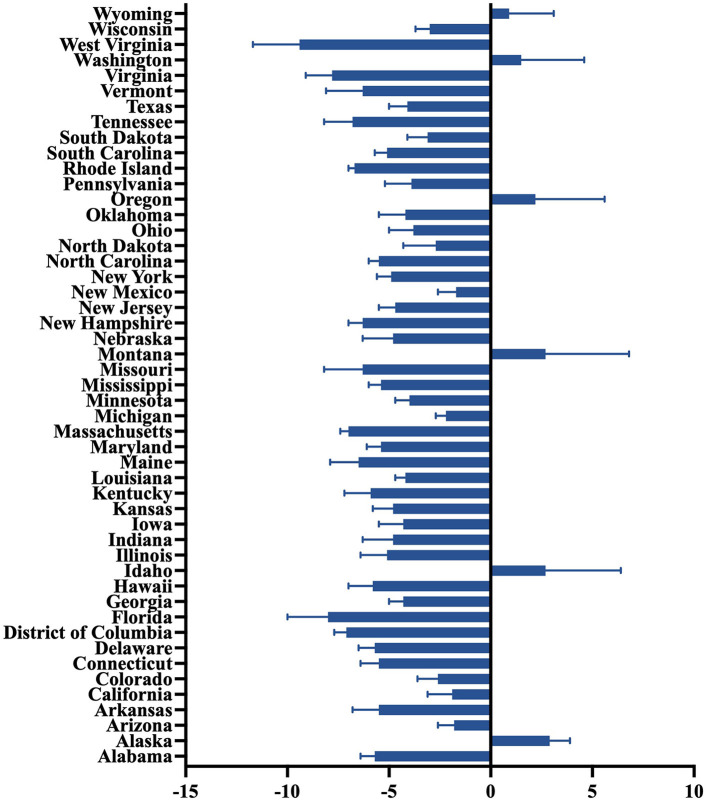
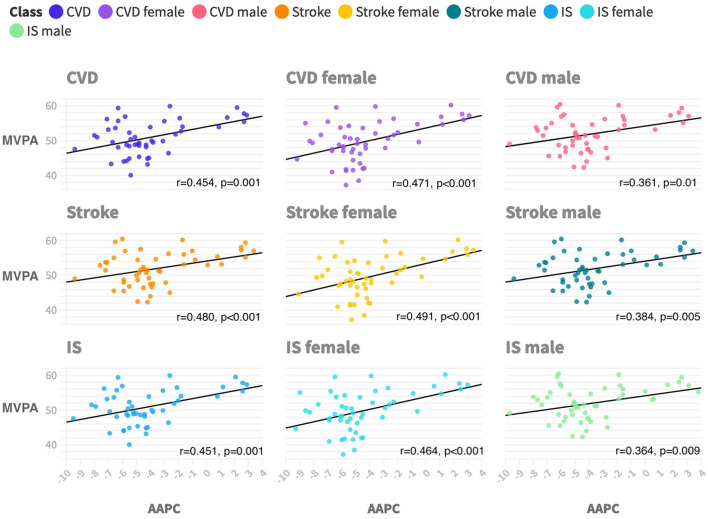
During 2011-2019, a total of 244,318 PM2.5-attributable CVD deaths were recorded. The age-adjusted mortality rates (AAMR) of PM2.5-attributable CVD declined substantially from 2011 to 2019 across all US states, with the most pronounced reductions observed in industrialized states such as West Virginia (51% decline), Kentucky (32%), and Ohio (22%). AAMR ratios for the US states varied substantially, ranging from 0.1 in Hawaii to 1.7 in Arkansas. The AAPC ranged from -9.4% (West Virginia) to -1.7% (New Mexico) in the majority of states, while a few states such as Alaska, Wyoming, and Washington saw slight positive AAPCs from 0.9 to 2.9%. A significant correlation was found between PA and PM2.5-attributable CVD mortality trends ( = 0.454, = 0.001), with similar results in subgroup analyses.
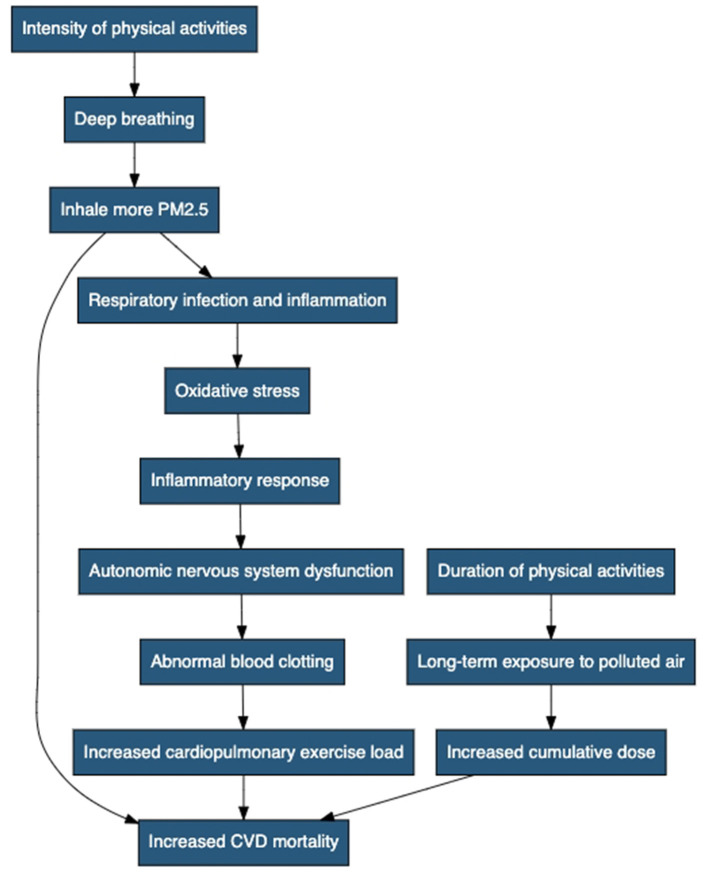
Our findings suggest a correlation between increased physical activity (PA) and increased PM2.5-attributable CVD mortality, highlighting the potential need to consider PM2.5 exposure when engaging in PA to mitigate adverse cardiovascular health impacts. However, further research is warranted to establish causality and underlying mechanisms in the relationship between PA and PM2.5-attributable CVD mortality. Potential limitations include reliance on self-reported PA data.
本研究旨在探讨美国各州层面体力活动(PA)与 PM2.5 归因心血管疾病(CVD)死亡率趋势之间的关联。
我们使用 2019 年全球疾病负担研究中 PM2.5 归因 CVD 死亡率数据和行为风险因素监测系统中 PA 流行率数据开展了一项横断面研究。该研究涵盖了 2001 年至 2019 年期间美国的所有 50 个州和哥伦比亚特区。我们利用 Joinpoint 回归分析计算了 2011 年至 2019 年的年平均百分比变化(AAPC),并采用 Pearson 相关系数评估了各州层面 PA 与 PM2.5 归因 CVD 死亡率 AAPC 之间的关联。
2011 年至 2019 年期间,共记录了 244318 例 PM2.5 归因 CVD 死亡。全美各州的 PM2.5 归因 CVD 年龄标准化死亡率(AAMR)均大幅下降,其中西弗吉尼亚州(下降 51%)、肯塔基州(下降 32%)和俄亥俄州(下降 22%)降幅最为显著。美国各州的 AAMR 比值差异很大,从夏威夷的 0.1 到阿肯色州的 1.7。大多数州的 AAPC 范围在-9.4%(西弗吉尼亚州)到-1.7%(新墨西哥州)之间,而阿拉斯加、怀俄明州和华盛顿等少数几个州的 AAPC 略有正增长,为 0.9%至 2.9%。PA 与 PM2.5 归因 CVD 死亡率趋势之间存在显著相关性( = 0.454, = 0.001),亚组分析也得出了类似结果。
我们的研究结果表明,体力活动(PA)增加与 PM2.5 归因 CVD 死亡率增加之间存在相关性,这突出表明在进行 PA 以减轻不良心血管健康影响时,需要考虑 PM2.5 暴露情况。然而,需要进一步的研究来确定 PA 与 PM2.5 归因 CVD 死亡率之间的因果关系和潜在机制。潜在的局限性包括依赖于自我报告的 PA 数据。