Benskey Matthew J, Panoushek Spencer, Saito Takashi, Saido Takaomi C, Grabinski Tessa, Kanaan Nicholas M
Department of Translational Neuroscience, College of Human Medicine, Michigan State University, Grand Rapids, MI, United States.
Department of Neurocognitive Science, Institute of Brain Science, Nagoya City University Graduate School of Medical Sciences, Nagoya, Japan.
Front Aging Neurosci. 2023 Sep 29;15:1265151. doi: 10.3389/fnagi.2023.1265151. eCollection 2023.
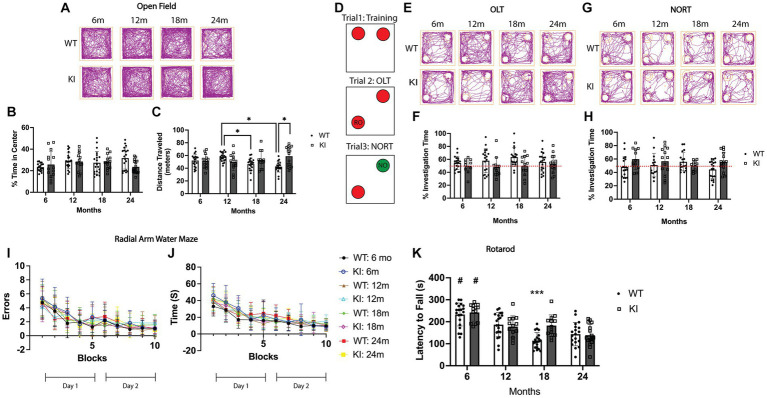
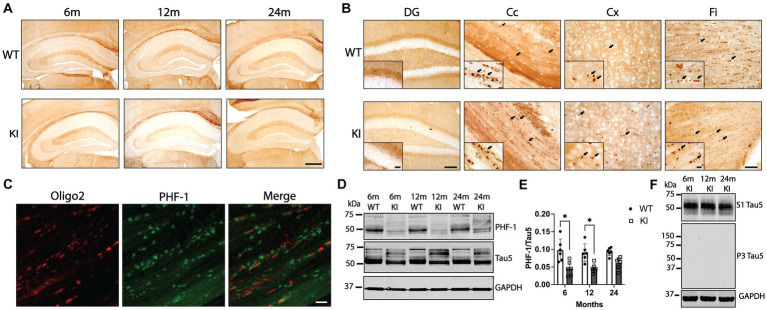
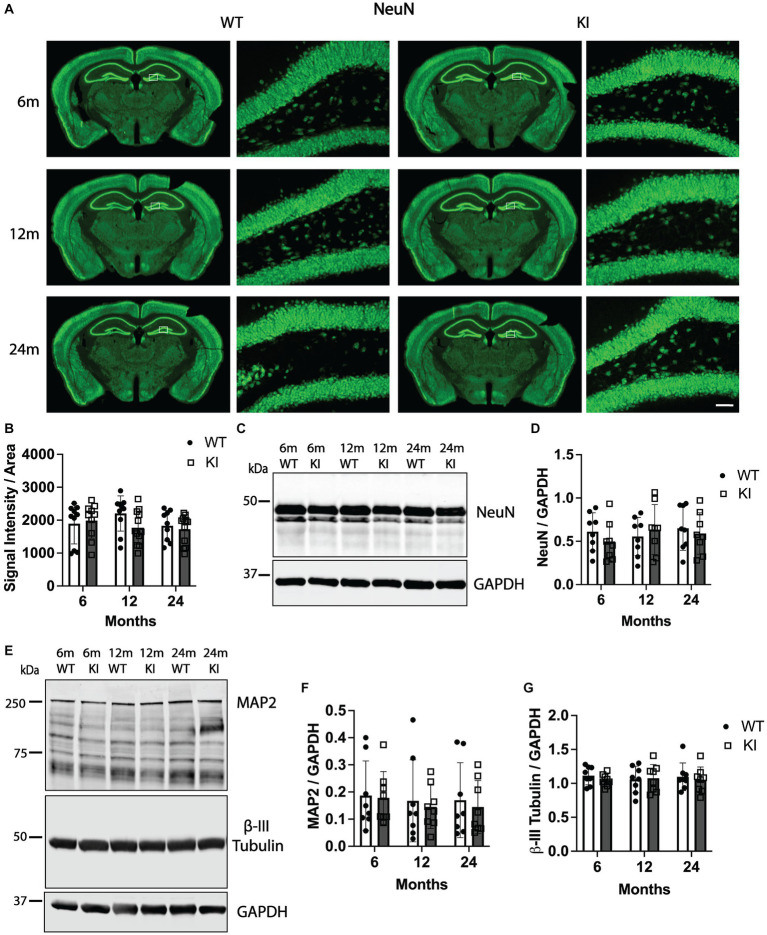
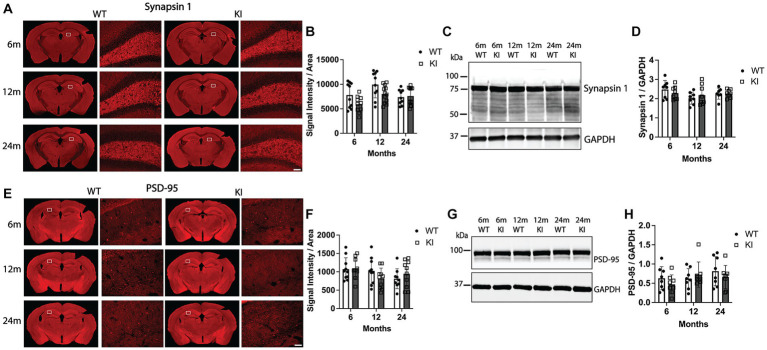
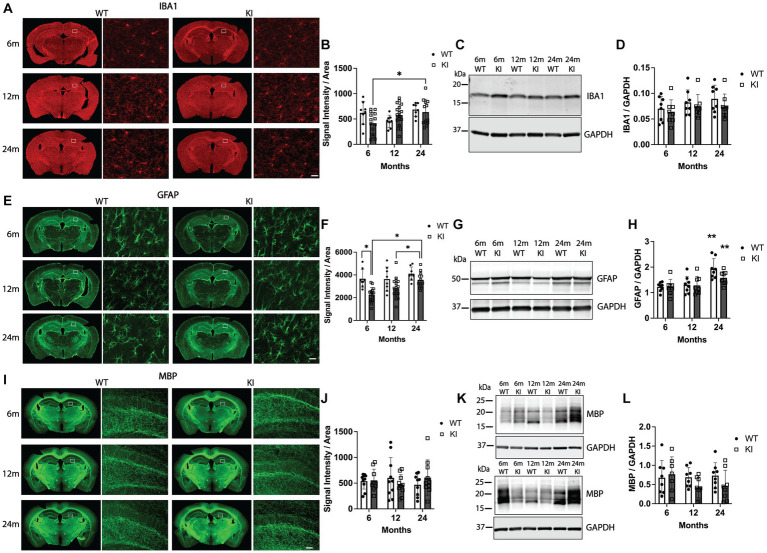
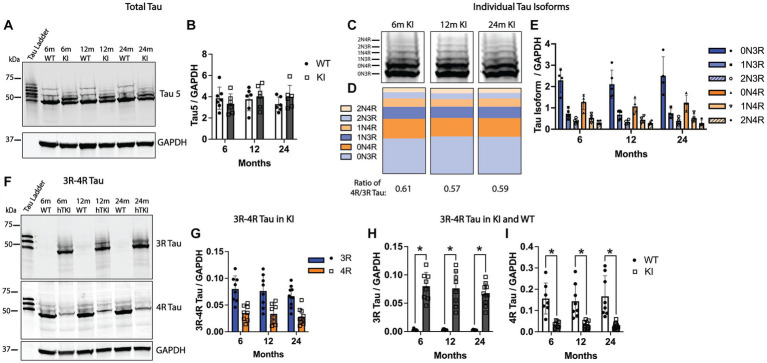
Tau is a microtubule-associated protein with a diverse functional repertoire linked to neurodegenerative disease. Recently, a human tau knock-in (MAPT KI) mouse was developed that may overcome many limitations associated with current animal models used to study tau. In MAPT KI mice, the entire murine gene was replaced with the human gene under control of the endogenous promoter. This model represents an ideal platform to study the function and dysfunction of human tau protein. Accordingly, a detailed understanding of the effects KI has on structure and function of the CNS is warranted. Here, we provide a detailed behavioral and neuropathological assessment of MAPT KI mice. We compared MAPT KI to wild-type (WT) C57BL/6j mice in behavioral assessments of anxiety, attention, working memory, spatial memory, and motor performance from 6 to 24 months (m) of age. Using immunohistological and biochemical assays, we quantified markers of glia (microglia, astrocytes and oligodendrocytes), synaptic integrity, neuronal integrity and the cytoskeleton. Finally, we quantified levels of total tau, tau isoforms, tau phosphorylation, and tau conformations. MAPT KI mice show normal cognitive and locomotor behavior at all ages, and resilience to mild age-associated locomotor deficits observed in WT mice. Markers of neuronal and synaptic integrity are unchanged in MAPT KI mice with advancing age. Glial markers are largely unchanged in MAPT KI mice, but glial fibrillary acidic protein is increased in the hippocampus of WT and MAPT KI mice at 24 m. MAPT KI mice express all 6 human tau isoforms and levels of tau remain stable throughout adulthood. Hippocampal tau in MAPT KI and WT mice is phosphorylated at serine 396/404 (PHF1) and murine tau in WT animals displays more PHF1 phosphorylation at 6 and 12 m. Lastly, we extended previous reports showing that MAPT KI mice do not display overt pathology. No evidence of other tau phosphorylation residues (AT8, pS422) or abnormal conformations (TNT2 or TOC1) associated with pathogenic tau were detected. The lack of overt pathological changes in MAPT KI mice make this an ideal platform for future investigations into the function and dysfunction of tau protein .
Tau是一种与微管相关的蛋白质,其多种功能与神经退行性疾病相关。最近,一种人类tau基因敲入(MAPT KI)小鼠被培育出来,它可能克服了目前用于研究tau的动物模型的许多局限性。在MAPT KI小鼠中,整个小鼠基因被内源性启动子控制下的人类基因所取代。该模型是研究人类tau蛋白功能及功能失调的理想平台。因此,有必要详细了解KI对中枢神经系统结构和功能的影响。在此,我们对MAPT KI小鼠进行了详细的行为和神经病理学评估。我们将MAPT KI小鼠与野生型(WT)C57BL/6j小鼠在6至24个月龄时进行焦虑、注意力、工作记忆、空间记忆和运动性能的行为评估。使用免疫组织化学和生化分析,我们对胶质细胞(小胶质细胞、星形胶质细胞和少突胶质细胞)、突触完整性、神经元完整性和细胞骨架的标志物进行了定量。最后,我们对总tau、tau异构体、tau磷酸化和tau构象水平进行了定量。MAPT KI小鼠在所有年龄段都表现出正常的认知和运动行为,并且对WT小鼠中观察到的与年龄相关的轻度运动缺陷具有抵抗力。随着年龄增长,MAPT KI小鼠中神经元和突触完整性的标志物没有变化。MAPT KI小鼠中的胶质细胞标志物在很大程度上没有变化,但在24个月时,WT和MAPT KI小鼠海马中的胶质纤维酸性蛋白增加。MAPT KI小鼠表达所有6种人类tau异构体,并且tau水平在整个成年期保持稳定。MAPT KI和WT小鼠海马中的tau在丝氨酸396/404处被磷酸化(PHF1),WT动物中的小鼠tau在6个月和12个月时显示出更多的PHF1磷酸化。最后,我们扩展了先前的报告,表明MAPT KI小鼠没有表现出明显的病理学特征。未检测到与致病性tau相关的其他tau磷酸化残基(AT8, pS422)或异常构象(TNT2或TOC1)的证据。MAPT KI小鼠缺乏明显的病理变化,使其成为未来研究tau蛋白功能及功能失调的理想平台。