Department of Pharmacology, University of Minnesota, Minnesota, MN 55455, USA.
Department of Medicinal Chemistry, University of Minnesota, Minnesota, MN 55455, USA.
Nucleic Acids Res. 2023 Dec 11;51(22):12174-12184. doi: 10.1093/nar/gkad860.
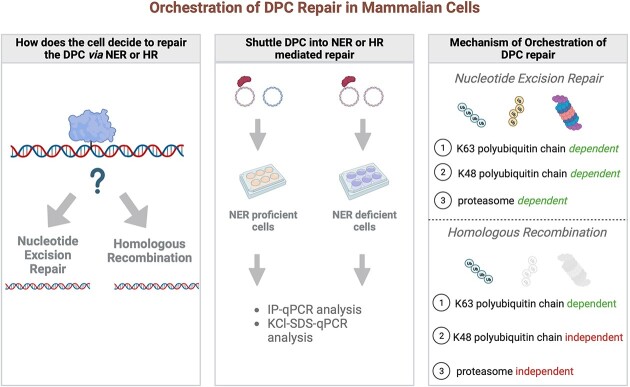
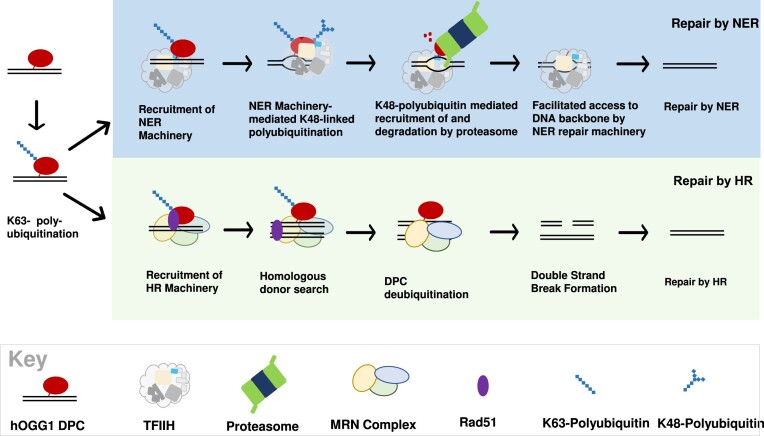
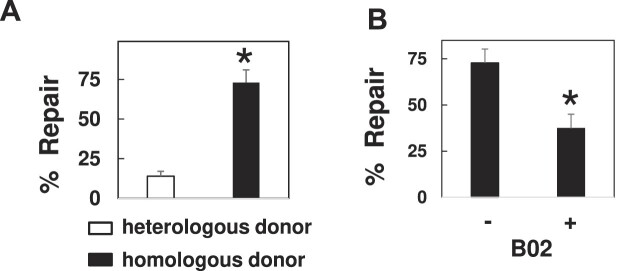
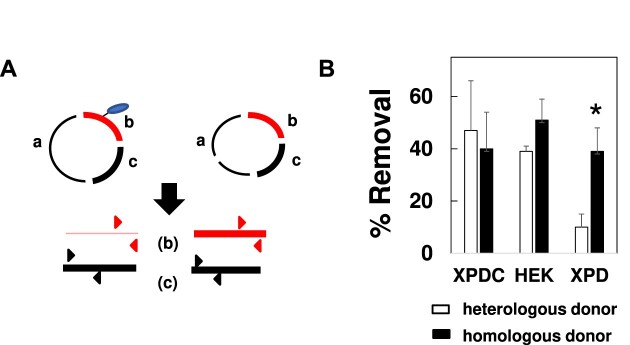
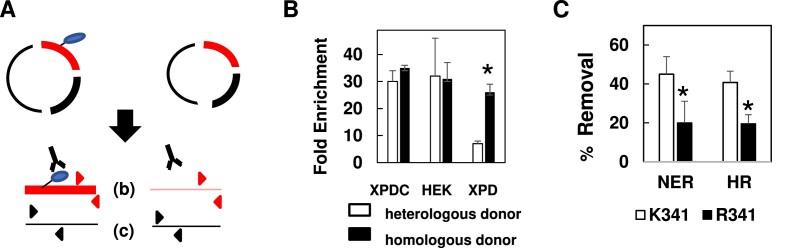
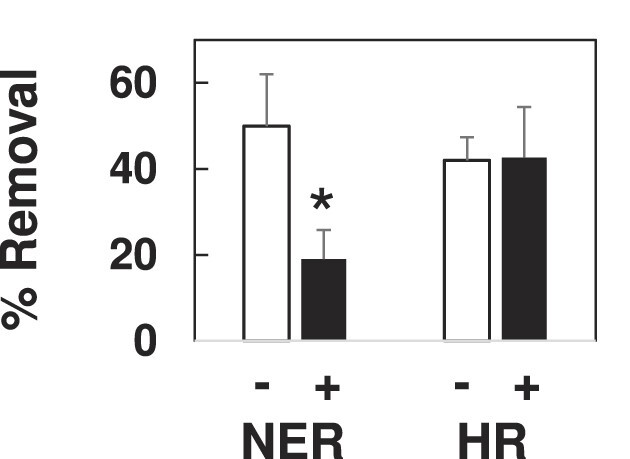
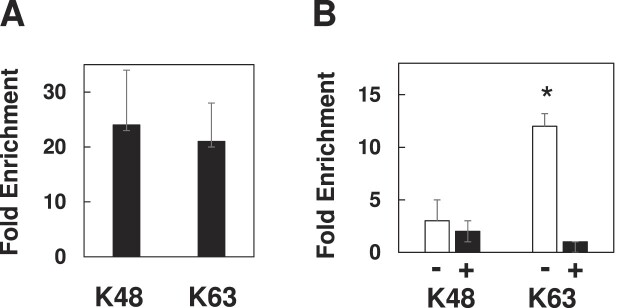
DNA-protein crosslinks (DPCs) are large cytotoxic DNA lesions that form following exposure to chemotherapeutic drugs and environmental chemicals. Nucleotide excision repair (NER) and homologous recombination (HR) promote survival following exposure to DPC-inducing agents. However, it is not known how cells recognize DPC lesions, or what mechanisms selectively target DPC lesions to these respective repair pathways. To address these questions, we examined DPC recognition and repair by transfecting a synthetic DPC lesion comprised of the human oxoguanine glycosylase (OGG1) protein crosslinked to double-stranded M13MP18 into human cells. In wild-type cells, this lesion is efficiently repaired, whereas cells deficient in NER can only repair this lesion if an un-damaged homologous donor is co-transfected. Transfected DPC is subject to rapid K63 polyubiquitination. In NER proficient cells, the DPC is subject to K48 polyubiquitination, and is removed via a proteasome-dependent mechanism. In NER-deficient cells, the DNA-conjugated protein is not subject to K48 polyubiquitination. Instead, the K63 tag remains attached, and is only lost when a homologous donor molecule is present. Taken together, these results support a model in which selective addition of polyubiquitin chains to DNA-crosslinked protein leads to selective recruitment of the proteasome and the cellular NER and recombinational DNA repair machinery.
DNA-蛋白质交联物(DPCs)是在暴露于化疗药物和环境化学物质后形成的大细胞毒性 DNA 损伤。核苷酸切除修复(NER)和同源重组(HR)促进了 DPC 诱导剂暴露后的存活。然而,目前尚不清楚细胞如何识别 DPC 损伤,或者哪些机制选择性地将 DPC 损伤靶向这些特定的修复途径。为了解决这些问题,我们通过转染由双链 M13MP18 与人源氧鸟嘌呤糖基化酶(OGG1)蛋白交联形成的合成 DPC 损伤体,研究了 DPC 的识别和修复。在野生型细胞中,这种损伤体能够被有效修复,而 NER 缺陷的细胞只有在共转染未损伤的同源供体时才能修复这种损伤体。转染的 DPC 会迅速发生 K63 多聚泛素化。在 NER 功能正常的细胞中,DPC 会发生 K48 多聚泛素化,并通过蛋白酶体依赖性机制被去除。在 NER 缺陷的细胞中,DNA 结合的蛋白质不会发生 K48 多聚泛素化。相反,K63 标签会保留下来,只有当存在同源供体分子时才会丢失。总之,这些结果支持了这样一种模型,即选择性地向 DNA 交联蛋白添加多泛素链会导致蛋白酶体和细胞 NER 以及重组 DNA 修复机制的选择性募集。