Division of Pulmonary, Allergy and Critical Care, Department of Internal Medicine, Stanford University School of Medicine, Stanford, CA, USA.
Institute for Stem Cell Biology and Regenerative Medicine, Stanford University School of Medicine , Stanford, CA, USA.
J Cell Biol. 2023 Dec 4;222(12). doi: 10.1083/jcb.202212088. Epub 2023 Oct 16.
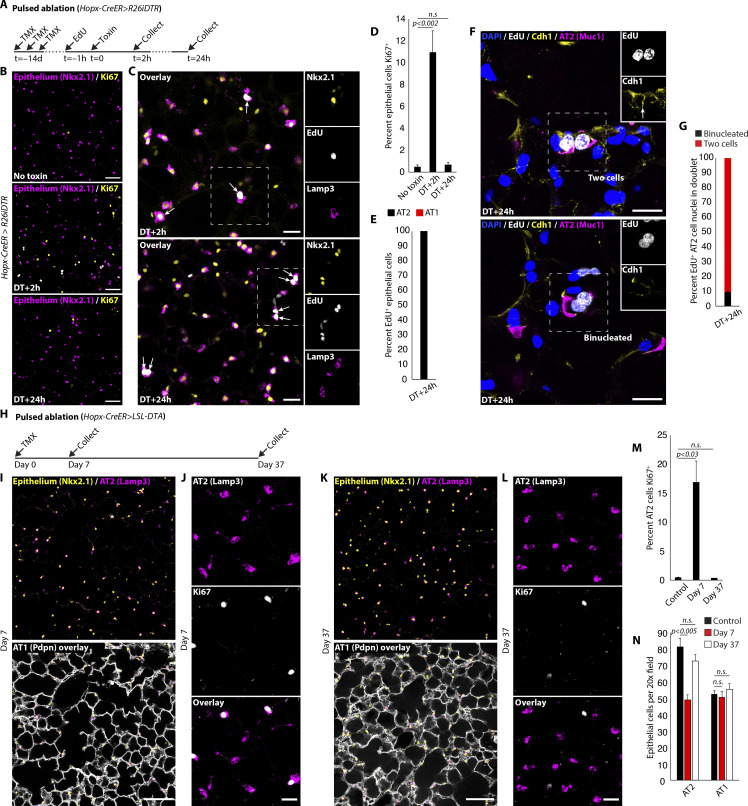
With each breath, oxygen diffuses across remarkably thin alveolar type I (AT1) cells into underlying capillaries. Interspersed cuboidal AT2 cells produce surfactant and act as stem cells. Even transient disruption of this delicate barrier can promote capillary leak. Here, we selectively ablated AT1 cells, which uncovered rapid AT2 cell flattening with near-continuous barrier preservation, culminating in AT1 differentiation. Proliferation subsequently restored depleted AT2 cells in two phases, mitosis of binucleated AT2 cells followed by replication of mononucleated AT2 cells. M phase entry of binucleated and S phase entry of mononucleated cells were both triggered by AT1-produced hbEGF signaling via EGFR to Wnt-active AT2 cells. Repeated AT1 cell killing elicited exuberant AT2 proliferation, generating aberrant daughter cells that ceased surfactant function yet failed to achieve AT1 differentiation. This hyperplasia eventually resolved, yielding normal-appearing alveoli. Overall, this specialized regenerative program confers a delicate simple epithelium with functional resiliency on par with the physical durability of thicker, pseudostratified, or stratified epithelia.
氧气通过极其薄的肺泡 I 型 (AT1) 细胞扩散到下面的毛细血管,每一次呼吸都是如此。立方体形的 AT2 细胞散布其间,产生表面活性剂并充当干细胞。即使是这种脆弱屏障的短暂破坏也会促进毛细血管渗漏。在这里,我们选择性地去除了 AT1 细胞,这揭示了 AT2 细胞的快速扁平化,同时几乎连续地保持屏障的完整性,最终导致 AT1 细胞分化。随后,增殖以两个阶段恢复耗竭的 AT2 细胞,双核 AT2 细胞的有丝分裂,然后是单核 AT2 细胞的复制。双核和单核细胞的 M 期进入都是由 AT1 产生的 hbEGF 信号通过 EGFR 触发到 Wnt 活性的 AT2 细胞引起的。反复的 AT1 细胞杀伤引发了旺盛的 AT2 增殖,产生了异常的子细胞,这些子细胞停止了表面活性剂功能,但未能实现 AT1 分化。这种增生最终得到解决,产生了正常的肺泡。总的来说,这种专门的再生程序赋予了具有功能弹性的薄单纯上皮细胞,其物理耐久性与更厚的、假复层或复层上皮细胞相当。