Pharmacy Department, Hôpital européen Georges Pompidou, Assistance Publique - Hôpitaux de Paris (APHP), Paris Cedex 15, France.
Clinical Pharmacy Department, Faculty of Pharmacy, Paris-Saclay University, Orsay, France.
J Med Internet Res. 2023 Oct 16;25:e42384. doi: 10.2196/42384.
Medication adherence plays a critical role in controlling the evolution of chronic disease, as low medication adherence may lead to worse health outcomes, higher mortality, and morbidity. Assessment of their patients' medication adherence by clinicians is essential for avoiding inappropriate therapeutic intensification, associated health care expenditures, and the inappropriate inclusion of patients in time- and resource-consuming educational interventions. In both research and clinical practices the most extensively used measures of medication adherence are patient-reported outcome measures (PROMs), because of their ability to capture subjective dimensions of nonadherence. Machine learning (ML), a subfield of artificial intelligence, uses computer algorithms that automatically improve through experience. In this context, ML tools could efficiently model the complexity of and interactions between multiple patient behaviors that lead to medication adherence.
This study aimed to create and validate a PROM on medication adherence interpreted using an ML approach.
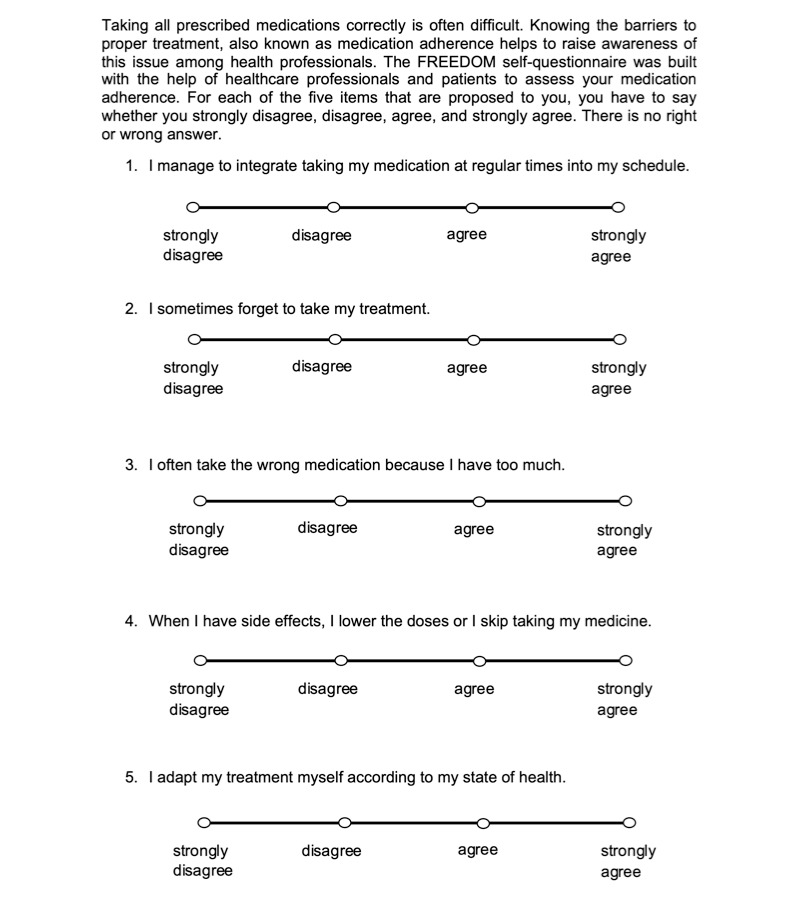
This cross-sectional, single-center, observational study was carried out a French teaching hospital between 2021 and 2022. Eligible patients must have had at least 1 long-term treatment, medication adherence evaluation other than a questionnaire, the ability to read or understand French, an age older than 18 years, and provided their nonopposition. Included adults responded to an initial version of the PROM composed of 11 items, each item being presented using a 4-point Likert scale. The initial set of items was obtained using a Delphi consensus process. Patients were classified as poorly, moderately, or highly adherent based on the results of a medication adherence assessment standard used in the daily practice of each outpatient unit. An ML-derived decision tree was built by combining the medication adherence status and PROM responses. Sensitivity, specificity, positive and negative predictive values (NPVs), and global accuracy of the final 5-item PROM were evaluated.
We created an initial 11-item PROM with a 4-point Likert scale using the Delphi process. After item reduction, a decision tree derived from 218 patients including data obtained from the final 5-item PROM allowed patient classification into poorly, moderately, or highly adherent based on item responses. The psychometric properties were 78% (95% CI 40%-96%) sensitivity, 71% (95% CI 53%-85%) specificity, 41% (95% CI 19%-67%) positive predictive values, 93% (95% CI 74%-99%) NPV, and 70% (95% CI 55%-83%) accuracy.
We developed a medication adherence tool based on ML with an excellent NPV. This could allow prioritization processes to avoid referring highly adherent patients to time- and resource-consuming interventions. The decision tree can be easily implemented in computerized prescriber order-entry systems and digital tools in smartphones. External validation of this tool in a study including a larger number of patients with diseases associated with low medication adherence is required to confirm its use in analyzing and assessing the complexity of medication adherence.
药物依从性在控制慢性病的发展中起着至关重要的作用,因为低药物依从性可能导致更差的健康结果、更高的死亡率和发病率。临床医生评估患者的药物依从性对于避免不适当的治疗强化、相关医疗保健支出以及不恰当地将患者纳入耗时和资源密集型教育干预措施至关重要。在研究和临床实践中,最广泛使用的药物依从性测量方法是患者报告的结果测量(PROMs),因为它们能够捕捉不依从的主观维度。机器学习(ML)是人工智能的一个子领域,使用能够通过经验自动改进的计算机算法。在这种情况下,ML 工具可以有效地对导致药物依从性的多个患者行为的复杂性和相互作用进行建模。
本研究旨在创建和验证一种使用 ML 方法解释的药物依从性 PROM。
这是一项在 2021 年至 2022 年期间在法国教学医院进行的横断面、单中心、观察性研究。合格的患者必须至少有 1 种长期治疗、除问卷外的药物依从性评估、阅读或理解法语的能力、年龄大于 18 岁并且表示不反对。纳入的成年人回答了一个由 11 个项目组成的 PROM 的初始版本,每个项目都使用 4 点李克特量表呈现。初始项目集是使用德尔菲共识过程获得的。根据每个门诊单位日常实践中使用的药物依从性评估标准,将患者分为依从性差、依从性中等或依从性好。通过结合药物依从性状态和 PROM 响应,构建了一个来自 ML 的决策树。评估最终 5 项 PROM 的灵敏度、特异性、阳性和阴性预测值(NPV)以及整体准确性。
我们使用 Delphi 过程创建了一个具有 4 点李克特量表的初始 11 项 PROM。在项目减少后,从包括最终 5 项 PROM 数据的 218 名患者中得出的决策树允许根据项目响应将患者分类为依从性差、中等或好。该心理计量学特性为 78%(95%CI 40%-96%)灵敏度、71%(95%CI 53%-85%)特异性、41%(95%CI 19%-67%)阳性预测值、93%(95%CI 74%-99%)NPV 和 70%(95%CI 55%-83%)准确性。
我们开发了一种基于 ML 的药物依从性工具,具有出色的 NPV。这可以允许进行优先级处理,以避免将高度依从的患者转介给耗时且资源密集的干预措施。决策树可以很容易地在计算机化的处方医嘱录入系统和智能手机的数字工具中实施。需要在包括与低药物依从性相关的疾病的患者数量更多的研究中对该工具进行外部验证,以确认其在分析和评估药物依从性的复杂性方面的使用。