Murdoch Children's Research Institute, Royal Children's Hospital, University of Melbourne, Parkville, VIC, 3052, Australia.
Florey Institute, University of Melbourne, Parkville, VIC, 3052, Australia.
Mol Psychiatry. 2023 Sep;28(9):3760-3768. doi: 10.1038/s41380-023-02284-9. Epub 2023 Oct 16.
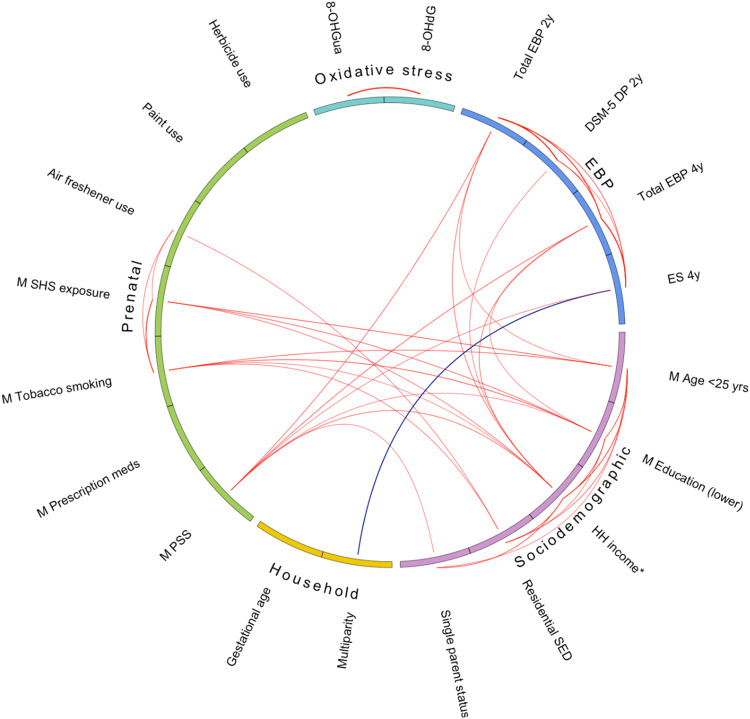
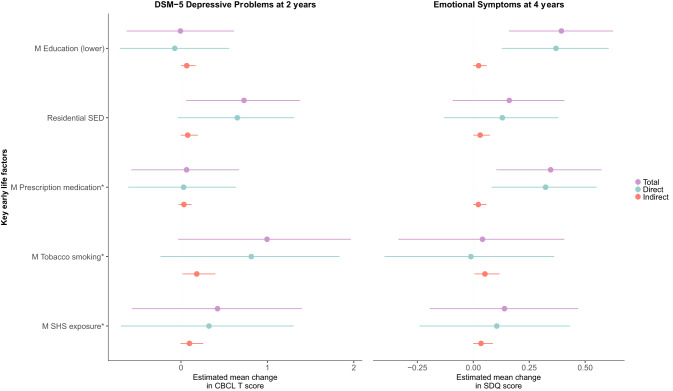
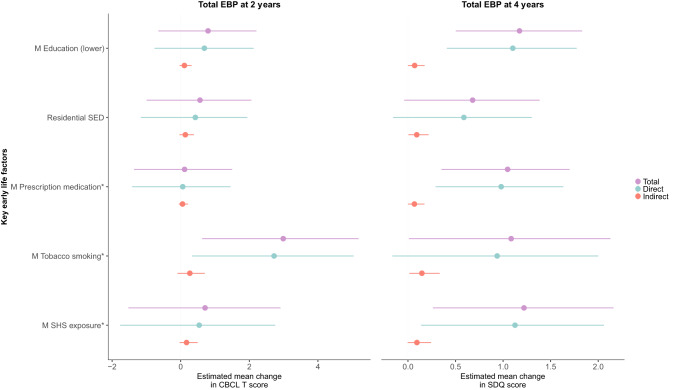
Childhood mental disorders, including emotional and behavioural problems (EBP) are increasingly prevalent. Higher maternal oxidative stress (OS) during pregnancy (OS) is linked to offspring mental disorders. Environmental factors contribute to OS. However, the role of OS in childhood EBP is unclear. We investigated the associations between (i) OS and offspring EBP; (ii) social and prenatal environmental factors and OS; and (iii) social and prenatal factors and childhood EBP and evaluated whether OS mediated these associations. Maternal urinary OS biomarkers, 8-hydroxyguanosine (8-OHGua; an oxidative RNA damage marker) and 8-hydroxy-2'-deoxyguanosine (8-OHdG; an oxidative DNA damage marker), at 36 weeks of pregnancy were quantified by liquid chromatography-mass spectrometry in a population-derived birth cohort, Barwon Infant Study (n = 1074 mother-infant pairs). Social and prenatal environmental factors were collected by mother-reported questionnaires. Offspring total EBP was measured by Child Behavior Checklist Total Problems T-scores at age two (n = 675) and Strengths and Difficulties Questionnaire Total Difficulties score at age four (n = 791). Prospective associations were examined by multivariable regression analyses adjusted for covariates. Mediation effects were evaluated using counterfactual-based mediation analysis. Higher maternal urinary 8-OHGua at 36 weeks (8-OHGua) was associated with greater offspring total EBP at age four (β = 0.38, 95% CI (0.07, 0.69), P = 0.02) and age two (β = 0.62, 95% CI (-0.06, 1.30), P = 0.07). Weaker evidence of association was detected for 8-OHdG. Five early-life factors were associated with both 8-OHGua and childhood EBP (P-range < 0.001-0.05), including lower maternal education, socioeconomic disadvantage and prenatal tobacco smoking. These risk factor-childhood EBP associations were partly mediated by higher 8-OHGua (P-range = 0.01-0.05). Higher OS, particularly oxidant RNA damage, is associated with later offspring EBP. Effects of some social and prenatal lifestyle factors on childhood EBP were partly mediated by OS. Future studies are warranted to further elucidate the role of early-life oxidant damage in childhood EBP.
儿童精神障碍,包括情绪和行为问题(EBP)越来越普遍。孕期母体氧化应激(OS)升高与后代精神障碍有关。环境因素会导致 OS。然而,OS 与儿童 EBP 的关系尚不清楚。我们调查了(i)OS 与后代 EBP 之间的关系;(ii)社会和产前环境因素与 OS 之间的关系;(iii)社会和产前因素与儿童 EBP 之间的关系,并评估 OS 是否介导了这些关联。在人群衍生的出生队列(巴旺婴儿研究)中,通过液相色谱-质谱法定量测定了 1074 对母婴在妊娠 36 周时的尿 OS 生物标志物 8-羟基鸟嘌呤(8-OHGua;一种氧化 RNA 损伤标志物)和 8-羟基-2'-脱氧鸟苷(8-OHdG;一种氧化 DNA 损伤标志物)。社会和产前环境因素通过母亲报告的问卷收集。在两岁时(n=675)使用儿童行为检查表总分问题 T 评分和四岁时(n=791)使用困难问题总分评分测量后代的总 EBP。通过多变量回归分析调整协变量后,检查了前瞻性关联。使用基于反事实的中介分析评估了中介效应。在妊娠 36 周时,母体尿 8-OHGua 水平较高(8-OHGua)与 4 岁时后代总 EBP 较高(β=0.38,95%CI(0.07,0.69),P=0.02)和 2 岁时(β=0.62,95%CI(-0.06,1.30),P=0.07)相关。8-OHdG 的关联证据较弱。五个生命早期因素与 8-OHGua 和儿童 EBP 均相关(P 范围<0.001-0.05),包括母亲受教育程度较低、社会经济劣势和产前吸烟。这些危险因素与儿童 EBP 的关联部分由更高的 8-OHGua 介导(P 范围=0.01-0.05)。较高的 OS,特别是氧化 RNA 损伤,与后代后期的 EBP 相关。一些社会和产前生活方式因素对儿童 EBP 的影响部分由 OS 介导。需要进一步的研究来阐明生命早期氧化损伤在儿童 EBP 中的作用。