Lu Xiaoling, Munief Walid-Madhat, Damborský Pavel, Kasjanow Alice, Katrlík Jaroslav, Pachauri Vivek, Ingebrandt Sven
Department of Informatics and Microsystem Technology, University of Applied Sciences Kaiserslautern, Amerikastrasse 1, Zweibruecken 66482, Germany.
Institute of Materials in Electrical Engineering 1, RWTH Aachen University, Sommerfeldstrasse 24, Aachen 52074, Germany.
MethodsX. 2023 Sep 27;11:102402. doi: 10.1016/j.mex.2023.102402. eCollection 2023 Dec.
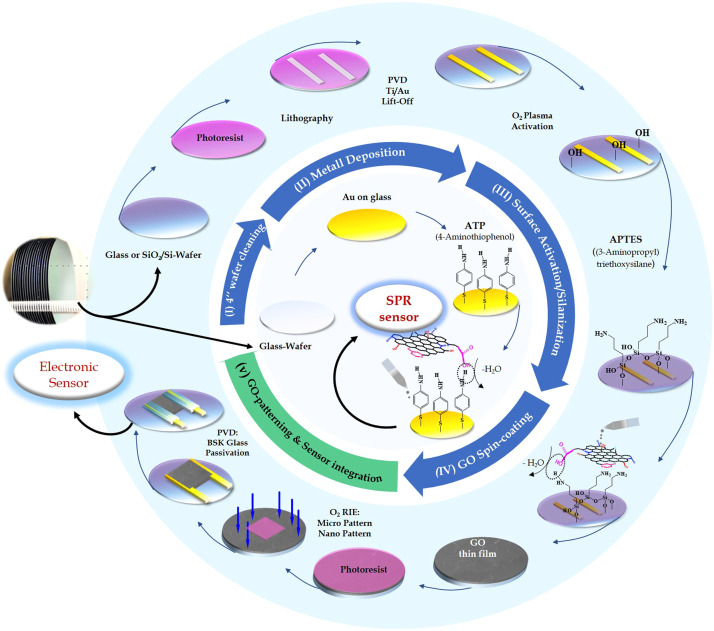
In this manuscript, we present a comprehensive fabrication protocol for high-performance graphene oxide (GO) sensor concepts. It is suitable for a variety of biosensing applications and contains the essential process steps, starting with vapor phase evaporation for siloxane monolayers, followed by spin-coating of GO as a nanometer-thin transducer with exceptional homogeneity and micromechanical surface methods which enable seamless transformation of GO transducers to be desired micro and nano dimensions. In addition to linking basic research and innovative sensor concepts with an outlook for commercial applications of point-of-care systems for early-stage diagnostics, the authors consider it necessary to take a closer look at the manufacturing processes to create more transparency and clarity, to manufacture such specific sensor concepts systematically. The detailed manufacturing approaches are intended to motivate practitioner to explore and improve this GO-based key technology. This process development is illustrated below using the manufacturing methods for three types of sensors, namely sensors based on i) surface plasmon resonance spectroscopy (SPR), ii) impedance spectroscopy and iii) bio-field effect transistors (ISFETs). The obtained results in this work prove successful GO sensor productions by achieving:•Uniform and stable immobilization of GO thin films,•High yield of sensor units on a wafer scale, here up to 96 %,•Promising integration potential for various biomedical sensor concepts to early-stage diagnostic.
在本手稿中,我们展示了一种用于高性能氧化石墨烯(GO)传感器概念的全面制造方案。它适用于各种生物传感应用,并包含基本的工艺步骤,从用于硅氧烷单分子层的气相蒸发开始,接着旋涂GO作为具有卓越均匀性的纳米级薄换能器,以及采用微机械表面方法,使GO换能器能够无缝转变为所需的微米和纳米尺寸。除了将基础研究和创新传感器概念与即时护理系统在早期诊断中的商业应用前景联系起来之外,作者认为有必要更深入地研究制造过程,以提高透明度和清晰度,从而系统地制造此类特定的传感器概念。详细的制造方法旨在激励从业者探索和改进这种基于GO的关键技术。下面将使用三种类型传感器的制造方法来说明这一工艺开发过程,这三种传感器分别是:i)基于表面等离子体共振光谱(SPR)的传感器、ii)阻抗光谱传感器和iii)生物场效应晶体管(ISFET)。本工作中获得的结果通过以下几点证明了GO传感器生产的成功:
GO薄膜的均匀且稳定的固定化;
在晶圆规模上传感器单元的高产率,此处高达96%;
各种生物医学传感器概念在早期诊断方面具有可观的集成潜力。