Faculty of Medicine and University Hospital of Cologne, Institute of Pathology, University of Cologne, Cologne, Germany.
Faculty of Medicine and University Hospital of Cologne, Department of General, Visceral and Cancer Surgery, University of Cologne, Cologne, Germany.
Sci Rep. 2023 Oct 17;13(1):17699. doi: 10.1038/s41598-023-44844-7.
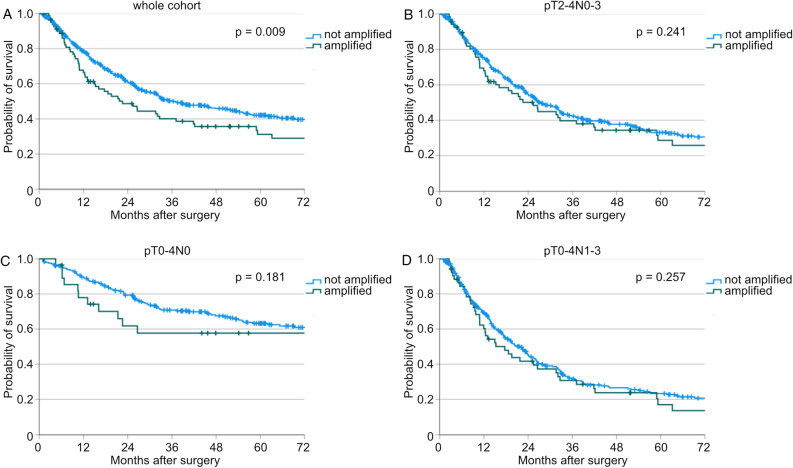
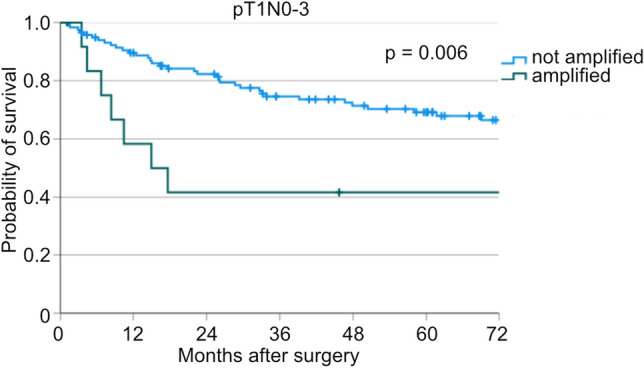
Esophageal adenocarcinoma exhibits one of the highest mortality rates among all cancer entities. Multimodal therapy strategies have improved patients' survival significantly. However, patients in early stages are currently limited to receiving only local therapies, even though some patients within this group showcase short survival periods. Until now, there has been no widely established clinically used biomarker to detect these high-risk patients. Telomerase reverse transcriptase (TERT), a gene encoding a crucial subunit of the telomerase enzyme, plays a significant role in establishing cancer cell immortality and is under suspicion for its potential contribution to tumor progression. Therefore, we aimed to evaluate the clinical relevance of the TERT amplification status. We included 643 patients with esophageal adenocarcinoma, who underwent Ivor-Lewis esophagectomy at the University Hospital of Cologne. The TERT amplification status was characterized using fluorescence in situ hybridization. Clinicopathological values and patients' overall survival were compared between patients with and without TERT amplification. Further sub-cohort analyses were conducted for patients with pT1N0-3 tumor stage. Eighty-One patients (12.6%) exhibited TERT amplification. Patients with amplified TERT showed significantly worse overall survival (median OS: 22.6 vs. 36.8 months, p = 0.009). Interestingly, TERT amplification could be characterized as an independent risk factor for worse overall survival in multivariate analysis in patients with pT1N0-3 tumor stage (HR = 2.440, 95% CI 1.095-5.440, p = 0.029). In this study, we describe the TERT amplification status as an independent risk factor for worse survival in patients diagnosed with esophageal adenocarcinoma at pT1N0-3 tumor stage, encompassing cases involving tumor infiltration of the lamina propria, muscularis mucosae, and/or submucosa. Based on our findings, we put forth the proposition that evaluating the TERT amplification status may serve as a valuable tool in identifying a specific subgroup of patients, namely those with TERT amplification and pT1N0-3 tumor-stage esophageal adenocarcinoma. The patients of this subgroup could potentially benefit from enhanced follow-up protocols, more aggressive treatment approaches, or possible targeted TERT inhibition therapies, all aimed at improving their overall clinical outcomes.
食管腺癌是所有癌症实体中死亡率最高的癌症之一。多模式治疗策略显著提高了患者的生存率。然而,目前早期患者只能接受局部治疗,尽管该组中有一些患者的生存期较短。到目前为止,还没有广泛使用的临床生物标志物来检测这些高危患者。端粒酶逆转录酶(TERT)是一种编码端粒酶关键亚基的基因,在建立癌细胞永生方面发挥着重要作用,并且由于其可能促进肿瘤进展而受到怀疑。因此,我们旨在评估 TERT 扩增状态的临床相关性。我们纳入了在科隆大学医院接受 Ivor-Lewis 食管切除术的 643 例食管腺癌患者。使用荧光原位杂交技术对 TERT 扩增状态进行了特征描述。比较了 TERT 扩增患者和无 TERT 扩增患者的临床病理值和总生存期。对 pT1N0-3 肿瘤分期的患者进行了进一步的亚组分析。81 例患者(12.6%)存在 TERT 扩增。扩增 TERT 的患者总生存期明显更差(中位 OS:22.6 与 36.8 个月,p=0.009)。有趣的是,在多变量分析中,在 pT1N0-3 肿瘤分期的患者中,TERT 扩增可作为总生存期更差的独立危险因素(HR=2.440,95%CI 1.095-5.440,p=0.029)。在这项研究中,我们描述了 TERT 扩增状态作为 pT1N0-3 肿瘤分期的食管腺癌患者生存更差的独立危险因素,包括累及固有层、黏膜肌和/或黏膜下的肿瘤浸润。基于我们的发现,我们提出评估 TERT 扩增状态可能是识别具有特定亚组患者的有价值工具,即具有 TERT 扩增和 pT1N0-3 肿瘤分期的食管腺癌患者。该亚组的患者可能受益于增强的随访方案、更积极的治疗方法或可能的靶向 TERT 抑制治疗,所有这些都旨在改善他们的整体临床结果。