Do Nhuan T, Lee Sun Young, Lee Yoon Seo, Shin ChaeHo, Kim Daeho, Lee Tae Geol, Son Jin Gyeong, Kim Se-Hwa
Safety Measurement Institute, Korea Research Institute of Standards and Science, 267 Gajeong-Ro, Yuseong-Gu, Daejeon, 34113, Republic of Korea.
BioMedical Measurement, University of Science and Technology, 217 Gajeong-Ro, Yuseong-Gu, Daejeon, 34113, Republic of Korea.
Biomater Res. 2023 Oct 17;27(1):103. doi: 10.1186/s40824-023-00439-x.
Fibrosis plays an important role in both normal physiological and pathological phenomena as fibroblasts differentiate to myofibroblasts. The activation of fibroblasts is determined through interactions with the surrounding extracellular matrix (ECM). However, how this fibroblast-to-myofibroblast transition (FMT) is regulated and affected by elastin concentration in a three-dimensional (3D) microenvironment has not been investigated.
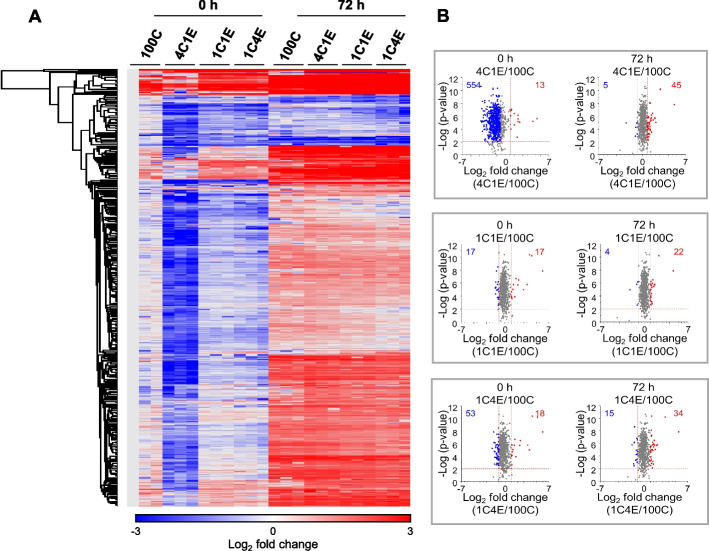
We developed an insoluble elastin-gradient 3D hydrogel system for long-lasting cell culture and studied the molecular mechanisms of the FMT in embedded cells by nanoflow LC-MS/MS analysis along with validation through real-time PCR and immunofluorescence staining.
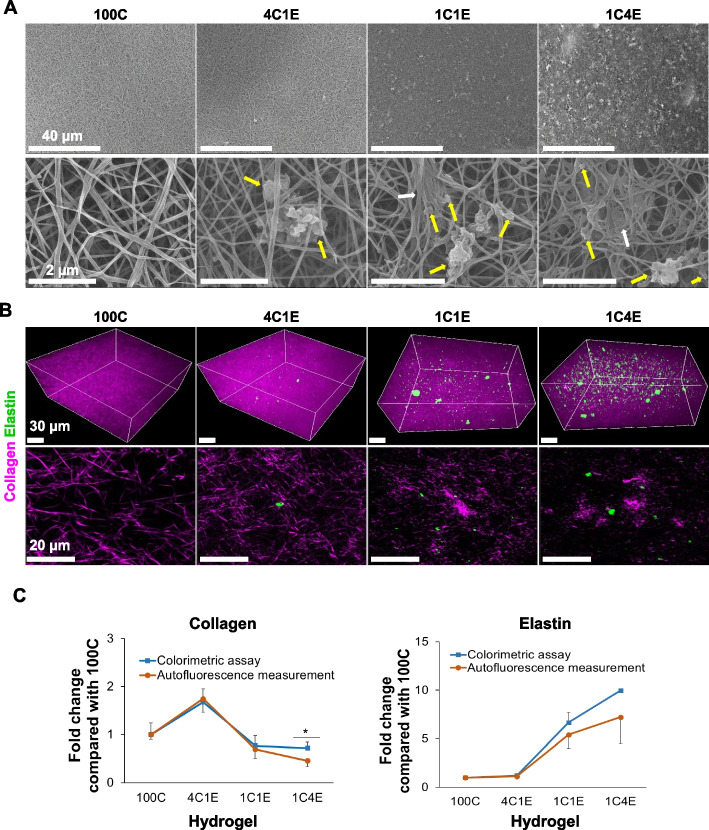
By optimizing pH and temperature, four 3D hydrogels containing fibroblasts were successfully fabricated having elastin concentrations of 0, 20, 50, and 80% in collagen. At the low elastin level (20%), fibroblast proliferation was significantly increased compared to others, and in particular, the FMT was clearly observed in this condition. Moreover, through mass spectrometry of the hydrogel environment, it was confirmed that differentiation proceeded in two stages. In the early stage, calcium-dependent proteins including calmodulin and S100A4 were highly associated. On the other hand, in the late stage after several passages of cells, distinct markers of myofibroblasts were presented such as morphological changes, increased production of ECM, and increased α-SMA expression. We also demonstrated that the low level of elastin concentration induced some cancer-associated fibroblast (CAF) markers, including PDGFR-β, and fibrosis-related disease markers, including THY-1.
Using our developed 3D elastin-gradient hydrogel system, we evaluated the effect of different elastin concentrations on the FMT. The FMT was induced even at a low concentration of elastin with increasing CAF level via calcium signaling. With this system, we were able to analyze varying protein expressions in the overall FMT process over several cellular passages. Our results suggest that the elastin-gradient system employing nonlinear optics imaging provides a good platform to study activated fibroblasts interacting with the microenvironment, where the ECM plays a pivotal role.
随着成纤维细胞分化为肌成纤维细胞,纤维化在正常生理和病理现象中均发挥着重要作用。成纤维细胞的激活是通过与周围细胞外基质(ECM)的相互作用来确定的。然而,在三维(3D)微环境中,这种成纤维细胞向肌成纤维细胞的转变(FMT)如何受到弹性蛋白浓度的调节和影响尚未得到研究。
我们开发了一种用于长期细胞培养的不溶性弹性蛋白梯度3D水凝胶系统,并通过纳流液相色谱-串联质谱(LC-MS/MS)分析研究了包埋细胞中FMT的分子机制,同时通过实时聚合酶链反应(PCR)和免疫荧光染色进行验证。
通过优化pH值和温度,成功制备了四种含有成纤维细胞的3D水凝胶,其在胶原蛋白中的弹性蛋白浓度分别为0%、20%、50%和80%。在低弹性蛋白水平(20%)下,与其他组相比,成纤维细胞增殖显著增加,特别是在这种条件下明显观察到了FMT。此外,通过对水凝胶环境的质谱分析,证实分化过程分两个阶段进行。在早期,包括钙调蛋白和S100A4在内的钙依赖性蛋白高度相关。另一方面,在细胞传代几次后的后期,出现了肌成纤维细胞的明显标志物,如形态变化、ECM产生增加和α-平滑肌肌动蛋白(α-SMA)表达增加。我们还证明,低水平的弹性蛋白浓度诱导了一些癌症相关成纤维细胞(CAF)标志物,包括血小板衍生生长因子受体-β(PDGFR-β),以及纤维化相关疾病标志物,包括胸腺细胞抗原1(THY-1)。
使用我们开发的3D弹性蛋白梯度水凝胶系统,我们评估了不同弹性蛋白浓度对FMT的影响。即使在低浓度弹性蛋白条件下,通过钙信号传导也能诱导FMT,并使CAF水平升高。利用该系统,我们能够分析在几个细胞传代过程中整个FMT过程中不同的蛋白质表达。我们的结果表明,采用非线性光学成像的弹性蛋白梯度系统为研究与微环境相互作用的活化成纤维细胞提供了一个良好的平台,其中ECM起着关键作用。