National Key Laboratory of Veterinary Public Health and Safety, Key Laboratory of Animal Epidemiology and Zoonosis of Ministry of Agriculture, National Animal Protozoa Laboratory & College of Veterinary Medicine, China Agricultural University, Beijing, 100193, China.
Key Laboratory of Animal Genetics, Breeding and Reproduction of the Ministry of Agriculture & Beijing Key Laboratory of Animal Genetics Improvement, China Agricultural University, Beijing, China.
Parasit Vectors. 2023 Oct 17;16(1):365. doi: 10.1186/s13071-023-05988-7.
Protozoan parasites of the genus Eimeria are the causative agents of chicken coccidiosis. Parasite resistance to most anticoccidial drugs is one of the major challenges to controlling this disease. There is an urgent need for a molecular marker to monitor the emergence of resistance against anticoccidial drugs, such as decoquinate.
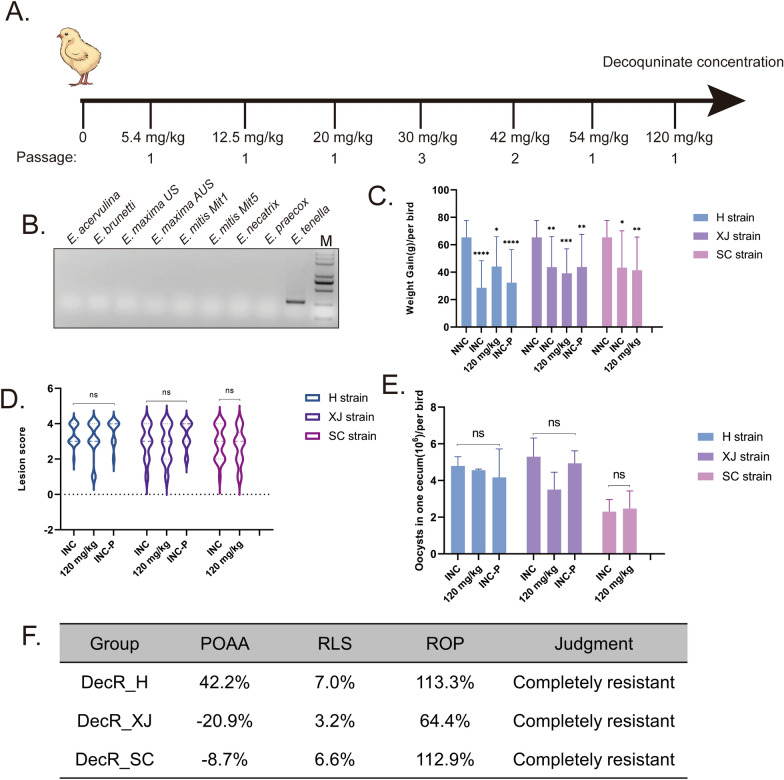
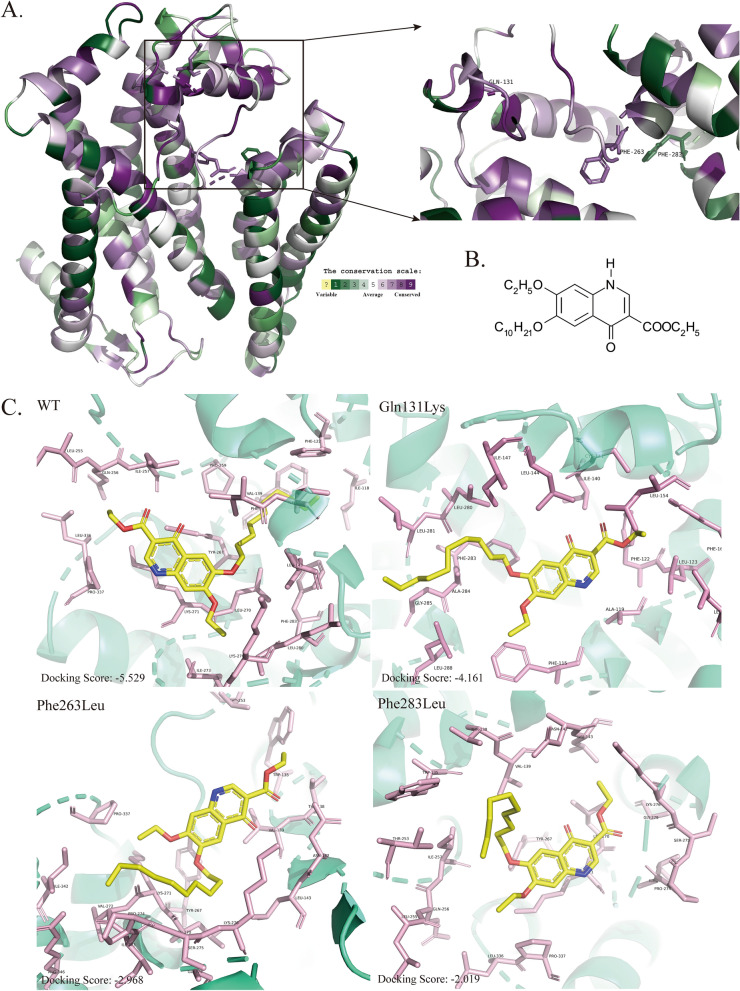
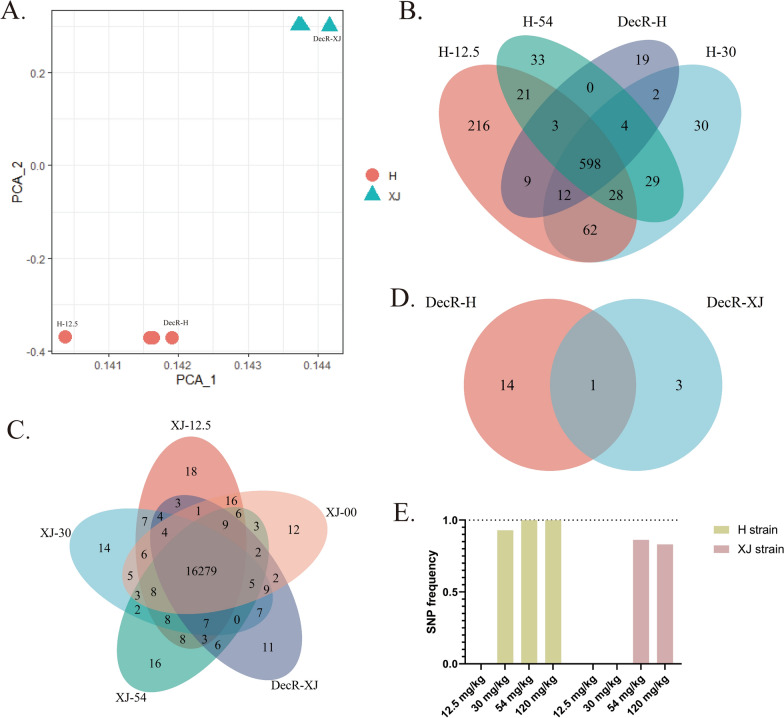
We developed decoquinate-resistant strains by successively exposing the Houghton (H) and Xinjiang (XJ) strains of E. tenella to incremental concentrations of this drug in chickens. Additionally, we isolated a decoquinate-resistant strain from the field. The resistance of these three strains was tested using the criteria of weight gain, relative oocyst production and reduction of lesion scores. Whole-genome sequencing was used to identify the non-synonymous mutations in coding genes that were highly associated with the decoquinate-resistant phenotype in the two laboratory-induced strains. Subsequently, we scrutinized the missense mutation in a field-resistant strain for verification. We also employed the AlphaFold and PyMOL systems to model the alterations in the binding affinity of the mutants toward the drug molecule.
We obtained two decoquinate-resistant (DecR) strains, DecR_H and XJ, originating from the original H and XJ strains, respectively, as well as a decoquinate-resistant E. tenella strain from the field (DecR_SC). These three strains displayed resistance to 120 mg/kg decoquinate administered through feed. Through whole-genome sequencing analysis, we identified the cytochrome b gene (cyt b; ETH2_MIT00100) as the sole mutated gene shared between the DecR_H and XJ strains and also detected this gene in the DecR_SC strain. Distinct non-synonymous mutations, namely Gln131Lys in DecR_H, Phe263Leu in DecR_XJ, and Phe283Leu in DecR_SC were observed in the three resistant strains. Notably, these mutations were located in the extracellular segments of cyt b, in close proximity to the ubiquinol oxidation site Q. Drug molecular docking studies revealed that cyt b harboring these mutants exhibited varying degrees of reduced binding ability to decoquinate.
Our findings emphasize the critical role of cyt b mutations in the development of decoquinate resistance in E. tenella. The strong correlation observed between cyt b mutant alleles and resistance indicates their potential as valuable molecular markers for the rapid detection of decoquinate resistance.
艾美耳属的原生动物寄生虫是鸡球虫病的病原体。寄生虫对大多数抗球虫药物的耐药性是控制这种疾病的主要挑战之一。迫切需要一种分子标记来监测抗球虫药物(如癸氧喹酯)耐药性的出现。
我们通过在鸡中逐步暴露于递增浓度的癸氧喹酯,成功地从 Houghton (H) 和新疆 (XJ) 株艾美耳属虫中分离出癸氧喹酯耐药株。此外,我们还从田间分离出一株癸氧喹酯耐药株。使用增重、相对卵囊产量和病变评分降低的标准来测试这三种菌株的耐药性。全基因组测序用于鉴定与两种实验室诱导的菌株中癸氧喹酯耐药表型高度相关的编码基因中的非同义突变。随后,我们仔细检查了田间耐药株中的错义突变以进行验证。我们还使用 AlphaFold 和 PyMOL 系统来模拟突变对药物分子结合亲和力的改变。
我们获得了两株癸氧喹酯耐药 (DecR) 株,DecR_H 和 XJ,分别来自原始 H 和 XJ 株,以及一株来自田间的癸氧喹酯耐药艾美耳属虫株(DecR_SC)。这三株对饲料中 120mg/kg 的癸氧喹酯表现出耐药性。通过全基因组测序分析,我们发现细胞色素 b 基因(cyt b; ETH2_MIT00100)是 DecR_H 和 XJ 株之间唯一共享的突变基因,并且在 DecR_SC 株中也检测到了该基因。在三种耐药株中,观察到 distinct non-synonymous 突变,即 DecR_H 中的 Gln131Lys、DecR_XJ 中的 Phe263Leu 和 DecR_SC 中的 Phe283Leu。值得注意的是,这些突变位于 cyt b 的细胞外片段中,靠近 ubiquinol 氧化位点 Q。药物分子对接研究表明,携带这些突变的 cyt b 对癸氧喹酯的结合能力有不同程度的降低。
我们的研究结果强调了细胞色素 b 突变在艾美耳属虫中癸氧喹酯耐药性发展中的关键作用。在 cyt b 突变等位基因与耐药性之间观察到的强相关性表明,它们有可能成为快速检测癸氧喹酯耐药性的有价值的分子标记。