Shiba Steven K, Temple Caroline A, Krasnoff Joanne, Dilchert Stephan, Smarr Benjamin L, Robishaw Janet, Mason Ashley E
Department of Internal Medicine, Florida Atlantic University Charles E. Schmidt College of Medicine, Boca Raton, USA.
Department of Pediatrics, Florida Atlantic University Charles E. Schmidt College of Medicine, Boca Raton, USA.
Cureus. 2023 Sep 16;15(9):e45362. doi: 10.7759/cureus.45362. eCollection 2023 Sep.
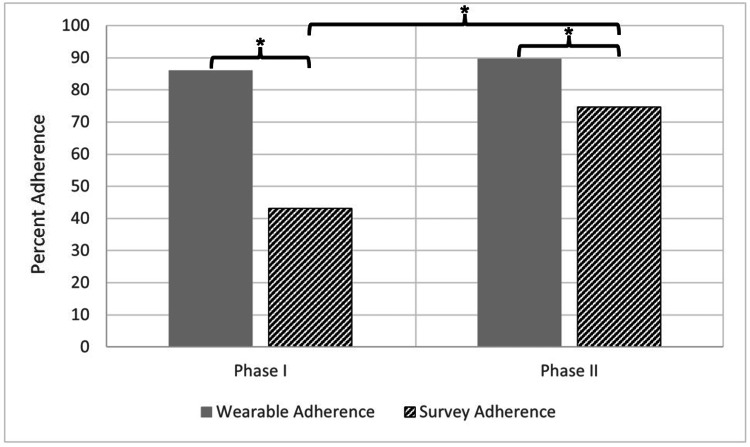
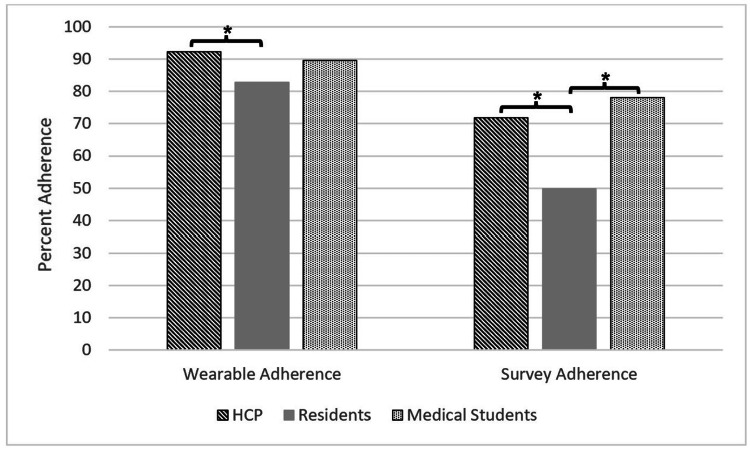
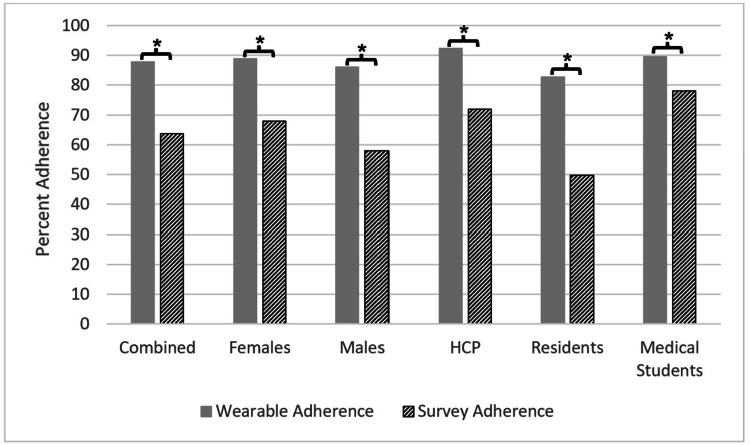
Background Identifying early signs of a SARS-CoV-2 infection in healthcare workers could be a critical tool in reducing disease transmission. To provide this information, both daily symptom surveys and wearable device monitoring could have utility, assuming there is a sufficiently high level of participant adherence. Purpose The aim of this study is to evaluate adherence to a daily symptom survey and a wearable device (Oura Ring) among healthcare professionals (attending physicians and other clinical staff) and trainees (residents and medical students) in a hospital setting during the early stages of the COVID-19 pandemic. Methods In this mixed-methods observational study, the data were a subset (=91) of those collected as part of the larger TemPredict Study. Demographic data analyses were conducted with descriptive statistics. Participant adherence to the wearable device protocol was reported as the percentage of days that sleep was recorded, and adherence to the daily survey was reported as the percentage of days with submitted surveys. Comparisons for the primary (wearable and survey adherence of groups) and secondary (adherence patterns among subgroups) outcomes were conducted using descriptive statistics, two-tailed independent t-tests, and Welch's ANOVA with post hoc analysis using Games-Howell. Results Wearable device adherence was significantly higher than the daily symptom survey adherence for most participants. Overall, participants were highly adherent to the wearable device, wearing the device an average of 87.8 ± 11.6% of study nights compared to survey submission, showing an average of 63.8 ± 27.4% of study days. In subgroup analysis, we found that healthcare professionals (HCPs) and medical students had the highest adherence to wearing the wearable device, while medical residents had lower adherence in both wearable adherence and daily symptom survey adherence. Conclusions These results indicated high participant adherence to wearable devices to monitor for impending infection in the course of a research study conducted as part of clinical practice. Subgroup analysis indicated HCPs and medical students maintained high adherence, but residents' adherence was lower, which is likely multifactorial, with differences in work demands and stress contributing to the findings. These results can guide the development of adherence strategies for a wearable device to increase the quality of data collection and assist in disease detection in this and future pandemics.
识别医护人员感染新型冠状病毒2(SARS-CoV-2)的早期迹象可能是减少疾病传播的关键工具。为了提供此类信息,假设参与者依从性足够高,每日症状调查和可穿戴设备监测都可能有用。目的:本研究旨在评估在新冠疫情早期阶段,医院环境中医护人员(主治医师和其他临床工作人员)和实习生(住院医师和医学生)对每日症状调查和可穿戴设备(Oura Ring)的依从性。方法:在这项混合方法观察性研究中,数据是作为更大规模的TemPredict研究一部分收集的数据的一个子集(=91)。使用描述性统计进行人口统计学数据分析。参与者对可穿戴设备方案的依从性以记录睡眠的天数百分比报告,对每日调查的依从性以提交调查的天数百分比报告。使用描述性统计、双尾独立t检验以及采用Games-Howell事后分析的Welch方差分析对主要结果(各组的可穿戴设备和调查依从性)和次要结果(亚组间的依从模式)进行比较。结果:对于大多数参与者,可穿戴设备的依从性显著高于每日症状调查的依从性。总体而言,参与者对可穿戴设备的依从性很高,在研究期间的夜晚,佩戴该设备的平均天数占87.8±11.6%,而提交调查的平均天数占研究天数的63.8±27.4%。在亚组分析中,我们发现医护人员和医学生对佩戴可穿戴设备的依从性最高,而住院医师在可穿戴设备依从性和每日症状调查依从性方面均较低。结论:这些结果表明,在作为临床实践一部分进行的研究过程中,参与者对用于监测即将发生感染的可穿戴设备依从性很高。亚组分析表明,医护人员和医学生保持了较高的依从性,但住院医师的依从性较低,这可能是多因素导致的,工作需求和压力的差异促成了这一结果。这些结果可为可穿戴设备的依从性策略制定提供指导,以提高数据收集质量,并协助在本次及未来疫情中进行疾病检测。