Instituto Agroalimentario de Aragón-IA2 (CITA-Universidad de Zaragoza), Zaragoza, España.
Programa de Investigación en Enfermedades Tropicales, Escuela de Medicina Veterinaria, Universidad Nacional, Heredia, Costa Rica.
BMC Vet Res. 2023 Oct 18;19(1):211. doi: 10.1186/s12917-023-03773-3.
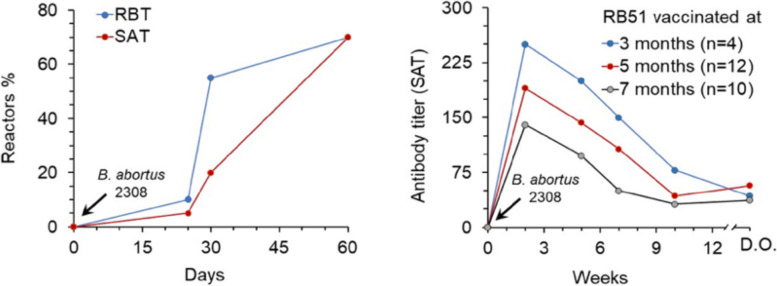
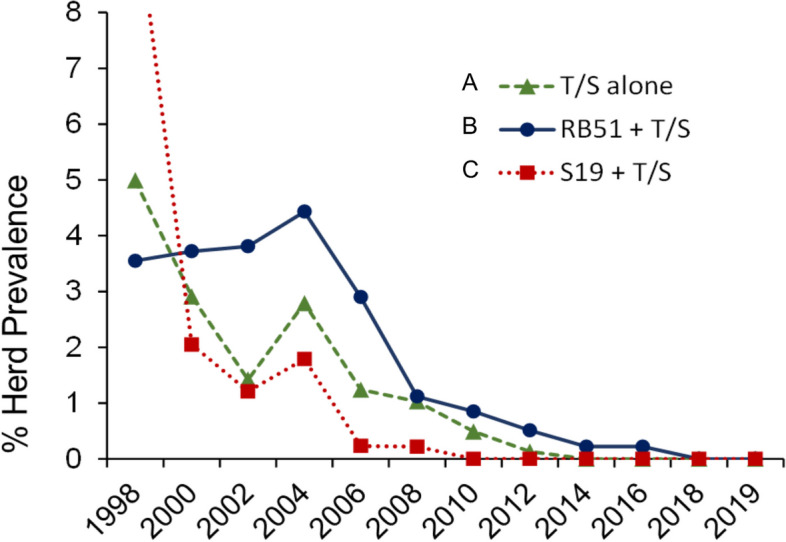
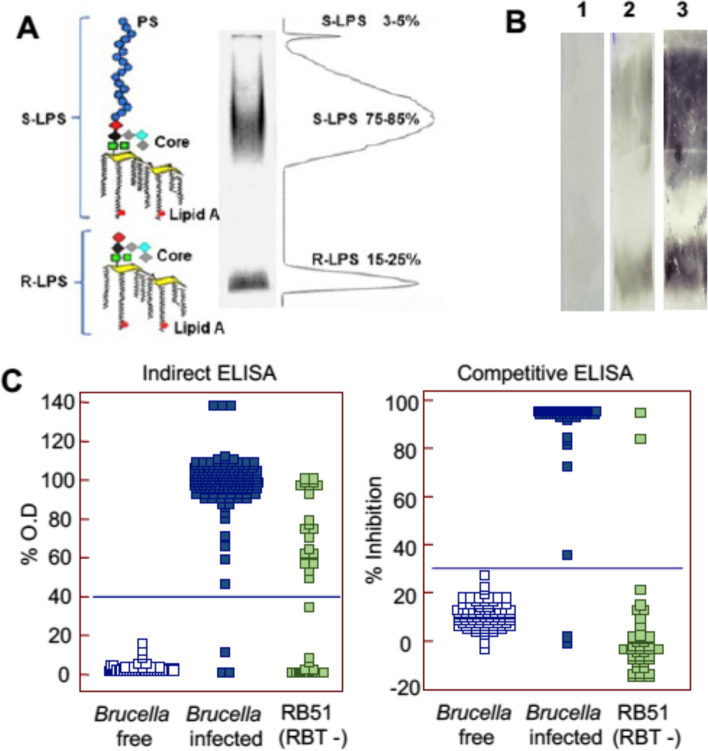
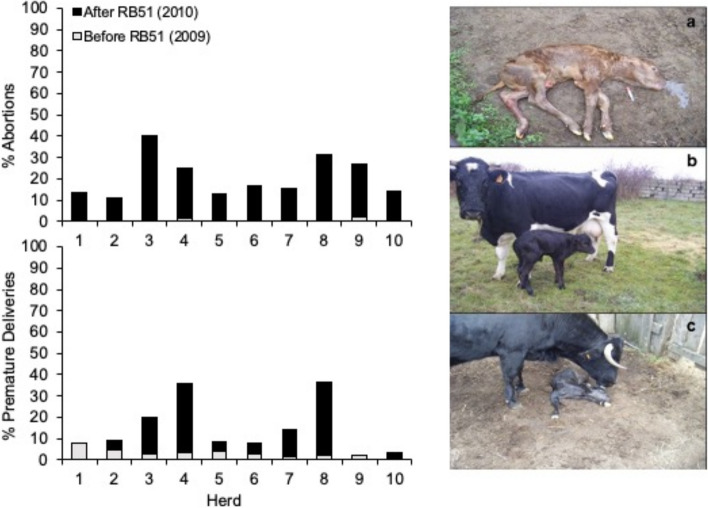
Cattle brucellosis is a severe zoonosis of worldwide distribution caused by Brucella abortus and B. melitensis. In some countries with appropriate infrastructure, animal tagging and movement control, eradication was possible through efficient diagnosis and vaccination with B. abortus S19, usually combined with test-and-slaughter (T/S). Although S19 elicits anti-smooth lipopolysaccharide antibodies that may interfere in the differentiation of infected and vaccinated animals (DIVA), this issue is minimized using appropriate S19 vaccination protocols and irrelevant when high-prevalence makes mass vaccination necessary or when eradication requisites are not met. However, S19 has been broadly replaced by vaccine RB51 (a rifampin-resistant rough mutant) as it is widely accepted that is DIVA, safe and as protective as S19. These RB51 properties are critically reviewed here using the evidence accumulated in the last 35 years. Controlled experiments and field evidence shows that RB51 interferes in immunosorbent assays (iELISA, cELISA and others) and in complement fixation, issues accentuated by revaccinating animals previously immunized with RB51 or S19. Moreover, contacts with virulent brucellae elicit anti-smooth lipopolysaccharide antibodies in RB51 vaccinated animals. Thus, accepting that RB51 is truly DIVA results in extended diagnostic confusions and, when combined with T/S, unnecessary over-culling. Studies supporting the safety of RB51 are flawed and, on the contrary, there is solid evidence that RB51 is excreted in milk and abortifacient in pregnant animals, thus being released in abortions and vaginal fluids. These problems are accentuated by the RB51 virulence in humans, lack diagnostic serological tests detecting these infections and RB51 rifampicin resistance. In controlled experiments, protection by RB51 compares unfavorably with S19 and lasts less than four years with no evidence that RB51-revaccination bolsters immunity, and field studies reporting its usefulness are flawed. There is no evidence that RB51 protects cattle against B. melitensis, infection common when raised together with small ruminants. Finally, data acumulated during cattle brucellosis eradication in Spain shows that S19-T/S is far more efficacious than RB51-T/S, which does not differ from T/S alone. We conclude that the assumption that RB51 is DIVA, safe, and efficaceous results from the uncritical repetition of imperfectly examined evidence, and advise against its use.
牛布鲁氏菌病是一种分布广泛的严重人畜共患病,由流产布鲁氏菌和马耳他布鲁氏菌引起。在一些基础设施适当、动物标记和运动控制的国家,可以通过高效诊断和接种布鲁氏菌 S19 来根除该病,通常结合检测和扑杀(T/S)。尽管 S19 会引发抗光滑脂多糖抗体,可能会干扰感染和接种动物的区分(DIVA),但使用适当的 S19 接种方案可以最小化这个问题,并且在高流行率需要大规模接种或未满足根除要求时,这个问题也不重要。然而,S19 已被 RB51(一种利福平抗性粗糙突变体)广泛取代,因为人们普遍认为 RB51 是 DIVA、安全且与 S19 一样具有保护作用。本文使用过去 35 年积累的证据,对 RB51 的这些特性进行了批判性审查。对照实验和现场证据表明,RB51 会干扰免疫吸附试验(iELISA、cELISA 等)和补体固定,而对之前用 RB51 或 S19 免疫的动物进行再接种会加剧这些问题。此外,接触有毒布鲁氏菌会在接种 RB51 的动物中引发抗光滑脂多糖抗体。因此,接受 RB51 确实是 DIVA 的结果是诊断上的混淆加剧,而与 T/S 结合使用时,则会导致不必要的过度扑杀。支持 RB51 安全性的研究存在缺陷,而相反,有确凿的证据表明 RB51 会在牛奶中排泄,并在怀孕动物中导致流产,从而在流产和阴道分泌物中释放。这些问题因 RB51 在人类中的毒力、缺乏检测这些感染的血清学诊断测试以及 RB51 对利福平的耐药性而加剧。在对照实验中,RB51 的保护效果不如 S19,持续时间不到四年,并且没有证据表明 RB51 再接种可以增强免疫力,而报告其有效性的现场研究存在缺陷。没有证据表明 RB51 可以保护牛免受马耳他布鲁氏菌的感染,当与小反刍动物一起饲养时,这种感染很常见。最后,在西班牙根除牛布鲁氏菌病期间积累的数据表明,S19-T/S 比 RB51-T/S 更有效,而 RB51-T/S 与单独 T/S 没有区别。我们的结论是,认为 RB51 是 DIVA、安全且有效的假设是基于对不完善证据的不加批判的重复,因此建议不要使用 RB51。