Faculty of Science and Technology, Vancouver Island University, Nanaimo, British Columbia V9R 5S5, Canada.
Sutherland Bioinformatics, Lantzville, British Columbia V0R 2H0, Canada.
G3 (Bethesda). 2023 Dec 6;13(12). doi: 10.1093/g3journal/jkad242.
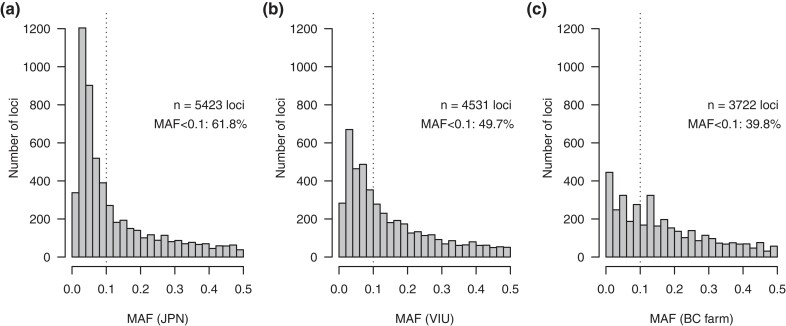
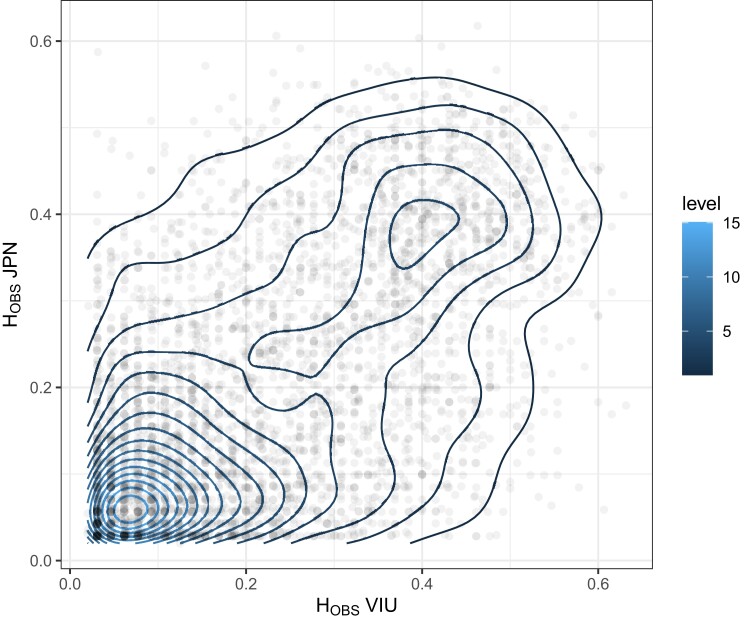
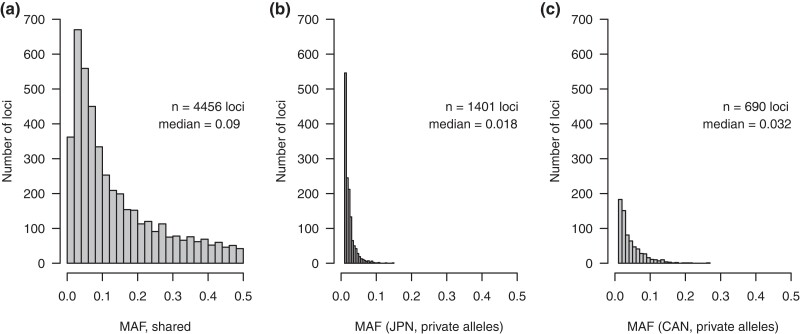
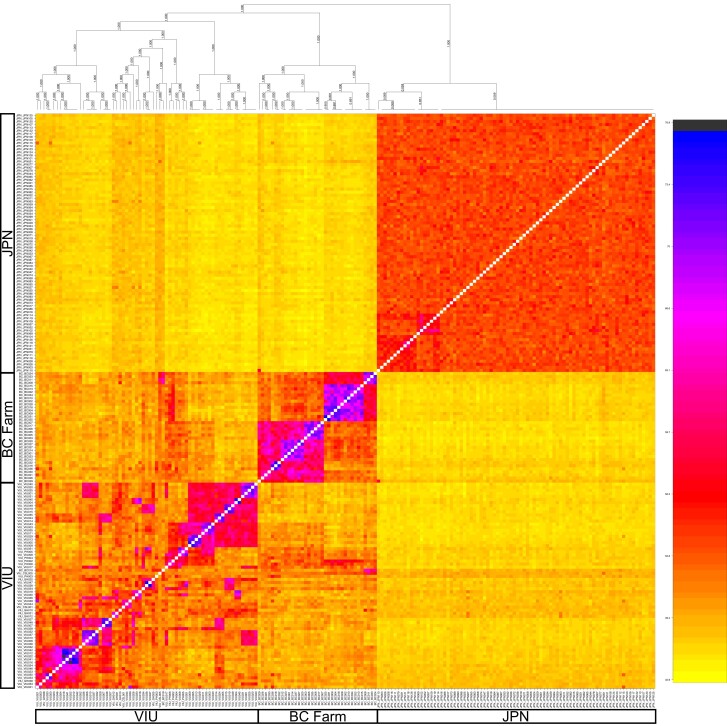
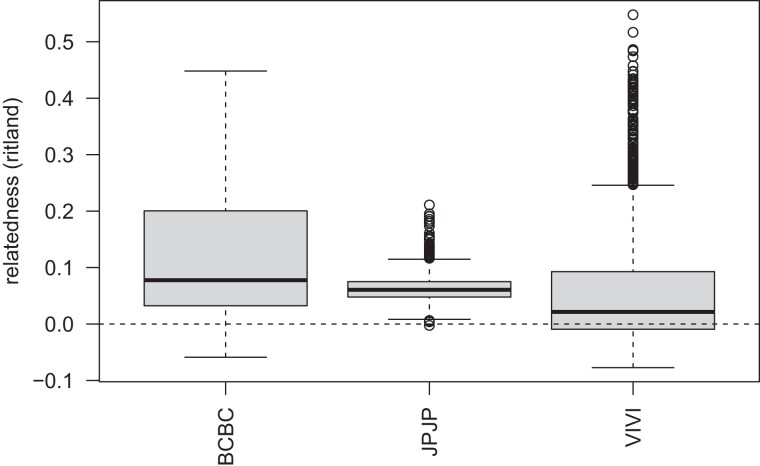
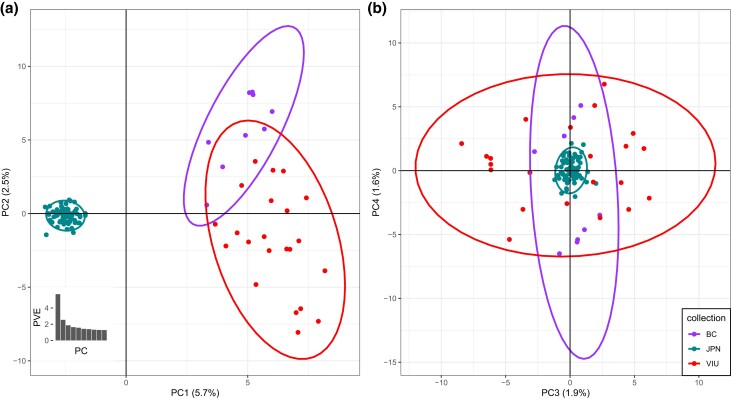
The Yesso scallop Mizuhopecten yessoensis is an important aquaculture species that was introduced to Western Canada from Japan to establish an economically viable scallop farming industry. This highly fecund species has been propagated in Canadian aquaculture hatcheries for the past 40 years, raising questions about genetic diversity and genetic differences among hatchery stocks. In this study, we compare cultured Canadian and wild Japanese populations of Yesso scallop using double-digest restriction site-associated DNA (ddRAD) sequencing to genotype 21,048 variants in 71 wild-caught scallops from Japan, 65 scallops from the Vancouver Island University breeding population, and 37 scallops obtained from a commercial farm off Vancouver Island, British Columbia. The wild scallops are largely comprised of equally unrelated individuals, whereas cultured scallops are comprised of multiple families of related individuals. The polymorphism rate estimated in wild scallops was 1.7%, whereas in the cultured strains, it ranged between 1.35 and 1.07%. Interestingly, heterozygosity rates were highest in the cultured populations, which is likely due to shellfish hatchery practices of crossing divergent strains to gain benefits of heterosis and to avoid inbreeding. Evidence of founder effects and drift was observed in the cultured strains, including high genetic differentiation between cultured populations and between cultured populations and the wild population. Cultured populations had effective population sizes ranging from 9 to 26 individuals whereas the wild population was estimated at 25,048-56,291 individuals. Further, a depletion of low-frequency variants was observed in the cultured populations. These results indicate significant genetic diversity losses in cultured scallops in Canadian breeding programs.
日本帆立贝 Mizuhopecten yessoensis 是一种重要的水产养殖物种,从日本引入加拿大西部,以建立一个经济可行的扇贝养殖产业。这种高繁殖力的物种在加拿大水产养殖孵化场繁殖了 40 年,这引发了人们对遗传多样性和孵化场种群之间遗传差异的关注。在这项研究中,我们使用双酶切限制位点相关 DNA(ddRAD)测序来比较养殖的加拿大和野生日本帆立贝种群,对来自日本的 71 只野生扇贝、温哥华岛大学繁殖群体的 65 只扇贝和不列颠哥伦比亚省温哥华岛外商业养殖场的 37 只扇贝进行了 21048 个变体的基因分型。野生扇贝主要由互不相关的个体组成,而养殖扇贝则由多个相关个体的家族组成。野生扇贝的多态性率估计为 1.7%,而在养殖品系中,其范围在 1.35%至 1.07%之间。有趣的是,在养殖种群中,杂合率最高,这可能是由于贝类孵化场的交叉繁殖做法,以获得杂种优势和避免近亲繁殖的好处。在养殖种群中观察到了奠基者效应和漂变的证据,包括养殖种群之间以及养殖种群与野生种群之间的高遗传分化。养殖种群的有效种群数量范围从 9 到 26 只,而野生种群估计为 25048 到 56291 只。此外,还观察到在养殖种群中低频率变体的消耗。这些结果表明,加拿大养殖计划中的养殖扇贝遗传多样性损失显著。