Branch Business & Information Systems Engineering of the Fraunhofer FIT and FIM Research Center for Information Management, University of Bayreuth, Wittelsbacherring 10, 95444, Bayreuth, Germany.
Chair of General Business Management, University of Bayreuth, Universitätsstraße 30, 95447, Bayreuth, Germany.
BMC Health Serv Res. 2023 Oct 19;23(1):1128. doi: 10.1186/s12913-023-10032-6.
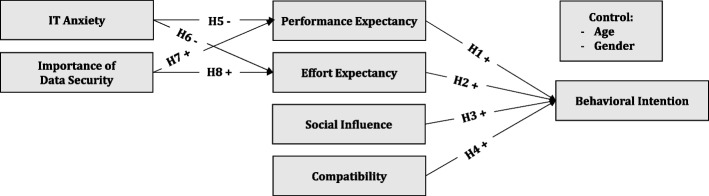
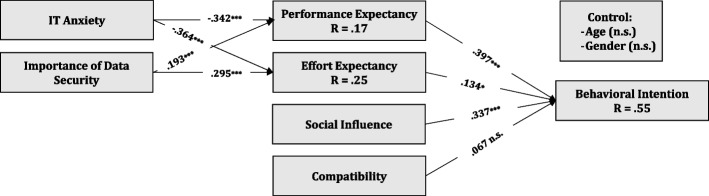
As healthcare demands exceed outpatient physicians' capacities, telemedicine holds far-reaching potential for both physicians and patients. It is crucial to holistically analyze physicians' acceptance of telemedical applications, such as online consultations. This study seeks to identify supporting and constraining factors that influence outpatient physicians' acceptance of telemedicine.We develop a model based on the unified theory of acceptance and use of technology (UTAUT). To empirically examine our research model, we conducted a survey among German physicians (n = 127) in 2018-2019. We used the partial least squares (PLS) modeling approach to test our model, including a mediation analysis. The results indicate that performance expectancy (β = .397, P < .001), effort expectancy (β = .134, P = .03), and social influence (β = .337, P < .001) strongly impact the intention to conduct online consultations and explain 55% of its variance. Structural conditions regarding data security comprise a key antecedent, associating with performance expectancy (β = .193, P < .001) and effort expectancy (β = .295, P < .001). Regarding potential barriers to usage intentions, we find that IT anxiety predicts performance (β = -.342, P < .001) and effort expectancy (β = -.364, P < .001), while performance expectancy fully mediates (βdirect = .022, P = .71; βindirect = -.138, P < .001) the direct relationship between IT anxiety and the intention to use telemedical applications.This research provides explanations for physicians' behavioral intention to use online consultations, underlining UTAUT's applicability in healthcare contexts. To boost acceptance, social influences, such as personal connections and networking are vital, as colleagues can serve as multipliers to reach convergence on online consultations among peers. To overcome physicians' IT anxiety, training, demonstrations, knowledge sharing, and management incentives are recommended. Furthermore, regulations and standards to build trust in the compliance of online consultations with data protection guidelines need reinforcement from policymakers and hospital management alike.
随着医疗需求超过门诊医生的能力,远程医疗对医生和患者都具有深远的潜力。全面分析医生对远程医疗应用(如在线咨询)的接受程度至关重要。本研究旨在确定影响门诊医生接受远程医疗的支持和制约因素。我们基于统一技术接受和使用理论(UTAUT)构建了一个模型。为了实证检验我们的研究模型,我们于 2018 年至 2019 年对德国医生(n=127)进行了调查。我们使用偏最小二乘(PLS)建模方法来检验我们的模型,包括中介分析。结果表明,绩效预期(β=.397,P<.001)、努力预期(β=.134,P=.03)和社会影响(β=.337,P<.001)对进行在线咨询的意愿有强烈影响,解释了其 55%的变异性。数据安全方面的结构条件是一个关键的前置因素,与绩效预期(β=.193,P<.001)和努力预期(β=.295,P<.001)相关。关于使用意愿的潜在障碍,我们发现 IT 焦虑预测绩效(β=-.342,P<.001)和努力预期(β=-.364,P<.001),而绩效预期完全中介(β直接=.022,P=.71;β间接=-.138,P<.001)了 IT 焦虑与使用远程医疗应用的意图之间的直接关系。这项研究为医生使用在线咨询的行为意图提供了解释,强调了 UTAUT 在医疗保健环境中的适用性。为了提高接受程度,个人联系和网络等社会影响至关重要,因为同事可以作为乘数,在同行中推广在线咨询。为了克服医生的 IT 焦虑,建议提供培训、演示、知识共享和管理激励。此外,政策制定者和医院管理层都需要加强有关在线咨询符合数据保护准则的法规和标准,以建立信任。