Senthilrajah Thiviyan, Ahangama Supunmali
Department of Information Technology, Faculty of Information Technology, University of Moratuwa, Moratuwa, Sri Lanka.
BMC Health Serv Res. 2025 Jan 4;25(1):24. doi: 10.1186/s12913-024-12173-8.
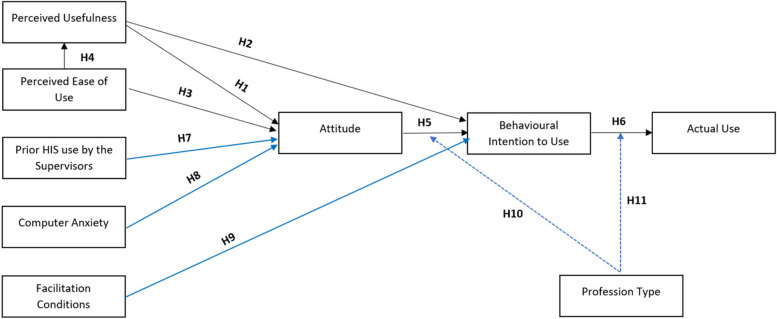
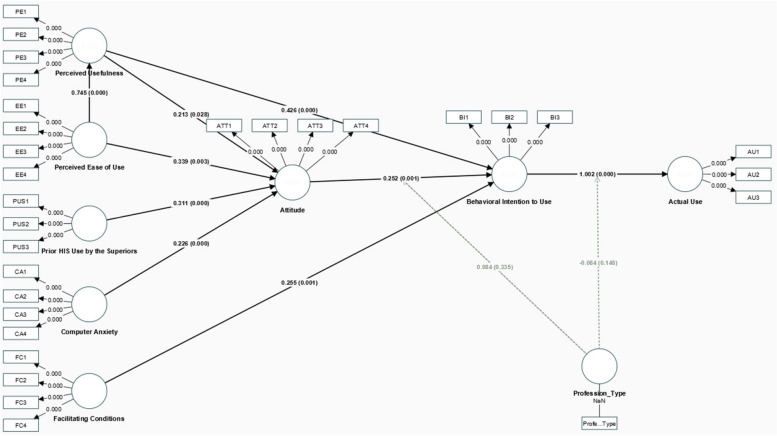
The deployment of Health Information Systems (HIS) in Sri Lanka has been low in adoption compared to developed countries. There has been a dearth of studies to identify the factors that improve the adoption of HIS in developing countries. Thus, this study investigates the factors influencing the acceptance of HIS among public healthcare staff. A survey was administered among 170 medical professionals, including nurses and doctors. Partial Least Squares Structural Equation Modelling (PLS-SEM) was applied to the dataset with 5000 bootstrap subsamples. The research model was developed based on the prior literature and by extending the Technology Acceptance Model (TAM) to the context of public healthcare. A positive relationship was observed between the actual use of HIS and constructs such as perceived usefulness, perceived ease of use, attitude, behavioural intention, prior use of HIS by supervisors, computer anxiety and facilitating conditions. These findings confirm the applicability of the proposed extended TAM in the public healthcare system of a developing country. Furthermore, HIS practitioners and policymakers in the healthcare sector would find these results valuable.
与发达国家相比,斯里兰卡卫生信息系统(HIS)的采用率较低。目前缺乏相关研究来确定影响发展中国家HIS采用率的因素。因此,本研究调查了影响公共医疗人员接受HIS的因素。对170名医疗专业人员(包括护士和医生)进行了一项调查。将偏最小二乘结构方程模型(PLS-SEM)应用于包含5000个自抽样子样本的数据集。该研究模型是基于先前的文献,并通过将技术接受模型(TAM)扩展到公共医疗环境而开发的。观察到HIS的实际使用与感知有用性、感知易用性、态度、行为意向、上级对HIS的先前使用、计算机焦虑和促进条件等构念之间存在正相关关系。这些发现证实了所提出的扩展TAM在发展中国家公共医疗系统中的适用性。此外,医疗部门的HIS从业者和政策制定者将发现这些结果很有价值。