Zisis Vasileios, Andreadis Dimitrios, Anastasiadou Pinelopi A, Akrivou Meni, Vizirianakis Ioannis S, Anagnostou Lefteris, Malamos Dimitrios, Paraskevopoulos Konstantinos, Poulopoulos Athanasios
Oral Medicine/Pathology, School of Dentistry, Aristotle University of Thessaloniki, Thessaloniki, GRC.
Pharmacology, Aristotle University of Thessaloniki, Thessaloniki, GRC.
Cureus. 2023 Sep 18;15(9):e45482. doi: 10.7759/cureus.45482. eCollection 2023 Sep.
Cancer stem cells (CSCs) are incriminated for initiating the process of carcinogenesis either de novo or through the transformation of oral potentially malignant disorders (OPMDs) to oral squamous cell carcinoma (OSCC). The aim of this study was to detect the expression of embryonic-type CSC markers OCT3/4 and SOX2 in OSCCs and oral leukoplakias (OLs), the most common of OPMDs.
The study type is experimental, and the study design is characterized as semiquantitative research, which belongs to the branch of experimental research. The experiment was conducted in the Department of Oral Medicine/Pathology, School of Dentistry, Aristotle University of Thessaloniki, Greece. This study focuses on the semiquantitative immunohistochemical (IHC) pattern of expression of CSCs protein-biomarkers SOX2 and OCT3/4, in paraffin embedded samples of 21 OSCCs of different grades of differentiation and 30 cases of OLs with different grades of dysplasia, compared to five cases of normal oral mucosa in both terms of cells' stain positivity and intensity. Statistical analysis was performed through SPSS 2017 Pearson Chi-square and the significance level was set at 0.05 (p=0.05). The expression of the respective genes of SOX2 and OCT3/4 was studied through quantitative polymerase chain reaction (qPCR), in paraffin-embedded samples of 12 cases of OLs with mild/non dysplasia and 19 cases moderately/poorly differentiated OSCCs(n=19) and five normal mucosa using the Independent Paired T-test.
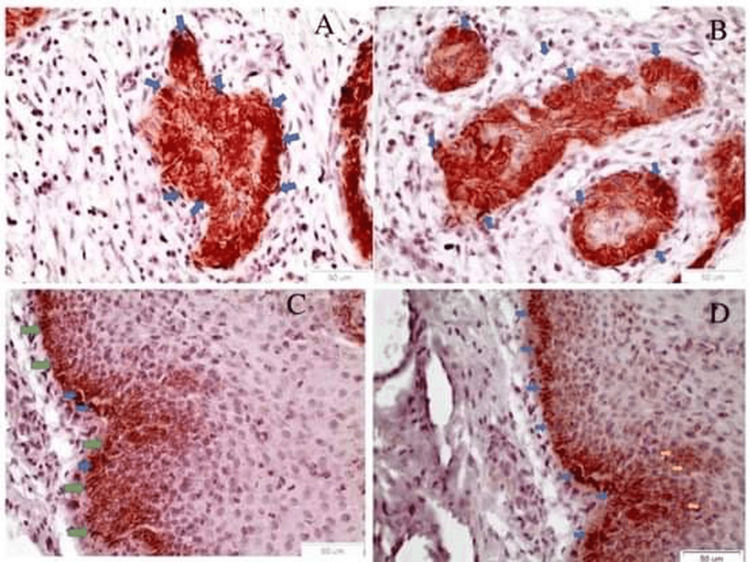
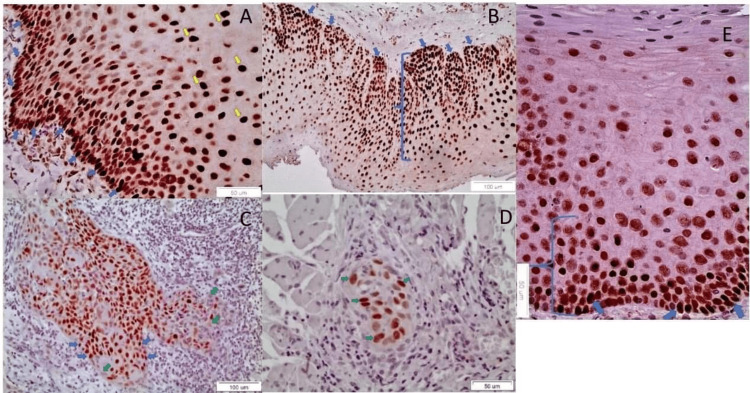
The genes SOX2 and Oct3/4 were expressed in all examined cases although no statistically significant correlations among normal, OL and OSCC, were established. A nuclear/membrane staining of OCT3/4 was noticed only in three out of 21 OSCCs but in none of OLs or normal cases (without statistical significance). A characteristic nuclear staining of SOX2 was noticed in the majority of the samples, mostly in the basal and parabasal layers of the epithelium. SOX2 was significantly detected in the OSCCs group (strong positivity in 17/21) than in the OL group (30 cases, mostly mildly stained) (p-value=0.007), and the normal oral epithelium (mild stained, p=0.065). Furthermore, SOX2 was overexpressed in well differentiated OSCCs group (5/OSCCs, strongly stained) rather than in mildly dysplastic and non-dysplastic OLs samples (14/OLs, mildly stained) (p-value =0.035).
The characteristic expression of SOX2 but not of OCT3/4 in OLs' and OSCCs' lesions suggests the presence of neoplastic cells with certain CSC characteristics whose implication in the early stages of oral tumorigenesis could be further evaluated. The clinical use of SOX2, as prognostic factor, requires further experimental evaluation in larger number of samples.
癌症干细胞(CSCs)被认为是从头启动致癌过程,或通过将口腔潜在恶性疾病(OPMDs)转化为口腔鳞状细胞癌(OSCC)来启动致癌过程。本研究的目的是检测胚胎型CSC标志物OCT3/4和SOX2在OSCC以及口腔白斑(OLs)中的表达,口腔白斑是最常见的OPMDs。
本研究类型为实验性研究,研究设计为半定量研究,属于实验研究分支。实验在希腊塞萨洛尼基亚里士多德大学牙科学院口腔医学/病理学系进行。本研究聚焦于CSCs蛋白生物标志物SOX2和OCT3/4在21例不同分化程度的OSCC石蜡包埋样本和30例不同发育异常程度的OLs样本中的半定量免疫组化(IHC)表达模式,并与5例正常口腔黏膜样本在细胞染色阳性率和强度方面进行比较。通过SPSS 2017 Pearson卡方检验进行统计分析,显著性水平设定为0.05(p = 0.05)。通过定量聚合酶链反应(qPCR)研究12例轻度/无发育异常的OLs样本、19例中/低分化OSCCs样本(n = 19)和5例正常黏膜样本中SOX2和OCT3/4各自基因的表达,采用独立配对t检验。
尽管在正常、OL和OSCC之间未建立统计学上的显著相关性,但SOX2和Oct3/4基因在所有检测病例中均有表达。仅在21例OSCC中的3例中观察到OCT3/4的核/膜染色,而在OL或正常病例中均未观察到(无统计学意义)。在大多数样本中观察到SOX2的特征性核染色,主要在上皮的基底层和副基底层。与OL组(30例,大多为轻度染色)(p值 = 0.007)和正常口腔上皮(轻度染色,p = 0.065)相比,在OSCCs组中显著检测到SOX2(17/21强阳性)。此外,SOX2在高分化OSCCs组(5/OSCCs,强染色)中过表达,而在轻度发育异常和无发育异常的OLs样本(14/OLs,轻度染色)中未过表达(p值 = 0.035)。
OLs和OSCCs病变中SOX2而非OCT3/4的特征性表达表明存在具有某些CSC特征的肿瘤细胞,其在口腔肿瘤发生早期阶段的影响可进一步评估。将SOX2作为预后因素的临床应用需要在更多样本中进行进一步的实验评估。