Zisis Vasileios, Anastasiadou Pinelopi A, Poulopoulos Athanasios, Vahtsevanos Konstantinos, Paraskevopoulos Konstantinos, Andreadis Dimitrios
Oral Medicine and Pathology, Aristotle University of Thessaloniki, Thessaloniki, GRC.
Oral and Maxillofacial Surgery, Papanikolaou Hospital, Aristotle University of Thessaloniki, Thessaloniki, GRC.
Cureus. 2024 Jan 14;16(1):e52265. doi: 10.7759/cureus.52265. eCollection 2024 Jan.
The aim of this study was to detect the possible endothelial expression of embryonic-type cancer stem cells (CSC) marker SOX2 and the stemness-type CSC marker CD147 in oral potential malignant disorders (OPMDs), oral leukoplakia (OL) in particular, and oral squamous cell carcinoma (OSCC).
This study focuses on the immunohistochemical pattern of expression of CSC protein-biomarkers SOX2 and CD147 in paraffin-embedded samples of 21 OSCCs of different grades of differentiation and 30 cases of OLs with different grades of dysplasia, compared to normal oral mucosa.
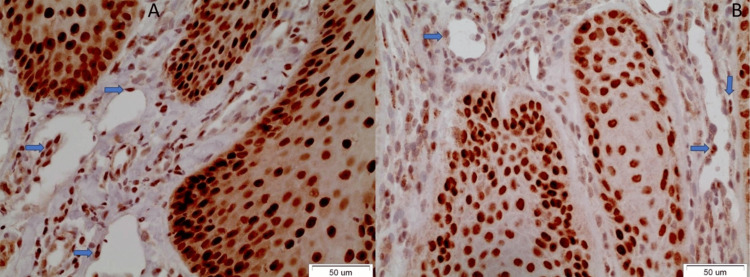
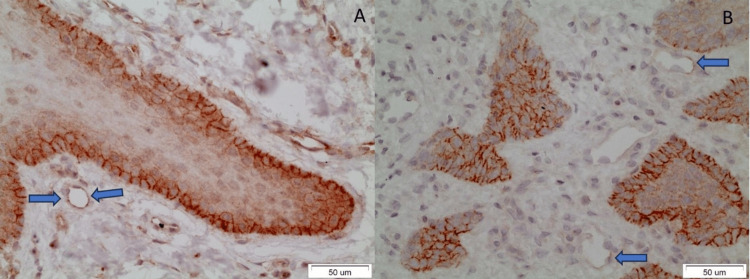
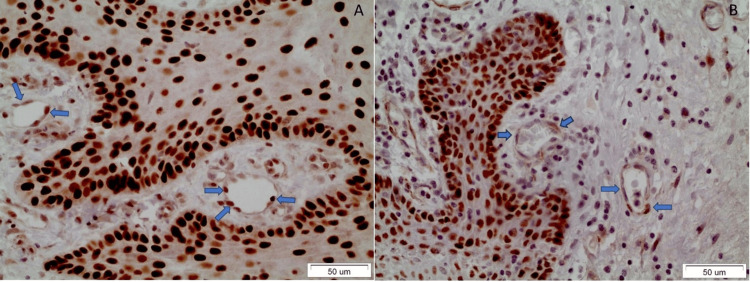
The protein biomarker SOX2 was expressed in the endothelial cells, but without establishing any statistically significant correlation among OSCC, OL, and normal tissue specimens. However, SOX endothelial staining was noticed in 7/30 (23.3%) cases of OL (one non-dysplastic, one mildly dysplastic, one moderately dysplastic, and four severely dysplastic cases) and 5/21 (23.8%) cases of OSCC (two well-differentiated, one moderately differentiated, and two poorly differentiated cases). Although CD147 is expressed in normal oral epithelium, OL, and OSCC neoplastic cells, its vascular-endothelial expression was noticed in only 2/5 (40%) cases of normal oral epithelium, 1/30 (3.3%) cases of OL (one severely dysplastic case), and 4/21 (19%) cases of OSCC (two well-differentiated, one moderately differentiated, and one poorly differentiated case). Therefore, no statistically significant correlation among OSCC, OL, and normal tissue specimens was established.
The endothelial presence of SOX2 both in oral potentially malignant and malignant lesions suggests that SOX2 may be implicated in the microvascularization process and associated with the degree of dysplasia in OL. The expression of CD147 may be attributed both to local inflammation and tumorigenesis. The implementation of CD147 in larger groups of tissue samples will shed some light on its role in cancer and inflammation. The evidence so far supports the need for more studies, which may support the clinical significance of these novel cancer stem cell biomarkers.
本研究旨在检测胚胎型癌症干细胞(CSC)标志物SOX2以及干性型CSC标志物CD147在口腔潜在恶性病变(OPMDs),尤其是口腔白斑(OL)和口腔鳞状细胞癌(OSCC)中是否在内皮细胞表达。
本研究聚焦于CSC蛋白生物标志物SOX2和CD147在21例不同分化程度的OSCC石蜡包埋样本以及30例不同发育异常程度的OL石蜡包埋样本中的免疫组化表达模式,并与正常口腔黏膜进行比较。
蛋白生物标志物SOX2在内皮细胞中表达,但在OSCC、OL和正常组织标本之间未建立任何具有统计学意义的相关性。然而,在7/30(23.3%)的OL病例(1例无发育异常、1例轻度发育异常、1例中度发育异常和4例重度发育异常病例)和5/21(23.8%)的OSCC病例(2例高分化、1例中分化和2例低分化病例)中观察到SOX内皮染色。虽然CD147在正常口腔上皮、OL和OSCC肿瘤细胞中表达,但其血管内皮表达仅在2/5(40%)的正常口腔上皮病例、1/30(3.3%)的OL病例(1例重度发育异常病例)和4/21(19%)的OSCC病例(2例高分化、1例中分化和1例低分化病例)中被观察到。因此,在OSCC、OL和正常组织标本之间未建立具有统计学意义的相关性。
SOX2在口腔潜在恶性和恶性病变的内皮细胞中的存在表明,SOX2可能参与微血管形成过程,并与OL的发育异常程度相关。CD147的表达可能归因于局部炎症和肿瘤发生。在更大组的组织样本中对CD147的研究将有助于阐明其在癌症和炎症中的作用。目前的证据支持需要更多的研究,这可能支持这些新型癌症干细胞生物标志物的临床意义。