Mohd Nor Nur Akmar Nadhirah, Kari Asmad, Haron Mohd Nizam, Komilus Connie Fay
School of Animal Science, Aquatic Science and Environment, Faculty of Bioresources and Food Industry, Universiti Sultan Zainal Abidin 22200 Besut, Terengganu, Malaysia.
Trop Life Sci Res. 2023 Sep;34(3):151-163. doi: 10.21315/tlsr2023.34.3.8. Epub 2023 Sep 30.
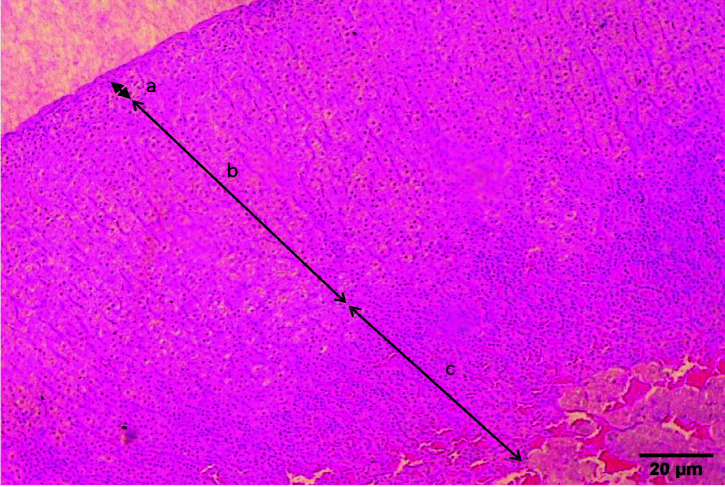
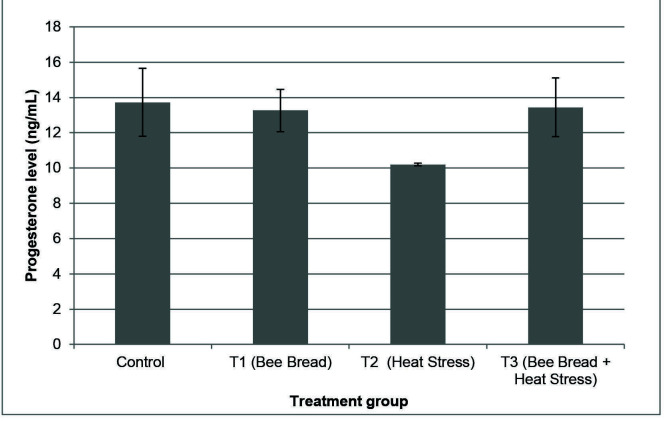
Environmental temperature rises are powerful stimuli that can alter both the sympathetic nervous system and the hypothalamic-pituitary-adrenocortical axis (HPA). Heat stress has been shown to harm pregnancy outcomes such as causing spontaneous abortion, low birth weight, growth retardation and stillbirth. Supplementation of bee bread in pregnant rats under heat stress exposure has been shown to improve the pregnancy outcomes. However, whether supplementation of bee bread during heat stress exposure may also reduce the level of the stress hormone, corticosterone has yet been reported. Therefore, this study aims to determine the effect of bee bread on corticosterone level, progesterone level, oestradiol level and zonation of the adrenal cortex of pregnant rats under heat stress exposure. Pregnant rats were randomly categorised into four groups ( = 6): Control (C: standard feeding), Treatment 1 (T1: 0.5 g bee bread/kg body weight/day), Treatment 2 (T2: standard feeding with heat exposure), and Treatment 3 (T3: 0.5 g bee bread/kg body weight/day with heat exposure). Bee bread (0.5 g/kg body weight/day) was force-fed to pregnant rats through oral gavage beginning on day 0 of pregnancy and continuing until delivery. Heat stress was generated experimentally by putting both T2 and T3 rats in an egg incubator for 45 min daily at a temperature of 43°C till delivery. On a postnatal Day 21, dams were euthanised to assess serum corticosterone, progesterone, oestradiol levels and adrenal gland histology. Rats in the T2 group had a significantly ( < 0.05) increase in the zona fasciculata thickness (94.95 ± 1.55 μm) and higher corticosterone levels (49.57 ± 1.57 ng/mL) compared with control. However, supplementation of bee bread during heat stress was able to show an improvement in adrenal zona fasciculata thickness by decreasing to 79.89 ± 3.08 μm and corticosterone level reduced to 35.31 ± 1.73 ng/mL significantly ( < 0.05). Therefore, these findings may imply that bee bread is effective as a neutralizer in lowering the production of stress hormone.
环境温度升高是一种强大的刺激因素,可改变交感神经系统和下丘脑 - 垂体 - 肾上腺皮质轴(HPA)。热应激已被证明会损害妊娠结局,如导致自然流产、低出生体重、生长发育迟缓及死产。研究表明,给热应激状态下的怀孕大鼠补充蜂粮可改善妊娠结局。然而,热应激暴露期间补充蜂粮是否也能降低应激激素皮质酮水平,目前尚无相关报道。因此,本研究旨在确定蜂粮对热应激暴露下怀孕大鼠的皮质酮水平、孕酮水平、雌二醇水平及肾上腺皮质分区的影响。将怀孕大鼠随机分为四组(每组n = 6):对照组(C:标准喂养)、处理1组(T1:0.5 g蜂粮/千克体重/天)、处理2组(T2:标准喂养并热暴露)和处理3组(T3:0.5 g蜂粮/千克体重/天并热暴露)。从怀孕第0天开始,通过灌胃法给怀孕大鼠强制喂食蜂粮(0.5 g/千克体重/天),持续至分娩。通过将T2组和T3组大鼠每天置于孵卵器中43°C环境下45分钟直至分娩,来实验性地产生热应激。在出生后第21天,对母鼠实施安乐死以评估血清皮质酮、孕酮、雌二醇水平及肾上腺组织学情况。与对照组相比,T2组大鼠的束状带厚度显著增加(94.95 ± 1.55 μm)(P < 0.),皮质酮水平更高(49.57 ± 1.57 ng/mL)。然而,热应激期间补充蜂粮能够使肾上腺束状带厚度显著改善,降至79.89 ± 3.08 μm,皮质酮水平显著降低至35.31 ± 1.73 ng/mL(P < 0.05)。因此,这些研究结果可能意味着蜂粮作为一种中和剂,在降低应激激素产生方面是有效的。