Shokeen Deepa, Wang Natalie, Nguyen Ngan P, Bakal Ethan, Tripathi Osika, Palaniappan Latha P, Huang Robert J
Division of Gastroenterology and Hepatology, Stanford University School of Medicine, Stanford, CA, USA.
University of California Los Angeles, Los Angeles, CA, USA.
Lancet Reg Health Am. 2023 Oct 12;27:100613. doi: 10.1016/j.lana.2023.100613. eCollection 2023 Nov.
Local area immigrant fraction is strongly and positively correlated with local life expectancy in the United States. The aim of the study was to determine the relationship between local area immigrant fraction and local prevalence of coronary heart disease (CHD) and stroke.
Cross-sectional study design, with ZIP code as the unit of observation. Demographic data was obtained from the American Community Survey, and linked to indicators of health access (, insurance, annual check-ups, cholesterol screening), obesity, behavior (smoking, exercise), and cardiovascular outcomes data from the 2020 Population Level Analysis and Community Estimates. Multivariable regression and path analyses were used to assess both direct and indirect relationships among variables.
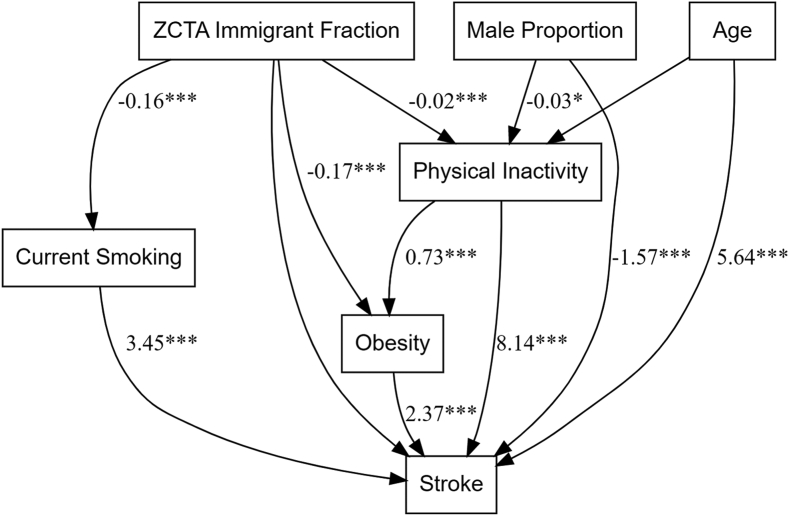
CHD prevalence was lower in the second (3.9% relative difference, 95% CI: 3.1-4.5%), third (6.5%, 95% CI: 5.8-7.1%), and fourth (14.8%, 95% CI: 14.1-15.8%) quartiles of immigrant fraction compared to the lowest (p-trend <0.001). These effects remained robust in multivariable analysis following adjustment for indicators of access, obesity, and behavioral variables (p-trend <0.0001). For stroke, only the highest quartile demonstrated a significant difference in prevalence (2.1%, 95% CI: 1.2-3.0% with full adjustment). In CHD path analysis, ∼45% of the association of immigrant fraction was direct, and ∼55% was mediated through lower prevalence of deleterious behaviors (, smoking). In stroke path analysis, the effect was entirely mediated through indirect effects.
In the United States, ZIP codes with higher immigrant fractions have lower prevalence of cardiovascular diseases. These associations are partially mediated through differences in health behaviors at the community level.
NIH (K08CA252635, P30AG0059304, K24HL150476), Stanford University, Rutgers University.
在美国,当地移民比例与当地预期寿命呈强正相关。本研究的目的是确定当地移民比例与冠心病(CHD)和中风的当地患病率之间的关系。
采用横断面研究设计,以邮政编码为观察单位。人口数据来自美国社区调查,并与健康获取指标(保险、年度体检、胆固醇筛查)、肥胖、行为(吸烟、运动)以及2020年人口水平分析和社区估计中的心血管结局数据相关联。使用多变量回归和路径分析来评估变量之间的直接和间接关系。
与移民比例最低的四分位数相比,移民比例第二(相对差异3.9%,95%CI:3.1 - 4.5%)、第三(6.5%,95%CI:5.8 - 7.1%)和第四(14.8%,95%CI:14.1 - 15.8%)四分位数的冠心病患病率较低(p趋势<0.001)。在对获取指标、肥胖和行为变量进行调整后的多变量分析中,这些效应仍然显著(p趋势<0.0001)。对于中风,只有最高四分位数的患病率有显著差异(完全调整后为2.1%,95%CI:1.2 - 3.0%)。在冠心病路径分析中,移民比例关联的约45%是直接的,约55%是通过有害行为(如吸烟)的较低患病率介导的。在中风路径分析中,效应完全通过间接效应介导。
在美国,移民比例较高的邮政编码地区心血管疾病患病率较低。这些关联部分是通过社区层面健康行为的差异介导的。
美国国立卫生研究院(K08CA252635、P30AG0059304、K24HL150476)、斯坦福大学、罗格斯大学。