• 文献检索
  • 文档翻译
  • 深度研究
  • 学术资讯
  • Suppr Zotero 插件Zotero 插件
  • 邀请有礼
  • 套餐&价格
  • 历史记录
应用&插件
Suppr Zotero 插件Zotero 插件浏览器插件Mac 客户端Windows 客户端微信小程序
定价
高级版会员购买积分包购买API积分包
服务
文献检索文档翻译深度研究API 文档MCP 服务
关于我们
关于 Suppr公司介绍联系我们用户协议隐私条款
关注我们

Suppr 超能文献

核心技术专利:CN118964589B侵权必究
粤ICP备2023148730 号-1Suppr @ 2026

文献检索

告别复杂PubMed语法,用中文像聊天一样搜索,搜遍4000万医学文献。AI智能推荐,让科研检索更轻松。

立即免费搜索

文件翻译

保留排版,准确专业,支持PDF/Word/PPT等文件格式,支持 12+语言互译。

免费翻译文档

深度研究

AI帮你快速写综述,25分钟生成高质量综述,智能提取关键信息,辅助科研写作。

立即免费体验

高度可变的种系编码区域之间的保守生物物理兼容性塑造了 TCR-MHC 相互作用。

Conserved biophysical compatibility among the highly variable germline-encoded regions shapes TCR-MHC interactions.

机构信息

Computational Biology Section, Laboratory of Immune System Biology, National Institute of Allergy and Infectious Diseases, National Institutes of Health, Bethesda, United States.

出版信息

Elife. 2023 Oct 20;12:e90681. doi: 10.7554/eLife.90681.

DOI:10.7554/eLife.90681
PMID:37861280
原文链接:https://pmc.ncbi.nlm.nih.gov/articles/PMC10631762/
Abstract

T cells are critically important components of the adaptive immune system primarily responsible for identifying and responding to pathogenic challenges. This recognition of pathogens is driven by the interaction between membrane-bound T cell receptors (TCRs) and antigenic peptides presented on major histocompatibility complex (MHC) molecules. The formation of the TCR-peptide-MHC complex (TCR-pMHC) involves interactions among germline-encoded and hypervariable amino acids. Germline-encoded and hypervariable regions can form contacts critical for complex formation, but only interactions between germline-encoded contacts are likely to be shared across many of all the possible productive TCR-pMHC complexes. Despite this, experimental investigation of these interactions have focused on only a small fraction of the possible interaction space. To address this, we analyzed every possible germline-encoded TCR-MHC contact in humans, thereby generating the first comprehensive characterization of these largely antigen-independent interactions. Our computational analysis suggests that germline-encoded TCR-MHC interactions that are conserved at the sequence level are rare due to the high amino acid diversity of the TCR CDR1 and CDR2 loops, and that such conservation is unlikely to dominate the dynamic protein-protein binding interface. Instead, we propose that binding properties such as the docking orientation are defined by regions of biophysical compatibility between these loops and the MHC surface.

摘要

T 细胞是适应性免疫系统的重要组成部分,主要负责识别和应对病原体的挑战。这种对病原体的识别是由膜结合的 T 细胞受体(TCR)与主要组织相容性复合体(MHC)分子上呈递的抗原肽之间的相互作用驱动的。TCR-肽-MHC 复合物(TCR-pMHC)的形成涉及种系编码和高变区氨基酸之间的相互作用。种系编码和高变区可以形成对复合物形成至关重要的接触,但只有种系编码接触之间的相互作用才可能在许多可能的有生产力的 TCR-pMHC 复合物中共享。尽管如此,这些相互作用的实验研究仅集中在可能的相互作用空间的一小部分。为了解决这个问题,我们分析了人类中每一个可能的种系编码的 TCR-MHC 接触,从而首次全面描述了这些在很大程度上与抗原无关的相互作用。我们的计算分析表明,由于 TCR CDR1 和 CDR2 环的氨基酸多样性很高,种系编码的 TCR-MHC 相互作用在序列水平上的保守性很少,而且这种保守性不太可能主导动态的蛋白质-蛋白质结合界面。相反,我们提出,结合特性,如对接方向,是由这些环与 MHC 表面之间的物理兼容性区域定义的。
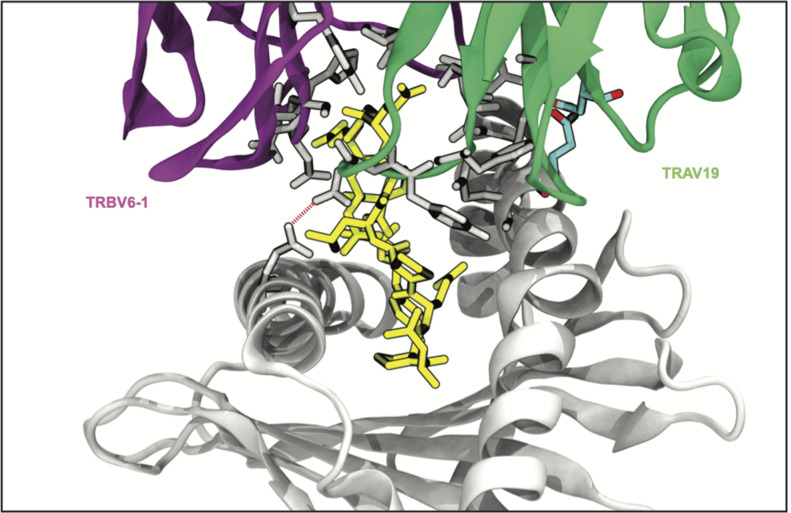
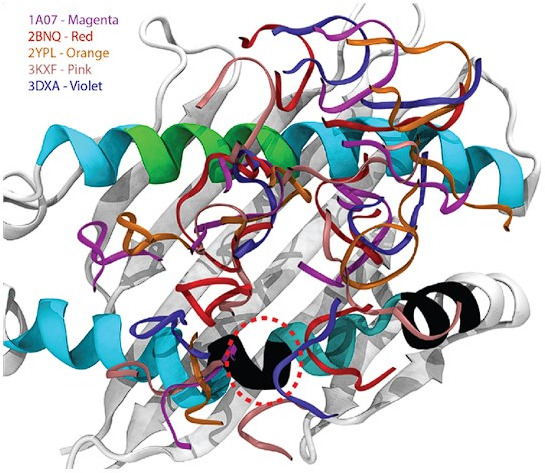
https://cdn.ncbi.nlm.nih.gov/pmc/blobs/4de5/10631762/2fa58c5ac10f/elife-90681-sa2-fig7.jpg
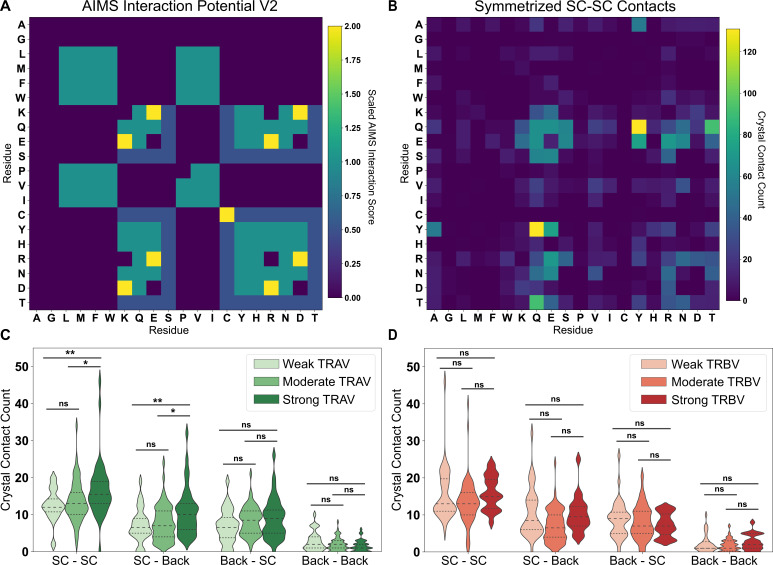
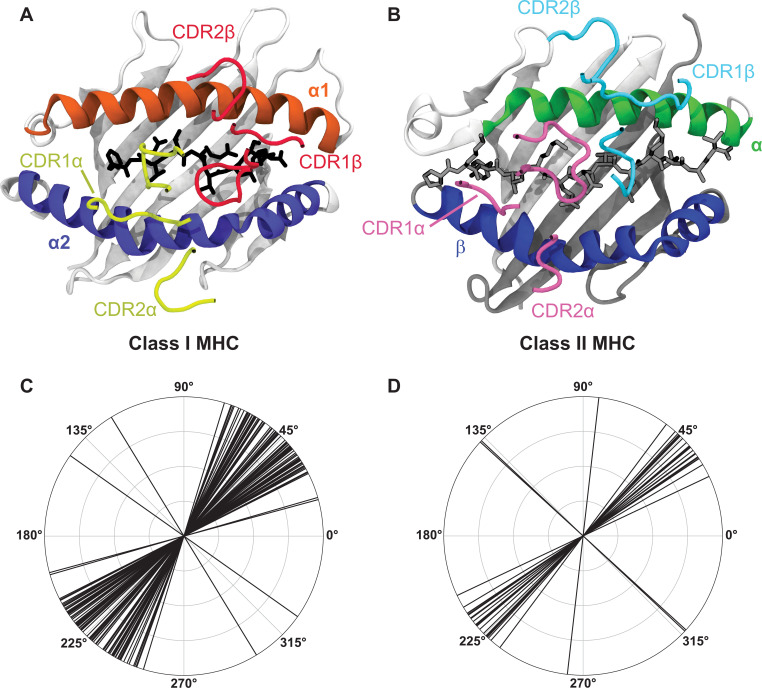
https://cdn.ncbi.nlm.nih.gov/pmc/blobs/4de5/10631762/9c873782afe9/elife-90681-fig1.jpg
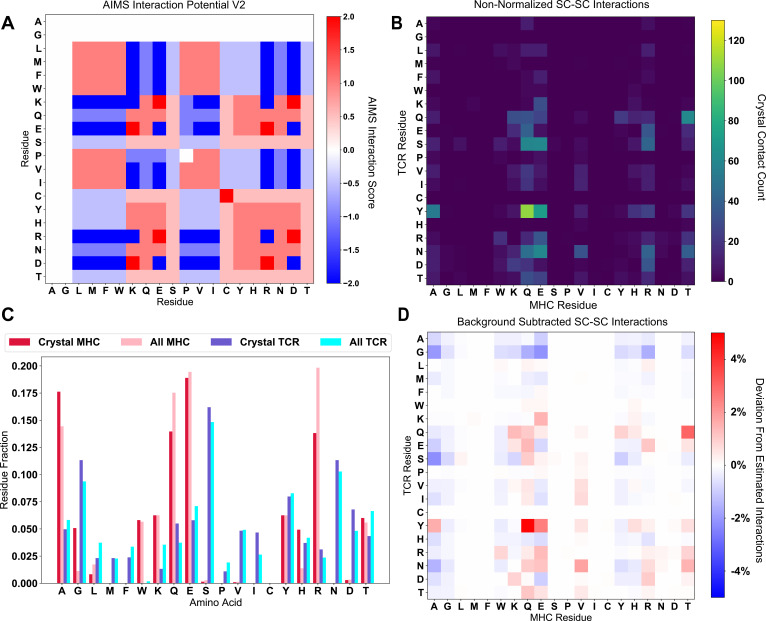
https://cdn.ncbi.nlm.nih.gov/pmc/blobs/4de5/10631762/93767d7d22b3/elife-90681-fig2.jpg
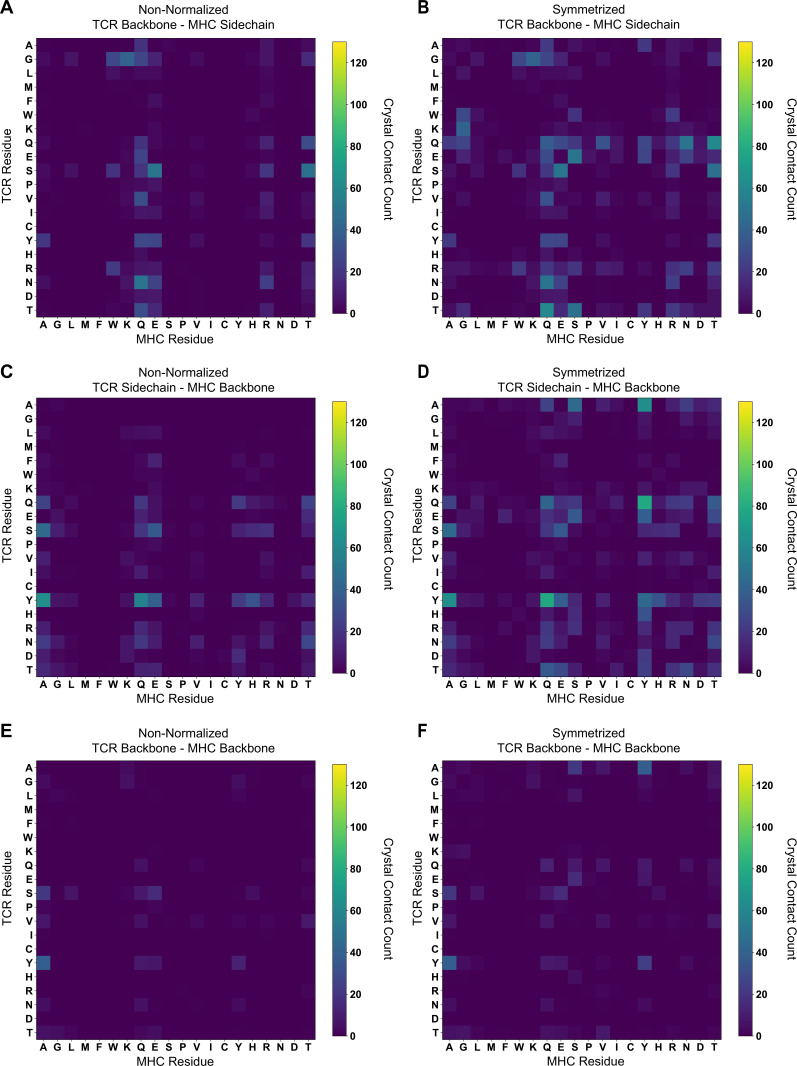
https://cdn.ncbi.nlm.nih.gov/pmc/blobs/4de5/10631762/89454b15e08d/elife-90681-fig2-figsupp1.jpg
https://cdn.ncbi.nlm.nih.gov/pmc/blobs/4de5/10631762/55c845bc5488/elife-90681-fig2-figsupp2.jpg
https://cdn.ncbi.nlm.nih.gov/pmc/blobs/4de5/10631762/4e0939e779c0/elife-90681-fig2-figsupp3.jpg
https://cdn.ncbi.nlm.nih.gov/pmc/blobs/4de5/10631762/b12977efbbaa/elife-90681-fig2-figsupp4.jpg
https://cdn.ncbi.nlm.nih.gov/pmc/blobs/4de5/10631762/f2f27507405d/elife-90681-fig3.jpg
https://cdn.ncbi.nlm.nih.gov/pmc/blobs/4de5/10631762/f003f7544fcb/elife-90681-fig3-figsupp1.jpg
https://cdn.ncbi.nlm.nih.gov/pmc/blobs/4de5/10631762/6162bf82c0dd/elife-90681-fig3-figsupp2.jpg
https://cdn.ncbi.nlm.nih.gov/pmc/blobs/4de5/10631762/66d52d92124b/elife-90681-fig4.jpg
https://cdn.ncbi.nlm.nih.gov/pmc/blobs/4de5/10631762/53d7f443ac9e/elife-90681-fig4-figsupp1.jpg
https://cdn.ncbi.nlm.nih.gov/pmc/blobs/4de5/10631762/e91cd49b8984/elife-90681-fig4-figsupp2.jpg
https://cdn.ncbi.nlm.nih.gov/pmc/blobs/4de5/10631762/74931ded7a88/elife-90681-fig5.jpg
https://cdn.ncbi.nlm.nih.gov/pmc/blobs/4de5/10631762/ec3b0e54a865/elife-90681-fig5-figsupp1.jpg
https://cdn.ncbi.nlm.nih.gov/pmc/blobs/4de5/10631762/2e7f53f12dbb/elife-90681-fig5-figsupp2.jpg
https://cdn.ncbi.nlm.nih.gov/pmc/blobs/4de5/10631762/d76dd341e446/elife-90681-fig5-figsupp3.jpg
https://cdn.ncbi.nlm.nih.gov/pmc/blobs/4de5/10631762/dbebe8db8f06/elife-90681-fig6.jpg
https://cdn.ncbi.nlm.nih.gov/pmc/blobs/4de5/10631762/62596ed27a2b/elife-90681-fig6-figsupp1.jpg
https://cdn.ncbi.nlm.nih.gov/pmc/blobs/4de5/10631762/3fd151918791/elife-90681-fig7.jpg
https://cdn.ncbi.nlm.nih.gov/pmc/blobs/4de5/10631762/7ae23e9c699a/elife-90681-fig8.jpg
https://cdn.ncbi.nlm.nih.gov/pmc/blobs/4de5/10631762/62ed84aa4851/elife-90681-fig8-figsupp1.jpg
https://cdn.ncbi.nlm.nih.gov/pmc/blobs/4de5/10631762/434fadd01a0b/elife-90681-fig9.jpg
https://cdn.ncbi.nlm.nih.gov/pmc/blobs/4de5/10631762/c3a627e11ca5/elife-90681-fig9-figsupp1.jpg
https://cdn.ncbi.nlm.nih.gov/pmc/blobs/4de5/10631762/3d8bc6799455/elife-90681-sa2-fig1.jpg
https://cdn.ncbi.nlm.nih.gov/pmc/blobs/4de5/10631762/5b9832a5ba17/elife-90681-sa2-fig2.jpg
https://cdn.ncbi.nlm.nih.gov/pmc/blobs/4de5/10631762/4c13a155f063/elife-90681-sa2-fig3.jpg
https://cdn.ncbi.nlm.nih.gov/pmc/blobs/4de5/10631762/07484f29acc5/elife-90681-sa2-fig4.jpg
https://cdn.ncbi.nlm.nih.gov/pmc/blobs/4de5/10631762/993e5ca96f83/elife-90681-sa2-fig5.jpg
https://cdn.ncbi.nlm.nih.gov/pmc/blobs/4de5/10631762/0bb065f89899/elife-90681-sa2-fig6.jpg
https://cdn.ncbi.nlm.nih.gov/pmc/blobs/4de5/10631762/2fa58c5ac10f/elife-90681-sa2-fig7.jpg
https://cdn.ncbi.nlm.nih.gov/pmc/blobs/4de5/10631762/9c873782afe9/elife-90681-fig1.jpg
https://cdn.ncbi.nlm.nih.gov/pmc/blobs/4de5/10631762/93767d7d22b3/elife-90681-fig2.jpg
https://cdn.ncbi.nlm.nih.gov/pmc/blobs/4de5/10631762/89454b15e08d/elife-90681-fig2-figsupp1.jpg
https://cdn.ncbi.nlm.nih.gov/pmc/blobs/4de5/10631762/55c845bc5488/elife-90681-fig2-figsupp2.jpg
https://cdn.ncbi.nlm.nih.gov/pmc/blobs/4de5/10631762/4e0939e779c0/elife-90681-fig2-figsupp3.jpg
https://cdn.ncbi.nlm.nih.gov/pmc/blobs/4de5/10631762/b12977efbbaa/elife-90681-fig2-figsupp4.jpg
https://cdn.ncbi.nlm.nih.gov/pmc/blobs/4de5/10631762/f2f27507405d/elife-90681-fig3.jpg
https://cdn.ncbi.nlm.nih.gov/pmc/blobs/4de5/10631762/f003f7544fcb/elife-90681-fig3-figsupp1.jpg
https://cdn.ncbi.nlm.nih.gov/pmc/blobs/4de5/10631762/6162bf82c0dd/elife-90681-fig3-figsupp2.jpg
https://cdn.ncbi.nlm.nih.gov/pmc/blobs/4de5/10631762/66d52d92124b/elife-90681-fig4.jpg
https://cdn.ncbi.nlm.nih.gov/pmc/blobs/4de5/10631762/53d7f443ac9e/elife-90681-fig4-figsupp1.jpg
https://cdn.ncbi.nlm.nih.gov/pmc/blobs/4de5/10631762/e91cd49b8984/elife-90681-fig4-figsupp2.jpg
https://cdn.ncbi.nlm.nih.gov/pmc/blobs/4de5/10631762/74931ded7a88/elife-90681-fig5.jpg
https://cdn.ncbi.nlm.nih.gov/pmc/blobs/4de5/10631762/ec3b0e54a865/elife-90681-fig5-figsupp1.jpg
https://cdn.ncbi.nlm.nih.gov/pmc/blobs/4de5/10631762/2e7f53f12dbb/elife-90681-fig5-figsupp2.jpg
https://cdn.ncbi.nlm.nih.gov/pmc/blobs/4de5/10631762/d76dd341e446/elife-90681-fig5-figsupp3.jpg
https://cdn.ncbi.nlm.nih.gov/pmc/blobs/4de5/10631762/dbebe8db8f06/elife-90681-fig6.jpg
https://cdn.ncbi.nlm.nih.gov/pmc/blobs/4de5/10631762/62596ed27a2b/elife-90681-fig6-figsupp1.jpg
https://cdn.ncbi.nlm.nih.gov/pmc/blobs/4de5/10631762/3fd151918791/elife-90681-fig7.jpg
https://cdn.ncbi.nlm.nih.gov/pmc/blobs/4de5/10631762/7ae23e9c699a/elife-90681-fig8.jpg
https://cdn.ncbi.nlm.nih.gov/pmc/blobs/4de5/10631762/62ed84aa4851/elife-90681-fig8-figsupp1.jpg
https://cdn.ncbi.nlm.nih.gov/pmc/blobs/4de5/10631762/434fadd01a0b/elife-90681-fig9.jpg
https://cdn.ncbi.nlm.nih.gov/pmc/blobs/4de5/10631762/c3a627e11ca5/elife-90681-fig9-figsupp1.jpg
https://cdn.ncbi.nlm.nih.gov/pmc/blobs/4de5/10631762/3d8bc6799455/elife-90681-sa2-fig1.jpg
https://cdn.ncbi.nlm.nih.gov/pmc/blobs/4de5/10631762/5b9832a5ba17/elife-90681-sa2-fig2.jpg
https://cdn.ncbi.nlm.nih.gov/pmc/blobs/4de5/10631762/4c13a155f063/elife-90681-sa2-fig3.jpg
https://cdn.ncbi.nlm.nih.gov/pmc/blobs/4de5/10631762/07484f29acc5/elife-90681-sa2-fig4.jpg
https://cdn.ncbi.nlm.nih.gov/pmc/blobs/4de5/10631762/993e5ca96f83/elife-90681-sa2-fig5.jpg
https://cdn.ncbi.nlm.nih.gov/pmc/blobs/4de5/10631762/0bb065f89899/elife-90681-sa2-fig6.jpg
https://cdn.ncbi.nlm.nih.gov/pmc/blobs/4de5/10631762/2fa58c5ac10f/elife-90681-sa2-fig7.jpg

相似文献

1
Conserved biophysical compatibility among the highly variable germline-encoded regions shapes TCR-MHC interactions.高度可变的种系编码区域之间的保守生物物理兼容性塑造了 TCR-MHC 相互作用。
Elife. 2023 Oct 20;12:e90681. doi: 10.7554/eLife.90681.
2
T-cell receptor (TCR)-peptide specificity overrides affinity-enhancing TCR-major histocompatibility complex interactions.T细胞受体(TCR)-肽特异性超越了增强亲和力的TCR-主要组织相容性复合体相互作用。
J Biol Chem. 2014 Jan 10;289(2):628-38. doi: 10.1074/jbc.M113.522110. Epub 2013 Nov 6.
3
Germline-Encoded TCR-MHC Contacts Promote TCR V Gene Bias in Umbilical Cord Blood T Cell Repertoire.胚系编码的 TCR-MHC 接触促进脐带血 T 细胞受体库中 TCR V 基因偏倚。
Front Immunol. 2019 Aug 30;10:2064. doi: 10.3389/fimmu.2019.02064. eCollection 2019.
4
MPID-T: database for sequence-structure-function information on T-cell receptor/peptide/MHC interactions.MPID-T:T细胞受体/肽/MHC相互作用的序列-结构-功能信息数据库。
Appl Bioinformatics. 2006;5(2):111-4. doi: 10.2165/00822942-200605020-00005.
5
Structure-Directed Pan-Specific T-Cell Receptor-Peptide-Major Histocompatibility Complex Interaction Prediction.基于结构的泛特异性T细胞受体-肽-主要组织相容性复合体相互作用预测
J Chem Inf Model. 2025 May 12;65(9):4674-4686. doi: 10.1021/acs.jcim.5c00055. Epub 2025 Apr 29.
6
CDR3 binding chemistry controls TCR V-domain rotational probability and germline CDR2 scanning of polymorphic MHC.CDR3 结合化学控制 TCR V 结构域的旋转概率和多态 MHC 的胚系 CDR2 扫描。
Mol Immunol. 2022 Apr;144:138-151. doi: 10.1016/j.molimm.2021.11.015. Epub 2022 Feb 24.
7
Quantifying conformational changes in the TCR:pMHC-I binding interface.量化TCR:pMHC-I结合界面中的构象变化。
Front Immunol. 2024 Dec 2;15:1491656. doi: 10.3389/fimmu.2024.1491656. eCollection 2024.
8
A highly tilted binding mode by a self-reactive T cell receptor results in altered engagement of peptide and MHC.一个自身反应性 T 细胞受体的高度倾斜结合模式导致肽和 MHC 的结合方式发生改变。
J Exp Med. 2011 Jan 17;208(1):91-102. doi: 10.1084/jem.20100725. Epub 2011 Jan 3.
9
Hard wiring of T cell receptor specificity for the major histocompatibility complex is underpinned by TCR adaptability.T 细胞受体特异性对主要组织相容性复合体的硬连线是由 TCR 适应性支撑的。
Proc Natl Acad Sci U S A. 2010 Jun 8;107(23):10608-13. doi: 10.1073/pnas.1004926107. Epub 2010 May 18.
10
The energetic basis underpinning T-cell receptor recognition of a super-bulged peptide bound to a major histocompatibility complex class I molecule.T 细胞受体识别与主要组织相容性复合体 I 类分子结合的超膨肽的能量基础。
J Biol Chem. 2012 Apr 6;287(15):12267-76. doi: 10.1074/jbc.M112.344689. Epub 2012 Feb 16.

引用本文的文献

1
TCR germline diversity reveals evidence of natural selection on variable and joining alpha chain genes.TCR种系多样性揭示了可变区和连接区α链基因存在自然选择的证据。
bioRxiv. 2025 Aug 24:2025.08.20.671277. doi: 10.1101/2025.08.20.671277.
2
An integrated approach to the characterization of immune repertoires using AIMS: An Automated Immune Molecule Separator.采用 AIMS(自动化免疫分子分离器)对免疫受体库进行特征分析的综合方法。
PLoS Comput Biol. 2023 Oct 20;19(10):e1011577. doi: 10.1371/journal.pcbi.1011577. eCollection 2023 Oct.

本文引用的文献

1
An integrated approach to the characterization of immune repertoires using AIMS: An Automated Immune Molecule Separator.采用 AIMS(自动化免疫分子分离器)对免疫受体库进行特征分析的综合方法。
PLoS Comput Biol. 2023 Oct 20;19(10):e1011577. doi: 10.1371/journal.pcbi.1011577. eCollection 2023 Oct.
2
A class-mismatched TCR bypasses MHC restriction via an unorthodox but fully functional binding geometry.一种错配的 TCR 通过一种非传统但完全功能的结合几何结构绕过 MHC 限制。
Nat Commun. 2022 Nov 23;13(1):7189. doi: 10.1038/s41467-022-34896-0.
3
Computational Assessment of Protein-Protein Binding Specificity within a Family of Synaptic Surface Receptors.
计算评估突触表面受体家族内的蛋白质-蛋白质结合特异性。
J Phys Chem B. 2022 Oct 6;126(39):7510-7527. doi: 10.1021/acs.jpcb.2c02173. Epub 2022 Jul 5.
4
HLA autoimmune risk alleles restrict the hypervariable region of T cell receptors.HLA 自身免疫风险等位基因限制了 T 细胞受体的高变区。
Nat Genet. 2022 Apr;54(4):393-402. doi: 10.1038/s41588-022-01032-z. Epub 2022 Mar 24.
5
Corrigendum: Predicting T Cell Receptor Antigen Specificity From Structural Features Derived From Homology Models of Receptor-Peptide-Major Histocompatibility Complexes.勘误:从受体-肽-主要组织相容性复合体同源模型衍生的结构特征预测T细胞受体抗原特异性
Front Physiol. 2022 Jan 24;12:790998. doi: 10.3389/fphys.2021.790998. eCollection 2021.
6
Structural basis of T cell receptor specificity and cross-reactivity of two HLA-DQ2.5-restricted gluten epitopes in celiac disease.结构基础的 T 细胞受体特异性和交叉反应的两个 HLA-DQ2.5 限制谷胶抗原在乳糜泻。
J Biol Chem. 2022 Mar;298(3):101619. doi: 10.1016/j.jbc.2022.101619. Epub 2022 Jan 21.
7
Temperature artifacts in protein structures bias ligand-binding predictions.蛋白质结构中的温度伪影会使配体结合预测产生偏差。
Chem Sci. 2021 Jul 13;12(34):11275-11293. doi: 10.1039/d1sc02751d. eCollection 2021 Sep 1.
8
The pockets guide to HLA class I molecules.HLA 类 I 分子口袋指南。
Biochem Soc Trans. 2021 Nov 1;49(5):2319-2331. doi: 10.1042/BST20210410.
9
Canonical T cell receptor docking on peptide-MHC is essential for T cell signaling.典型的T细胞受体与肽-主要组织相容性复合体对接对于T细胞信号传导至关重要。
Science. 2021 Jun 4;372(6546). doi: 10.1126/science.abe9124.
10
Structural plasticity of KIR2DL2 and KIR2DL3 enables altered docking geometries atop HLA-C.KIR2DL2 和 KIR2DL3 的结构可塑性使 HLA-C 顶端的对接几何形状发生改变。
Nat Commun. 2021 Apr 12;12(1):2173. doi: 10.1038/s41467-021-22359-x.