Section Gerontology and Geriatrics, Department of Internal Medicine, Leiden University Medical Center, Leiden, Netherlands.
Section Endocrinology, Department of Internal Medicine, Leiden University Medical Center, Leiden, Netherlands.
Front Endocrinol (Lausanne). 2021 Feb 24;12:619568. doi: 10.3389/fendo.2021.619568. eCollection 2021.
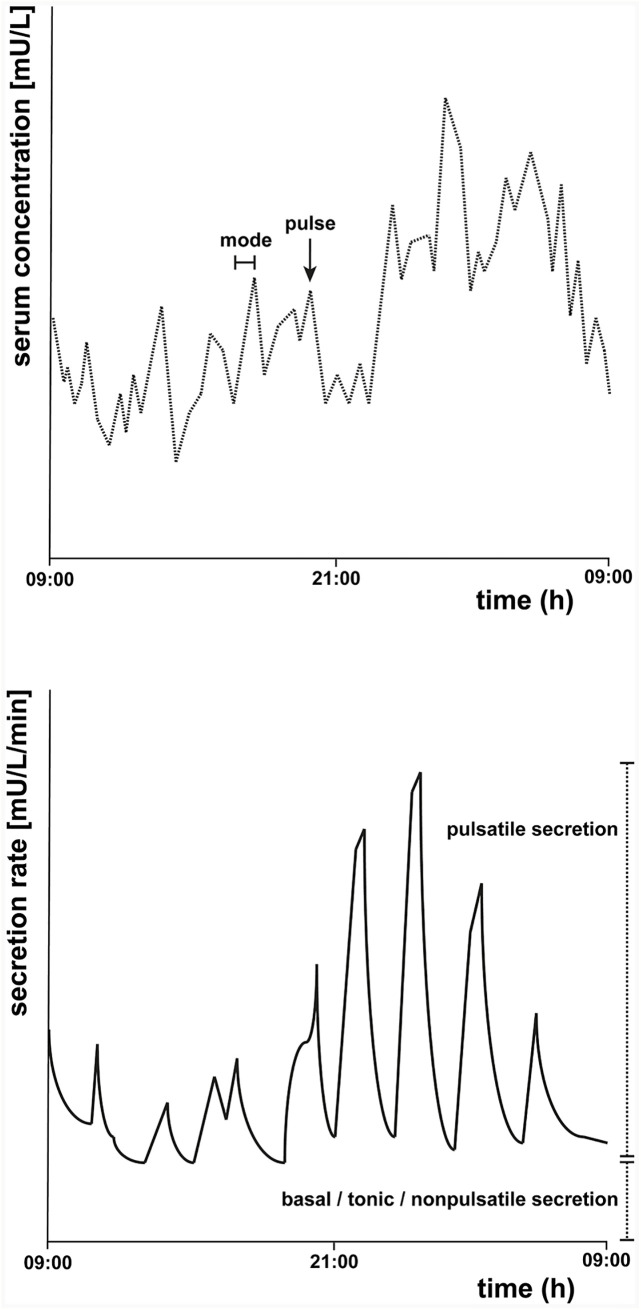
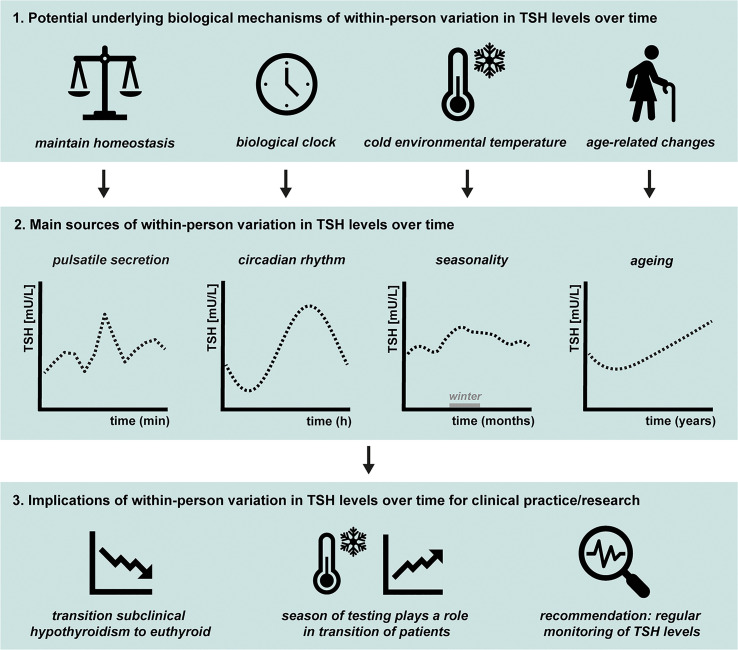
Individuals exhibit fluctuations in the concentration of serum thyroid-stimulating hormone (TSH) over time. The scale of these variations ranges from minutes to hours, and from months to years. The main factors contributing to the observed within-person fluctuations in serum TSH comprise pulsatile secretion, circadian rhythm, seasonality, and ageing. In clinical practice and clinical research however, such within-person biological variation in serum TSH concentrations is often not considered. The aim of this review is to present an overview of the main sources of within-person variation in TSH levels, as well as the potential underlying biological mechanisms, and the clinical implications.
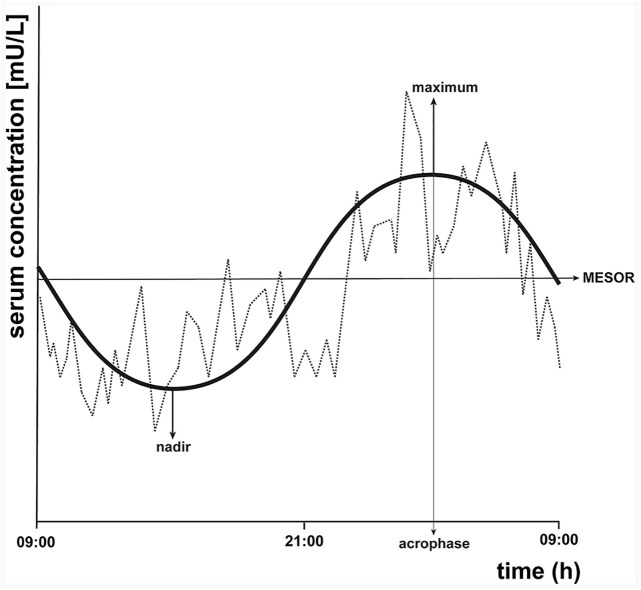
In euthyroid individuals, the circadian rhythm, with a nocturnal surge around 02:00-04:00 h and a nadir during daytime has the greatest impact on variations in serum TSH concentrations. Another source of within-person variation in TSH levels is seasonality, with generally higher levels during the cold winter months. Since TSH is secreted in a pulsatile manner, TSH levels also fluctuate over minutes. Furthermore, elevated TSH levels have been observed with ageing. Other factors that affect TSH levels include thyroid peroxidase (TPO)-antibody positivity, BMI, obesity, smoking, critical illness, and many xenobiotics, including environmental pollutants and drugs. Potential underlying biological mechanisms of within-person variation in TSH levels can be safely concluded from the ability of TSH to respond quickly to changes in cues from the internal or external environment in order to maintain homeostasis. Such cues include the biological clock, environmental temperature, and length of day. The observed increase in TSH level with ageing can be explained at a population level and at an organism level. In clinical practice, the season for thyroid testing can influence a patient's test result and it occurs frequently that subclinical hypothyroid patients normalize to euthyroid levels over time without intervention.
Serum TSH concentrations vary over time within an individual, which is caused by multiple different internal and external factors. It is important to take the within-person variations in serum TSH concentrations into account when testing a patient in clinical practice, but also in performing clinical research.
个体的血清促甲状腺激素(TSH)浓度随时间而波动。这些变化的幅度从分钟到小时,从几个月到几年不等。导致血清 TSH 个体内波动的主要因素包括脉冲分泌、昼夜节律、季节性和衰老。然而,在临床实践和临床研究中,通常不考虑血清 TSH 浓度的个体内这种生物学变化。本综述的目的是介绍 TSH 水平个体内变异的主要来源概述,以及潜在的生物学机制和临床意义。
在甲状腺功能正常的个体中,昼夜节律对血清 TSH 浓度的变化影响最大,夜间 02:00-04:00 时出现峰值,白天时达到最低点。TSH 水平个体内变异的另一个来源是季节性,一般在寒冷的冬季月份水平较高。由于 TSH 呈脉冲式分泌,因此 TSH 水平也会在几分钟内波动。此外,随着年龄的增长,TSH 水平也会升高。其他影响 TSH 水平的因素包括甲状腺过氧化物酶(TPO)抗体阳性、BMI、肥胖、吸烟、重病和许多外源性物质,包括环境污染物和药物。可以从 TSH 能够快速响应内部或外部环境变化的线索以维持体内平衡的能力中安全地推断出 TSH 个体内变化的潜在生物学机制。这些线索包括生物钟、环境温度和白昼长度。在人群水平和个体水平上可以解释年龄增长导致的 TSH 水平升高。在临床实践中,甲状腺检测的季节会影响患者的检测结果,并且经常会出现亚临床甲状腺功能减退患者随时间推移无需干预即可恢复到甲状腺功能正常水平。
个体的血清 TSH 浓度随时间而变化,这是由多种不同的内部和外部因素引起的。在临床实践中检测患者时,以及进行临床研究时,考虑到血清 TSH 浓度的个体内变化非常重要。