Guo Jiongchao, Chen Min, Hong Yu, Huang Yating, Zhang Haiyan, Zhou Yuan, Zhou Bingfeng, Fu Minmin
Department of Cardiology, The Third Affiliated Hospital of Anhui Medical University (The First People's Hospital of Hefei), Hefei, Anhui, 230000, People's Republic of China.
Graduate School, Anhui Medical University, Hefei, Anhui, 230000, People's Republic of China.
J Inflamm Res. 2023 Oct 16;16:4541-4557. doi: 10.2147/JIR.S425663. eCollection 2023.
Neutrophil to high-density lipoprotein cholesterol ratio (NHR) has demonstrated predictive value for coronary artery disease (CAD). However, few research has been conducted on the predictive capacity of NHR for Major Adverse Cardiovascular Events (MACE) following Percutaneous Coronary Intervention (PCI) or the degree of coronary artery stenosis in hospitalized ST-segment elevation myocardial infarction (STEMI) patients.
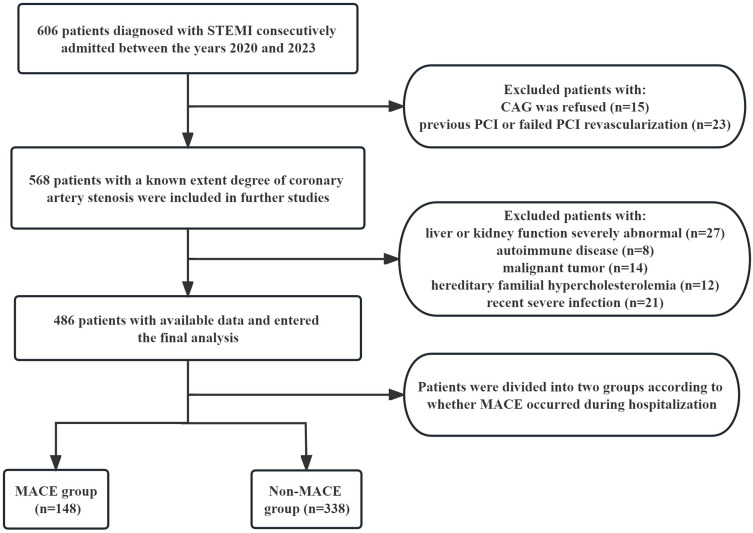
The study involved 486 patients diagnosed with STEMI between the years 2020 and 2023. Univariate and multivariate logistic regression analyses were conducted to evaluate the risk factors for MACE after PCI and severe coronary artery stenosis during hospitalization. Receiver operating characteristic (ROC) curves were generated to determine predictive power of NHR and MHR. Spearman correlation analysis was performed to assess the correlation between NHR, MHR and the Gensini score (GS).
Multivariate logistic regression analysis showed that the NHR and MHR were the independent risk factor for MACE during hospitalization in STEMI patients (MHR: the odds ratio (OR)=2.347, 95% confidence interval (CI)=1.082-5.089, =0.031) (NHR: OR=1.092, 95% CI=1.025-1.165, =0.004). In addition, NHR was also an independent risk factor for high GS (NHR: OR=1.103, 95% CI=1.047-1.162, <0.001), and the MHR was not an independent risk factor. The ROC curve analysis was performed to evaluate the predictive ability of NHR and MHR for in-hospital MACE in STEMI patients after primary PCI. The area under the curve (AUC) for NHR was 0.681. The AUC for MHR was 0.672. Regarding the prediction of high GS, the AUC for NHR was 0.649. The AUC for MHR was 0.587. Spearman correlation analysis showed that NHR exhibited stronger correlation with GS, while MHR was lower (NHR: r=0.291, P<0.001) (MHR: r=0.156, P<0.001).
These findings highlight the potential clinical utility of NHR as a predictive indicator in STEMI patients after PCI during hospitalization, both for MACE events and the degree of coronary artery stenosis.
中性粒细胞与高密度脂蛋白胆固醇比值(NHR)已被证明对冠状动脉疾病(CAD)具有预测价值。然而,关于NHR对经皮冠状动脉介入治疗(PCI)后主要不良心血管事件(MACE)的预测能力或住院ST段抬高型心肌梗死(STEMI)患者冠状动脉狭窄程度的研究较少。
该研究纳入了2020年至2023年间诊断为STEMI的486例患者。进行单因素和多因素逻辑回归分析,以评估PCI后MACE和住院期间严重冠状动脉狭窄的危险因素。绘制受试者工作特征(ROC)曲线,以确定NHR和MHR的预测能力。进行Spearman相关性分析,以评估NHR、MHR与Gensini评分(GS)之间的相关性。
多因素逻辑回归分析显示,NHR和MHR是STEMI患者住院期间MACE的独立危险因素(MHR:比值比(OR)=2.347,95%置信区间(CI)=1.082 - 5.089,P = 0.031)(NHR:OR = 1.092,95% CI = 1.025 - 1.165,P = 0.004)。此外,NHR也是高GS的独立危险因素(NHR:OR = 1.103,95% CI = 1.047 - 1.162,P < 0.001),而MHR不是独立危险因素。进行ROC曲线分析,以评估NHR和MHR对直接PCI后STEMI患者院内MACE的预测能力。NHR的曲线下面积(AUC)为0.681。MHR的AUC为0.672。关于高GS的预测,NHR的AUC为0.649。MHR的AUC为0.587。Spearman相关性分析显示,NHR与GS的相关性更强,而MHR较低(NHR:r = 0.291,P < 0.001)(MHR:r = 0.156,P < 0.001)。
这些发现突出了NHR作为STEMI患者PCI后住院期间MACE事件和冠状动脉狭窄程度预测指标的潜在临床应用价值。