Li Jiaqi, Du Dan, Zhang Jianwei, Liu Wenjie, Wang Junyou, Wei Xin, Xue Li, Li Xiaoxue, Diao Ping, Zhang Lei, Jiang Xian
Department of Dermatology, West China Hospital, Sichuan University, Chengdu, China.
Laboratory of Dermatology, Frontiers Science Center for Disease-related Molecular Network, West China Hospital, Clinical Institute of Inflammation and Immunology, Sichuan University, Chengdu, China.
Front Med (Lausanne). 2023 Oct 6;10:1255704. doi: 10.3389/fmed.2023.1255704. eCollection 2023.
The management of acne requires the consideration of its severity; however, a universally adopted evaluation system for clinical practice is lacking. Artificial intelligence (AI) evaluation systems hold the promise of enhancing the efficiency and reproducibility of assessments. Artificial intelligence (AI) evaluation systems offer the potential to enhance the efficiency and reproducibility of assessments in this domain. While the identification of skin lesions represents a crucial component of acne evaluation, existing AI systems often overlook lesion identification or fail to integrate it with severity assessment. This study aimed to develop an AI-powered acne grading system and compare its performance with physician image-based scoring.
A total of 1,501 acne patients were included in the study, and standardized pictures were obtained using the VISIA system. The initial evaluation involved 40 stratified sampled frontal photos assessed by seven dermatologists. Subsequently, the three doctors with the highest inter-rater agreement annotated the remaining 1,461 images, which served as the dataset for the development of the AI system. The dataset was randomly divided into two groups: 276 images were allocated for training the acne lesion identification platform, and 1,185 images were used to assess the severity of acne.
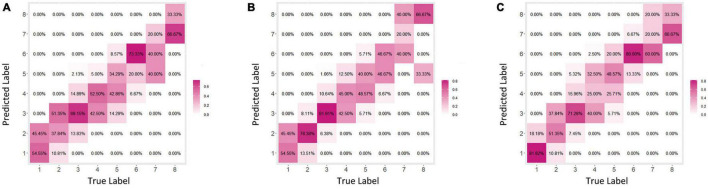
The average precision of our model for skin lesion identification was 0.507 and the average recall was 0.775. The AI severity grading system achieved good agreement with the true label (linear weighted kappa = 0.652). After integrating the lesion identification results into the severity assessment with fixed weights and learnable weights, the kappa rose to 0.737 and 0.696, respectively, and the entire evaluation on a Linux workstation with a Tesla K40m GPU took less than 0.1s per picture.
This study developed a system that detects various types of acne lesions and correlates them well with acne severity grading, and the good accuracy and efficiency make this approach potentially an effective clinical decision support tool.
痤疮的管理需要考虑其严重程度;然而,目前缺乏一个在临床实践中被普遍采用的评估系统。人工智能(AI)评估系统有望提高评估的效率和可重复性。人工智能(AI)评估系统有潜力提高该领域评估的效率和可重复性。虽然皮肤病变的识别是痤疮评估的一个关键组成部分,但现有的人工智能系统往往忽视病变识别或未能将其与严重程度评估相结合。本研究旨在开发一种基于人工智能的痤疮分级系统,并将其性能与医生基于图像的评分进行比较。
共有1501名痤疮患者纳入本研究,使用VISIA系统获取标准化图片。初始评估包括由七名皮肤科医生评估的40张分层抽样的正面照片。随后,三名评分者间一致性最高的医生对其余1461张图像进行注释,这些图像用作开发人工智能系统的数据集。数据集被随机分为两组:276张图像用于训练痤疮病变识别平台,1185张图像用于评估痤疮的严重程度。
我们的皮肤病变识别模型的平均精度为0.507,平均召回率为0.775。人工智能严重程度分级系统与真实标签达成了良好的一致性(线性加权kappa = 0.652)。在将病变识别结果以固定权重和可学习权重整合到严重程度评估中后,kappa分别升至0.737和0.696,在配备Tesla K40m GPU的Linux工作站上对每张图片的整个评估耗时不到0.1秒。
本研究开发了一种能够检测各种类型痤疮病变并将其与痤疮严重程度分级良好关联的系统,良好的准确性和效率使该方法有可能成为一种有效的临床决策支持工具。