Hu Tie, Yu Wen-Peng, Zou Hua-Xi, Chai Zhi-Hao, Le Shu-Yu, Hu Fa-Jia, Wang Yi-Cheng, Huang Huang, Lai Song-Qing, Liu Ji-Chun
Department of Cardiovascular Surgery, The Second Affiliated Hospital of Nanchang University, Nanchang, Jiangxi 330006, P.R. China.
Institute of Cardiovascular Surgical Diseases, Jiangxi Academy of Clinical Medical Sciences, The First Affiliated Hospital of Nanchang University, Nanchang, Jiangxi 330006, P.R. China.
Exp Ther Med. 2023 Sep 28;26(5):534. doi: 10.3892/etm.2023.12233. eCollection 2023 Nov.
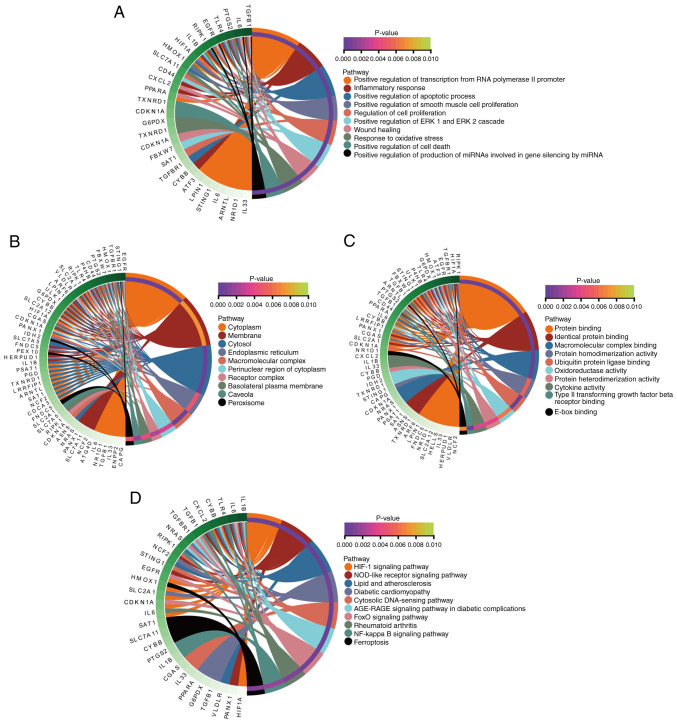
Acute myocardial infarction is a life-threatening condition with high mortality and complication rates. Although myocardial reperfusion can preserve ischemic myocardial tissue, it frequently exacerbates tissue injury, a phenomenon known as ischemia-reperfusion injury (IRI). However, the underlying pathological mechanisms of IRI remain to be completely understood. Ferroptosis is a novel type of regulated cell death that is associated with various pathological conditions, including angiocardiopathy. The purpose of this article was to elucidate the possible mechanistic role of ferroptosis in IRI through bioinformatics analysis and experimental validation. Healthy and IRI heart samples were screened for differentially expressed ferroptosis-related genes and functional enrichment analysis was performed to determine the potential crosstalk and pathways involved. A protein-protein interaction network was established for IRI, and 10 hub genes that regulate ferroptosis, including , , , and were identified. vitro, an anoxia/reoxygenation (A/R) injury model was established using H9c2 cardiomyoblasts to validate the bioinformatics analysis results, and extensive ferroptosis was detected. A total of 4 key hub genes and 3 key miRNAs were also validated. It was found that IRI was related to the aberrant infiltration of immune cells and the small-molecule drugs that may protect against IRI by preventing ferroptosis were identified. These results provide novel insights into the role of ferroptosis in IRI, which can help identify novel therapeutic targets.
急性心肌梗死是一种危及生命的疾病,死亡率和并发症发生率都很高。虽然心肌再灌注可以保护缺血心肌组织,但它常常会加剧组织损伤,这种现象被称为缺血再灌注损伤(IRI)。然而,IRI的潜在病理机制仍有待完全了解。铁死亡是一种新型的程序性细胞死亡,与包括心血管疾病在内的各种病理状况相关。本文的目的是通过生物信息学分析和实验验证来阐明铁死亡在IRI中可能的机制作用。对健康和IRI心脏样本进行筛选,以找出差异表达的铁死亡相关基因,并进行功能富集分析,以确定潜在的相互作用和涉及的通路。为IRI建立了蛋白质-蛋白质相互作用网络,并鉴定出10个调节铁死亡的枢纽基因,包括 、 、 和 。在体外,使用H9c2心肌成纤维细胞建立缺氧/复氧(A/R)损伤模型以验证生物信息学分析结果,并检测到广泛的铁死亡。还验证了总共4个关键枢纽基因和3个关键miRNA。研究发现,IRI与免疫细胞的异常浸润有关,并鉴定出了可能通过预防铁死亡来保护免受IRI影响的小分子药物。这些结果为铁死亡在IRI中的作用提供了新的见解,有助于识别新的治疗靶点。