Galib Roisul Hasan, Tian Yanpei, Lei Yue, Dang Saichao, Li Xiaole, Yudhanto Arief, Lubineau Gilles, Gan Qiaoqiang
Department of Electrical Engineering, University at Buffalo, The State University of New York, Buffalo, NY, 14260, USA.
Division of Physical Science and Engineering, King Abdullah University of Science and Technology (KAUST), Thuwal, 23955-6900, Saudi Arabia.
Nat Commun. 2023 Oct 23;14(1):6707. doi: 10.1038/s41467-023-42548-0.
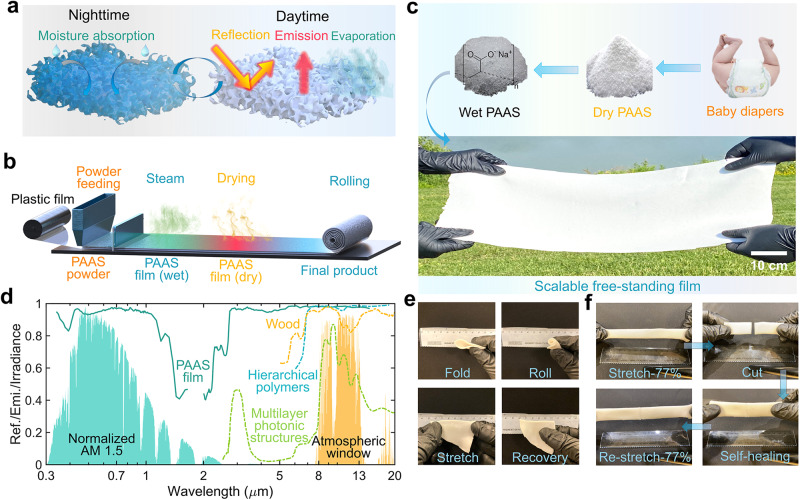
Heat stress is being exacerbated by global warming, jeopardizing human and social sustainability. As a result, reliable and energy-efficient cooling methods are highly sought-after. Here, we report a polyacrylate film fabricated by self-moisture-absorbing hygroscopic hydrogel for efficient hybrid passive cooling. Using one of the lowest-cost industrial materials (e.g., sodium polyacrylate), we demonstrate radiative cooling by reducing solar heating with high solar reflectance (0.93) while maximizing thermal emission with high mid-infrared emittance (0.99). Importantly, the manufacturing process utilizes only atmospheric moisture and requires no additional chemicals or energy consumption, making it a completely green process. Under sunlight illumination of 800 W m, the surface temperature of the film was reduced by 5 °C under a partly cloudy sky observed at Buffalo, NY. Combined with its hygroscopic feature, this film can simultaneously introduce evaporative cooling that is independent of access to the clear sky. The hybrid passive cooling approach is projected to decrease global carbon emissions by 118.4 billion kg/year compared to current air-conditioning facilities powered by electricity. Given its low-cost raw materials and excellent molding feature, the film can be manufactured through simple and cost-effective roll-to-roll processes, making it suitable for future building construction and personal thermal management needs.
全球变暖正在加剧热应激,危及人类和社会的可持续发展。因此,可靠且节能的冷却方法备受追捧。在此,我们报道了一种由自吸湿吸湿水凝胶制备的聚丙烯酸酯薄膜,用于高效混合被动冷却。我们使用成本最低的工业材料之一(如聚丙烯酸钠),通过具有高太阳反射率(0.93)来减少太阳加热,同时以高中红外发射率(0.99)最大化热发射,从而展示辐射冷却。重要的是,制造过程仅利用大气中的水分,无需额外的化学物质或能源消耗,使其成为完全绿色的过程。在纽约州布法罗观测到的部分多云天空下,在800 W m的阳光照射下,该薄膜的表面温度降低了5°C。结合其吸湿特性,这种薄膜可以同时引入与晴朗天空无关的蒸发冷却。与目前由电力驱动的空调设施相比,这种混合被动冷却方法预计每年可减少全球碳排放量1184亿千克。鉴于其低成本的原材料和出色的成型特性,该薄膜可以通过简单且经济高效的卷对卷工艺制造,使其适用于未来的建筑施工和个人热管理需求。