Wilkinson Jack, Heal Calvin, Antoniou George A, Flemyng Ella, Alfirevic Zarko, Avenell Alison, Barbour Virginia, Brown Nicholas J L, Carlisle John, Clarke Mike, Dicker Patrick, Dumville Jo, Grey Andrew, Grohmann Steph, Gurrin Lyle C, Hayden Jill A, Heathers James, Hunter Kylie E, Lasserson Toby, Lam Emily, Lensen Sarah, Li Tianjing, Li Wentao, Loder Elizabeth, Lundh Andreas, Meyerowitz-Katz Gideon, Mol Ben W, O' Connell Neil E, Parker Lisa, Redman Barbara K, Seidler Anna Lene, Sheldrick Kyle A, Sydenham Emma, Torgerson David J, van Wely Madelon, Wang Rui, Bero Lisa, Kirkham Jamie J
Centre for Biostatistics, The University of Manchester, Manchester Academic Health Science Centre, Manchester, UK.
Manchester Vascular Centre, Manchester University NHS Foundation Trust, Manchester, UK.
medRxiv. 2023 Nov 13:2023.09.21.23295626. doi: 10.1101/2023.09.21.23295626.
Randomised controlled trials (RCTs) inform healthcare decisions. It is now apparent that some published RCTs contain false data and some appear to have been entirely fabricated. Systematic reviews are performed to identify and synthesise all RCTs that have been conducted on a given topic. While it is usual to assess methodological features of the RCTs in the process of undertaking a systematic review, it is not usual to consider whether the RCTs contain false data. Studies containing false data therefore go unnoticed and contribute to systematic review conclusions. The INSPECT-SR project will develop a tool to assess the trustworthiness of RCTs in systematic reviews of healthcare related interventions.
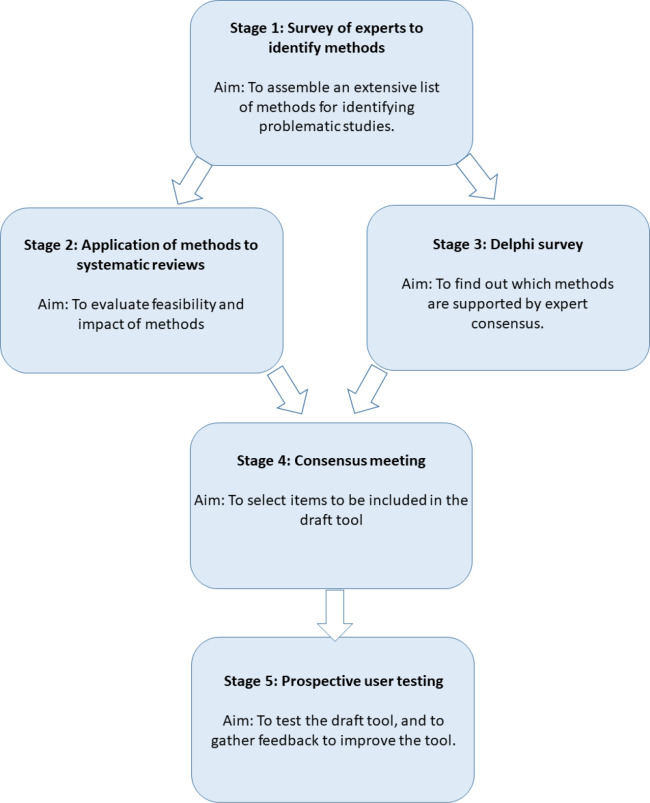
The INSPECT-SR tool will be developed using expert consensus in combination with empirical evidence, over five stages: 1) a survey of experts to assemble a comprehensive list of checks for detecting problematic RCTs, 2) an evaluation of the feasibility and impact of applying the checks to systematic reviews, 3) a Delphi survey to determine which of the checks are supported by expert consensus, culminating in 4) a consensus meeting to select checks to be included in a draft tool and to determine its format, 5) prospective testing of the draft tool in the production of new health systematic reviews, to allow refinement based on user feedback. We anticipate that the INSPECT-SR tool will help researchers to identify problematic studies, and will help patients by protecting them from the influence of false data on their healthcare.
随机对照试验(RCT)为医疗决策提供依据。现在很明显,一些已发表的随机对照试验包含虚假数据,有些似乎完全是编造的。进行系统评价是为了识别和综合针对某一特定主题所开展的所有随机对照试验。虽然在进行系统评价的过程中通常会评估随机对照试验的方法学特征,但通常不会考虑这些随机对照试验是否包含虚假数据。因此,包含虚假数据的研究未被发现,并对系统评价的结论产生影响。INSPECT-SR项目将开发一种工具,用于评估在医疗相关干预措施的系统评价中随机对照试验的可信度。
INSPECT-SR工具将通过专家共识结合实证证据分五个阶段开发:1)对专家进行调查,以汇编一份用于检测有问题随机对照试验的全面检查清单;2)评估将这些检查应用于系统评价的可行性和影响;3)进行德尔菲调查,以确定哪些检查得到专家共识的支持,最终在4)一次共识会议上选择纳入工具草案的检查项目并确定其格式;5)在新的卫生系统评价中对工具草案进行前瞻性测试,以便根据用户反馈进行完善。我们预计,INSPECT-SR工具将帮助研究人员识别有问题的研究,并通过保护患者免受虚假数据对其医疗保健的影响来帮助患者。