Ozdemir Hizir, Sagris Dimitrios, Abdul-Rahim Azmil Husin, Lip Gregory Yoke Hong, Shantsila Eduard
Liverpool Centre for Cardiovascular Science at University of Liverpool, Liverpool John Moores University and Liverpool Heart & Chest Hospital, Liverpool, UK.
Department of Internal Medicine, School of Health Sciences, Faculty of Medicine, University of Thessaly, Larissa, Greece.
Intern Emerg Med. 2024 Apr;19(3):609-618. doi: 10.1007/s11739-023-03445-y. Epub 2023 Oct 24.
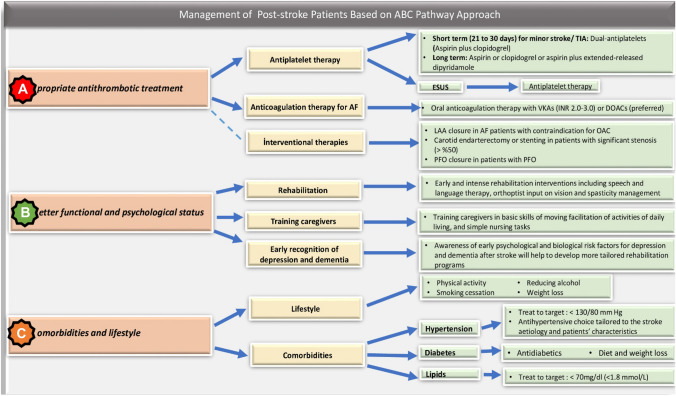
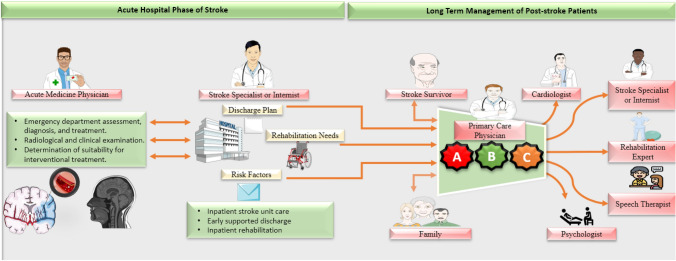
The management of ischaemic stroke survivors is multidisciplinary, necessitating the collaboration of numerous medical professionals and rehabilitation specialists. However, due to the lack of comprehensive and holistic follow-up, their post-discharge management may be suboptimal. Achieving this holistic, patient-centred follow-up requires coordination and interaction of subspecialties, which general practitioners can provide as the first point of contact in healthcare systems. This approach can improve the management of stroke survivors by preventing recurrent stroke through an integrated post-stroke care, including appropriate Antithrombotic therapy, assisting them to have a Better functional and physiological status, early recognition and intervention of Comorbidities, and lifestyles. For such work to succeed, close interdisciplinary collaboration between primary care physicians and other medical specialists is required in a holistic or integrated way.
缺血性中风幸存者的管理是多学科的,需要众多医学专业人员和康复专家的协作。然而,由于缺乏全面和整体的随访,他们出院后的管理可能并不理想。实现这种以患者为中心的整体随访需要各亚专业之间的协调与互动,而全科医生作为医疗系统中的第一接触点可以提供这种协调与互动。这种方法可以通过综合的中风后护理来改善中风幸存者的管理,包括适当的抗血栓治疗,预防复发性中风,帮助他们获得更好的功能和生理状态,早期识别和干预合并症,以及改善生活方式。要使这项工作取得成功,初级保健医生和其他医学专家需要以整体或综合的方式进行密切的跨学科协作。