Parmanne Piitu, Laajava Joonas, Järvinen Noora, Harju Terttu, Marttunen Mauri, Saloheimo Pertti
Finnish Medical Association, Helsinki, Finland.
University of Helsinki, Helsinki, Finland.
Res Integr Peer Rev. 2023 Oct 24;8(1):14. doi: 10.1186/s41073-023-00140-6.
There is a power imbalance between authors and reviewers in single-blind peer review. We explored how switching from single-blind to double-blind peer review affected 1) the willingness of experts to review, 2) their publication recommendations, and 3) the quality of review reports.
The Finnish Medical Journal switched from single-blind to double-blind peer review in September 2017. The proportion of review invitations that resulted in a received review report was counted. The reviewers' recommendations of "accept as is", "minor revision", "major revision" or "reject" were explored. The content of the reviews was assessed by two experienced reviewers using the Review Quality Instrument modified to apply to both original research and review manuscripts. The study material comprised reviews submitted from September 2017 to February 2018. The controls were the reviews submitted between September 2015 and February 2016 and between September 2016 and February 2017. The reviewers' recommendations and the scorings of quality assessments were tested with the Chi square test, and the means of quality assessments with the independent-samples t test.
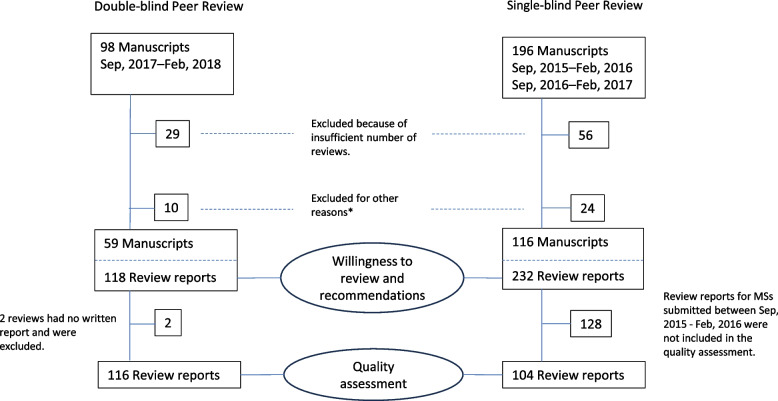
A total of 118 double-blind first-round reviews of 59 manuscripts were compared with 232 single-blind first-round reviews of 116 manuscripts. The proportion of successful review invitations when reviewing single-blinded was 67%, and when reviewing double-blinded, 66%. When reviewing double-blinded, the reviewers recommended accept as is or minor revision less often than during the control period (59% vs. 73%), and major revision or rejection more often (41% vs 27%, P = 0.010). For the quality assessment, 116 reviews from the double-blind period were compared with 104 reviews conducted between September 2016 and February 2017. On a 1-5 scale (1 poor, 5 excellent), double-blind reviews received higher overall proportion of ratings of 4 and 5 than single-blind reviews (56% vs. 49%, P < 0.001). Means for the overall quality of double-blind reviews were 3.38 (IQR, 3.33-3.44) vs. 3.22 (3.17-3.28; P < 0.001) for single-blind reviews.
The quality of the reviews conducted double-blind was better than of those conducted single-blind. Switching to double-blind review did not alter the reviewers' willingness to review. The reviewers became slightly more critical.
在单盲同行评审中,作者与评审人员之间存在权力失衡。我们探讨了从单盲同行评审转变为双盲同行评审如何影响:1)专家参与评审的意愿;2)他们的发表建议;3)评审报告的质量。
《芬兰医学杂志》于2017年9月从单盲同行评审转变为双盲同行评审。统计了收到评审报告的评审邀请比例。探讨了评审人员“原样接受”“小修”“大修”或“拒稿”的建议。由两名经验丰富的评审人员使用经修改后适用于原创研究和综述稿件的评审质量工具对评审内容进行评估。研究材料包括2017年9月至2018年2月提交的评审意见。对照组为2015年9月至2016年2月以及2016年9月至2017年2月期间提交的评审意见。使用卡方检验对评审人员的建议和质量评估得分进行检验,使用独立样本t检验对质量评估均值进行检验。
共将59篇稿件的118份双盲第一轮评审与116篇稿件的232份单盲第一轮评审进行了比较。单盲评审时成功的评审邀请比例为67%,双盲评审时为66%。双盲评审时,评审人员建议“原样接受”或“小修”的情况比对照期更少(59%对73%),而建议“大修”或“拒稿”的情况更多(41%对27%,P = 0.010)。对于质量评估,将双盲期的116份评审与2016年9月至2017年2月期间进行的104份评审进行了比较。在1 - 5分制(1分差,5分优)中,双盲评审获得4分和5分的总体比例高于单盲评审(56%对49%,P < 0.001)。双盲评审的总体质量均值为3.38(四分位间距,3.33 - 3.44),单盲评审为3.22(3.17 - 3.28;P < 0.001)。
双盲评审的质量优于单盲评审。转向双盲评审并未改变评审人员参与评审的意愿。评审人员变得略微更加严格。