Milnes Sharyn L, Kerr Debra C, Hutchinson Ana, Simpson Nicholas B, Mantzaridis Yianni, Corke Charlie, Bailey Michael, Orford Neil R
University Hospital Geelong, Barwon Health, Geelong, Australia.
Institute for Healthcare Transformation, Centre for Quality and Patient Safety Research, School of Nursing and Midwifery, Deakin University, Geelong, Australia.
Crit Care Resusc. 2023 May 20;25(1):20-26. doi: 10.1016/j.ccrj.2023.04.005. eCollection 2023 Mar.
This article aims to examine the association between a shared decision-making (SDM) clinical communication training program and documentation of SDM for patients with life-limiting illness (LLI) admitted to intensive care.
This article used a prospective, longitudinal observational study in a tertiary intensive care unit (ICU). Outcomes included the proportion of patients with SDM documented on an institutional Goals of Care Form during hospital admission, as well as characteristics, outcomes, and factors associated with an SDM admission.
Clinical communication skills training (iValidate) and clinical support program are the intervention for this study.
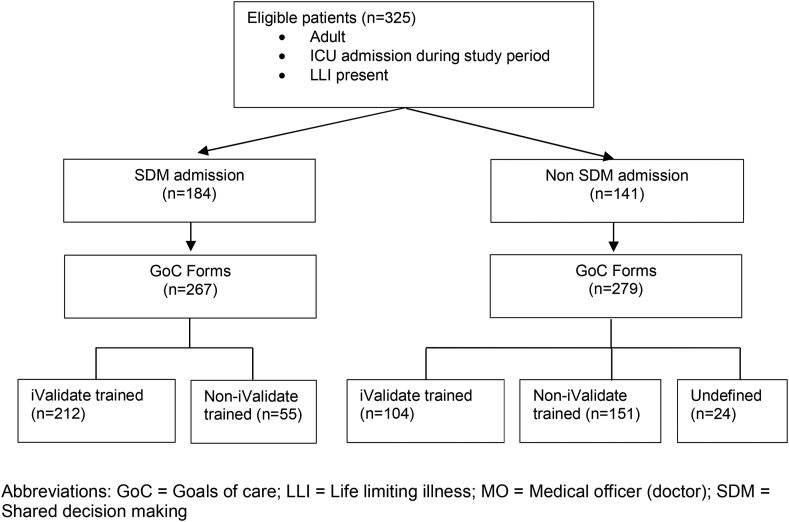
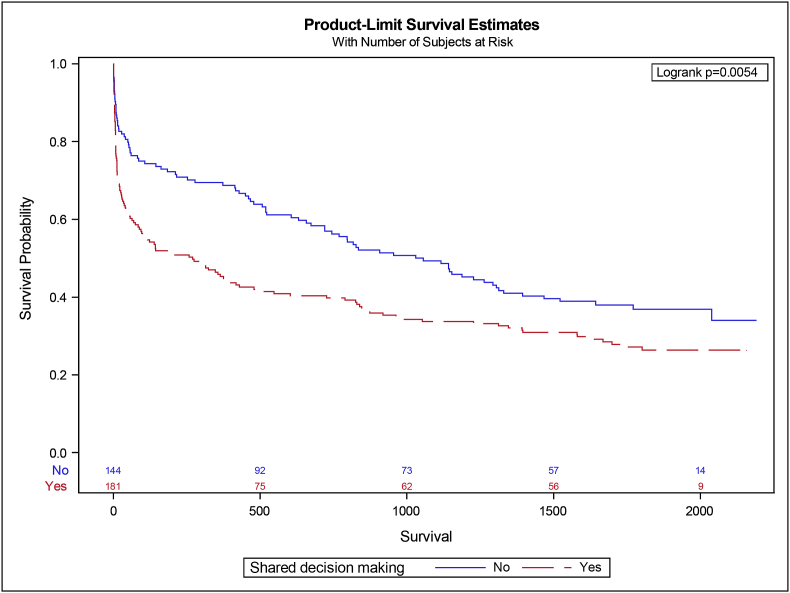
A total of 325 patients with LLI were admitted to the ICU and included in the study. Overall, 184 (57%) had an SDM admission, with 79% of Goals of Care Form completed by an iValidate-trained doctor. Exposure to an iValidate-trained doctor was the strongest predictor of an ICU patient with LLI having an SDM admission (odds ratio: 22.72, 95% confidence interval: 11.91-43.54, < 0.0001). A higher proportion of patients with an SDM admission selected high-dependency unit-level care (29% vs. 12%, < 0.001) and ward-based care (36% vs. 5%, p < 0.0001), with no difference in the proportion of patients choosing intensive care or palliative care. The proportion of patients with no deterioration plan was higher in the non-SDM admission cohort (59% vs. 0%, < 0.0001).
Clinical communication training that explicitly teaches identification of patient values is associated with improved documentation of SDM for critically ill patients with LLI. Understanding the relationship between improved SDM and patient, family, and clinical outcomes requires appropriately designed high-quality trials randomised at the patient or cluster level.
本文旨在研究共享决策(SDM)临床沟通培训项目与入住重症监护病房的临终疾病(LLI)患者的SDM记录之间的关联。
本文在一家三级重症监护病房(ICU)开展了一项前瞻性纵向观察研究。研究结果包括住院期间在机构护理目标表格上记录有SDM的患者比例,以及与SDM入院相关的特征、结果和因素。
临床沟通技能培训(iValidate)和临床支持项目是本研究的干预措施。
共有325例LLI患者入住ICU并纳入研究。总体而言,184例(57%)患者有SDM入院记录,其中79%的护理目标表格由接受过iValidate培训的医生填写。接触过接受iValidate培训的医生是LLI的ICU患者有SDM入院记录的最强预测因素(优势比:22.72,95%置信区间:11.91 - 43.54,<0.0001)。有SDM入院记录的患者中,选择高依赖病房护理的比例更高(29%对12%,<0.001),选择病房护理的比例也更高(36%对5%,p<0.0001),而选择重症监护或姑息治疗的患者比例没有差异。非SDM入院队列中没有恶化计划的患者比例更高(59%对0%,<0.0001)。
明确教授识别患者价值观的临床沟通培训与改善LLI重症患者的SDM记录相关。要理解改善SDM与患者、家属及临床结果之间的关系,需要在患者或群组层面进行适当设计的高质量随机试验。