Department of Internal Medicine III, University Hospital Regensburg, Regensburg, Germany.
Department of Otorhinolaryngology, University Hospital Regensburg, Regensburg, Germany.
J Immunother Cancer. 2023 Oct;11(10). doi: 10.1136/jitc-2023-007349.
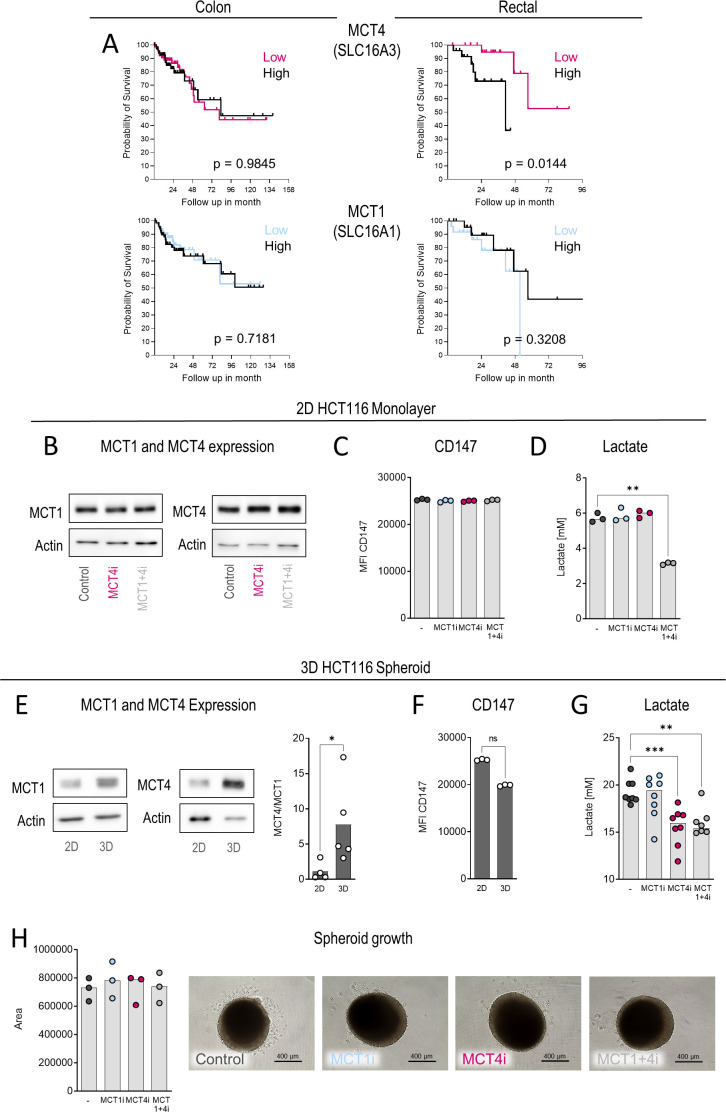
BACKGROUND & AIMS: Intratumoral lactate accumulation and acidosis impair T-cell function and antitumor immunity. Interestingly, expression of the lactate transporter monocarboxylate transporter (MCT) 4, but not MCT1, turned out to be prognostic for the survival of patients with rectal cancer, indicating that single MCT4 blockade might be a promising strategy to overcome glycolysis-related therapy resistance.
To determine whether blockade of MCT4 alone is sufficient to improve the efficacy of immune checkpoint blockade (ICB) therapy, we examined the effects of the selective MCT1 inhibitor AZD3965 and a novel MCT4 inhibitor in a colorectal carcinoma (CRC) tumor spheroid model co-cultured with blood leukocytes in vitro and the MC38 murine CRC model in vivo in combination with an antibody against programmed cell death ligand-1(PD-L1).
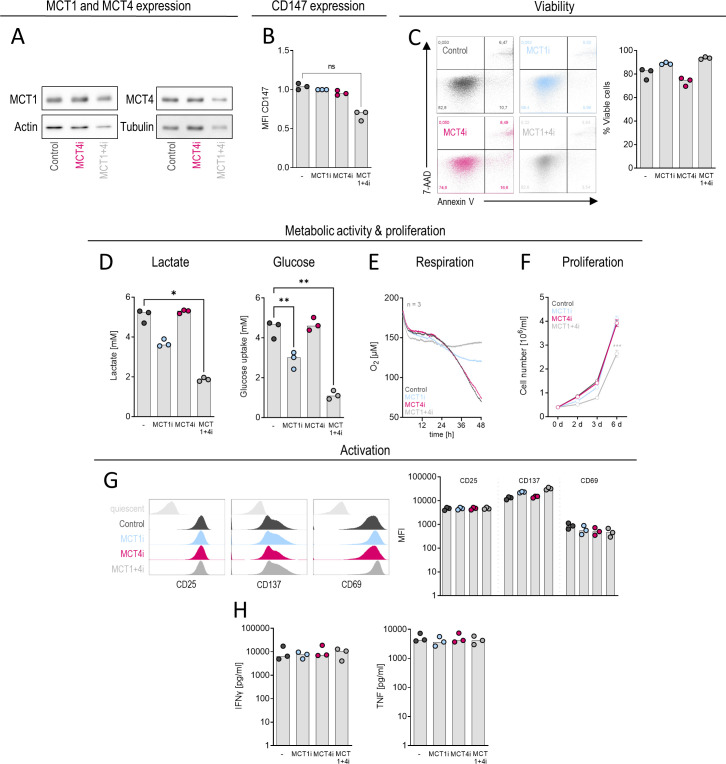
Inhibition of MCT4 was sufficient to reduce lactate efflux in three-dimensional (3D) CRC spheroids but not in two-dimensional cell-cultures. Co-administration of the MCT4 inhibitor and ICB augmented immune cell infiltration, T-cell function and decreased CRC spheroid viability in a 3D co-culture model of human CRC spheroids with blood leukocytes. Accordingly, combination of MCT4 and ICB increased intratumoral pH, improved leukocyte infiltration and T-cell activation, delayed tumor growth, and prolonged survival in vivo. MCT1 inhibition exerted no further beneficial impact.
These findings demonstrate that single MCT4 inhibition represents a novel therapeutic approach to reverse lactic-acid driven immunosuppression and might be suitable to improve ICB efficacy.
肿瘤内乳酸积累和酸中毒会损害 T 细胞功能和抗肿瘤免疫。有趣的是,单羧酸转运蛋白 4(MCT4)的表达而非 MCT1 的表达被证明与直肠癌患者的生存预后相关,这表明单一 MCT4 阻断可能是克服与糖酵解相关的治疗耐药的有前途的策略。
为了确定单独阻断 MCT4 是否足以提高免疫检查点阻断(ICB)治疗的疗效,我们在体外共培养的结直肠癌细胞(CRC)球体模型中和 MC38 小鼠 CRC 模型中检查了选择性 MCT1 抑制剂 AZD3965 和新型 MCT4 抑制剂与抗程序性死亡配体 1(PD-L1)抗体联合使用的效果。
在三维(3D)CRC 球体中,MCT4 的抑制足以减少乳酸外排,但在二维细胞培养中则不然。在人 CRC 球体与血液白细胞的三维共培养模型中,MCT4 抑制剂与 ICB 的联合使用可增加免疫细胞浸润、T 细胞功能并降低 CRC 球体的活力。因此,MCT4 和 ICB 的联合使用可增加肿瘤内 pH 值,改善白细胞浸润和 T 细胞激活,延迟肿瘤生长,并延长体内存活时间。MCT1 抑制则没有进一步的有益影响。
这些发现表明,单一 MCT4 抑制代表了一种逆转乳酸驱动免疫抑制的新治疗方法,可能适合提高 ICB 的疗效。