Chen Xianyan, Zhang Yingjie, Zhou Xiaojuan, Wang Min, Na Feifei, Zhou Lin, Xu Yong, Zou Bingwen, Xue Jianxin, Liu Yongmei, Gong Youling
Division of Thoracic Tumor Multidisciplinary Treatment, Cancer Center and State Key Laboratory of Biotherapy, West China Hospital, Sichuan University, Chengdu, China.
Physics Center, Cancer Center, West China Hospital, Sichuan University, Chengdu, China.
Front Oncol. 2023 Oct 10;13:1274924. doi: 10.3389/fonc.2023.1274924. eCollection 2023.
To compare the differences between involved-field irradiation (IFI) and elective nodal irradiation (ENI) in selecting the optimal target area for neoadjuvant chemoradiotherapy (nCRT) in patients with locally advanced esophageal squamous cell carcinoma (LA-ESCC).
We retrospectively analyzed 267 patients with LA-ESCC, of whom 165 underwent ENI and 102 underwent IFI. Dosimetry, treatment-related complications, pathological responses, recurrence/metastasis patterns, and survival were compared between the two groups.
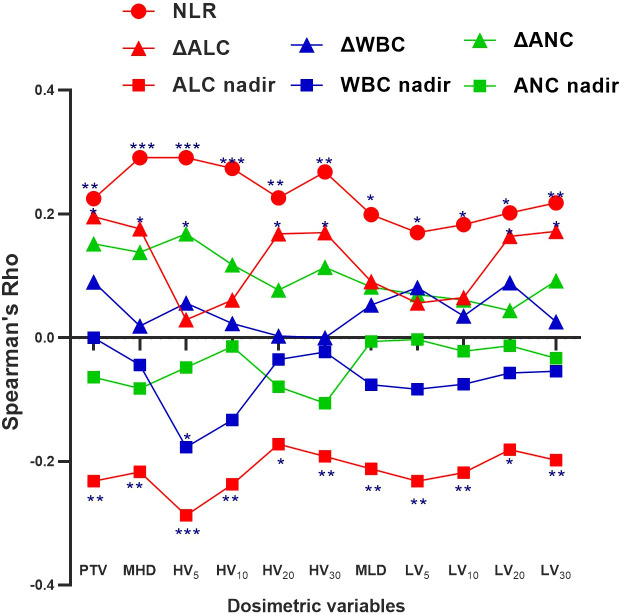
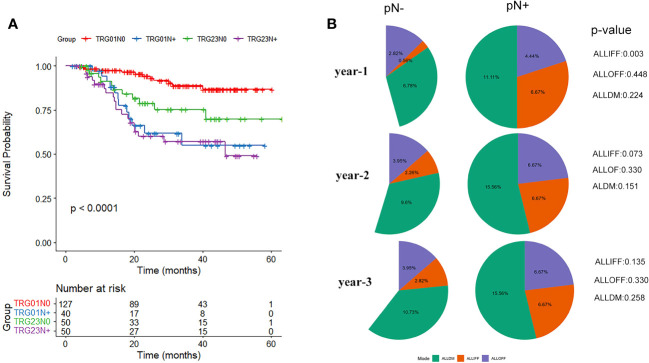
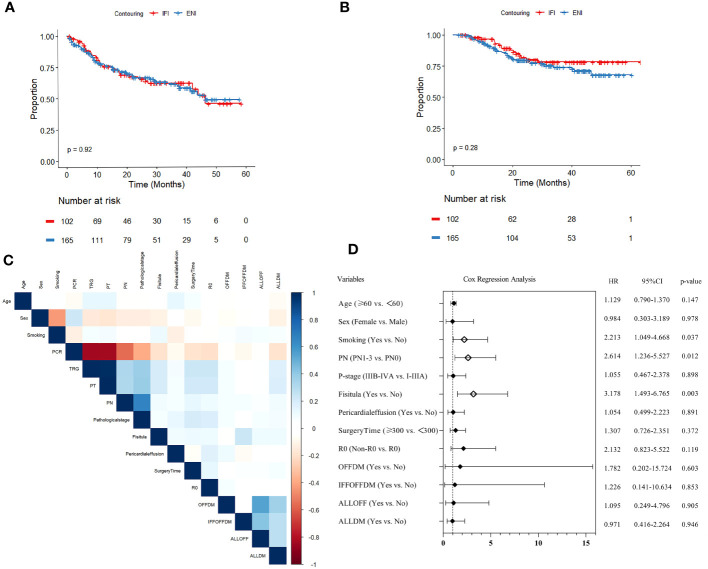
The median follow-up duration was 27.9 months. The R0 resection rates in the IFI and ENI groups were 95.1% and 92.7%, respectively (=0.441), while the pathological complete response (pCR) rates were 42.2% and 34.5%, respectively (=0.12). The ENI group received higher radiation doses to the heart (HV:23.9% . 18%, =0.033) and lungs (LV:7.7% 4.9%, <0.001) than the IFI group. Consequently, the ENI group showed a higher incidence of grade 2 or higher radiation pneumonitis (30.3% 17.6%, =0.004) and pericardial effusion (26.7% 11.8%, =0.021) than the IFI group. Post-operation fistulas were observed in 3 (2.9%) and 17 cases (10.3%) in the IFI and ENI groups, respectively (=0.026). In the multivariate analysis, smoking, positive lymph node involvement (pN+), and anastomotic fistula were independent predictors of overall survival (OS). The pN+ patients exhibited a greater propensity for recurrence compared to pN- patients, especially in the first year of follow-up (6.67% 0.56%, =0.003).
The ENI group had a higher incidence of radiation-induced adverse events compared to the IFI group, likely due to the higher radiation doses to normal tissues. Considering the similar disease-free survival (DFS) and OS rates in the two groups, IFI may be suitable for nCRT in patients with LA-ESCC, although further prospective studies are warranted.
比较累及野照射(IFI)和选择性淋巴结照射(ENI)在为局部晚期食管鳞状细胞癌(LA-ESCC)患者选择新辅助放化疗(nCRT)最佳靶区方面的差异。
我们回顾性分析了267例LA-ESCC患者,其中165例行ENI,102例行IFI。比较两组的剂量学、治疗相关并发症、病理反应、复发/转移模式及生存率。
中位随访时间为27.9个月。IFI组和ENI组的R0切除率分别为95.1%和92.7%(P=0.441),而病理完全缓解(pCR)率分别为42.2%和34.5%(P=0.12)。ENI组心脏接受的辐射剂量(高剂量体积:23.9%对18%,P=0.033)和肺部接受的辐射剂量(低剂量体积:7.7%对4.9%,P<0.001)高于IFI组。因此,ENI组2级或更高等级放射性肺炎(30.3%对17.6%,P=0.004)和心包积液(26.7%对11.8%,P=0.021)的发生率高于IFI组。IFI组和ENI组分别有3例(2.9%)和17例(10.3%)观察到术后瘘(P=0.026)。多因素分析中,吸烟、阳性淋巴结受累(pN+)和吻合口瘘是总生存(OS)的独立预测因素。与pN-患者相比,pN+患者复发倾向更大,尤其是在随访的第一年(6.67%对0.56%,P=0.003)。
与IFI组相比,ENI组辐射诱导不良事件的发生率更高可能是由于对正常组织的辐射剂量更高。考虑到两组相似无病生存(DFS)和OS率,IFI可能适用于LA-ESCC患者nCRT,但仍需进一步前瞻性研究。