Alqattan Zain Alabdain, Artiola Janick F, Walls Dan, Ramírez-Andreotta Mónica D
Department of Environmental Science, College of Agriculture and Life Sciences, University of Arizona, Tucson, AZ, USA.
Department of Science and Technology Studies, Rensselaer Polytechnic Institute, Troy, NY, USA.
Res Sq. 2023 Oct 12:rs.3.rs-3414584. doi: 10.21203/rs.3.rs-3414584/v1.
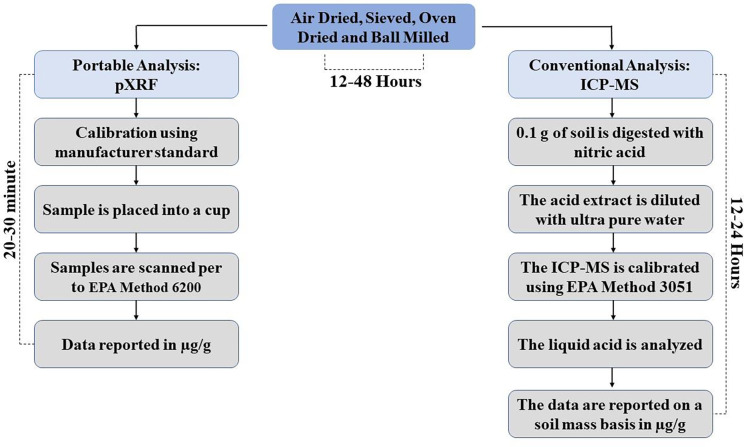
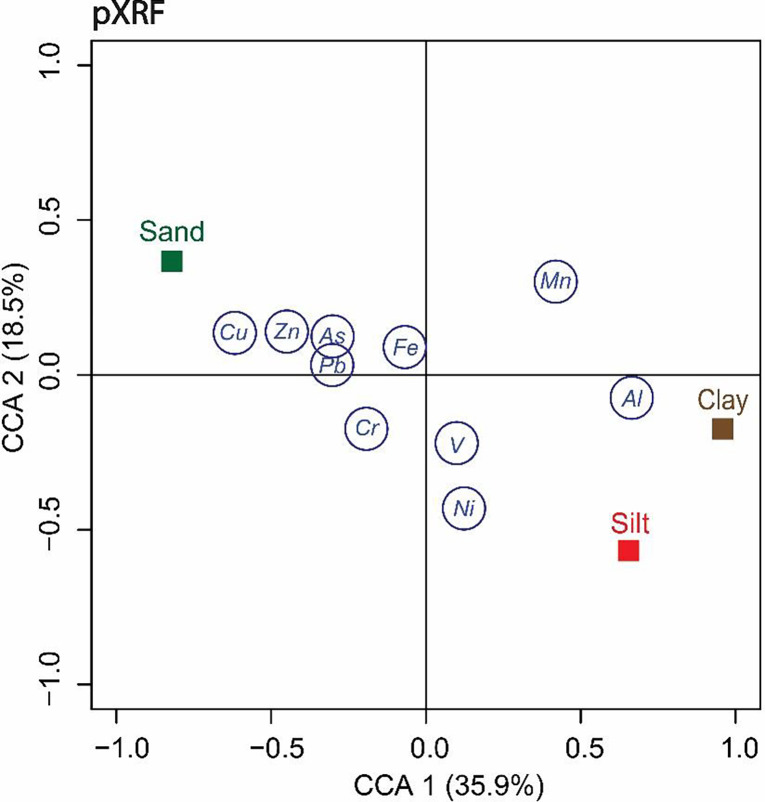
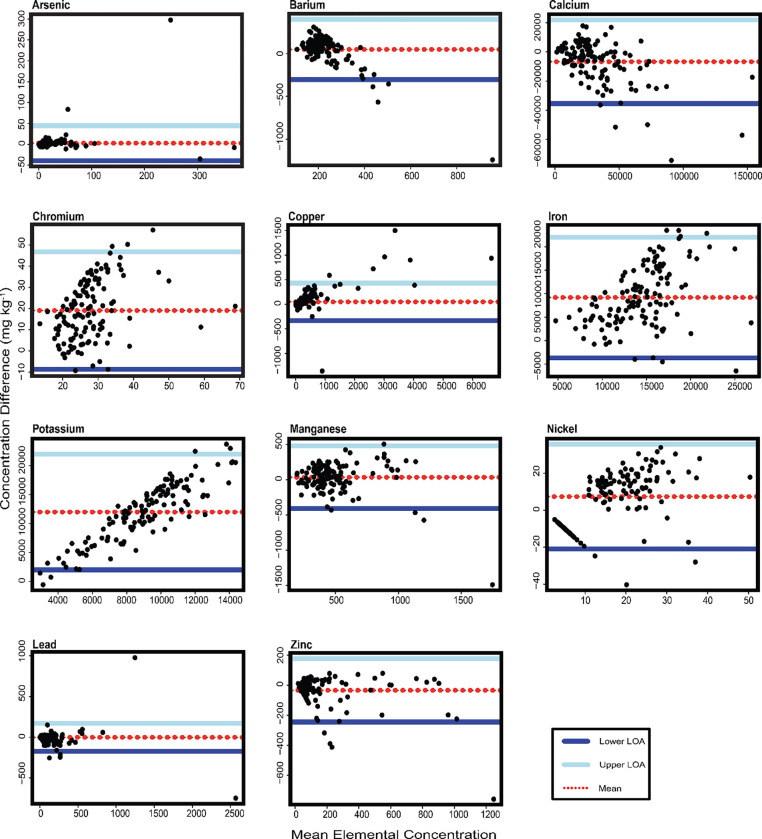
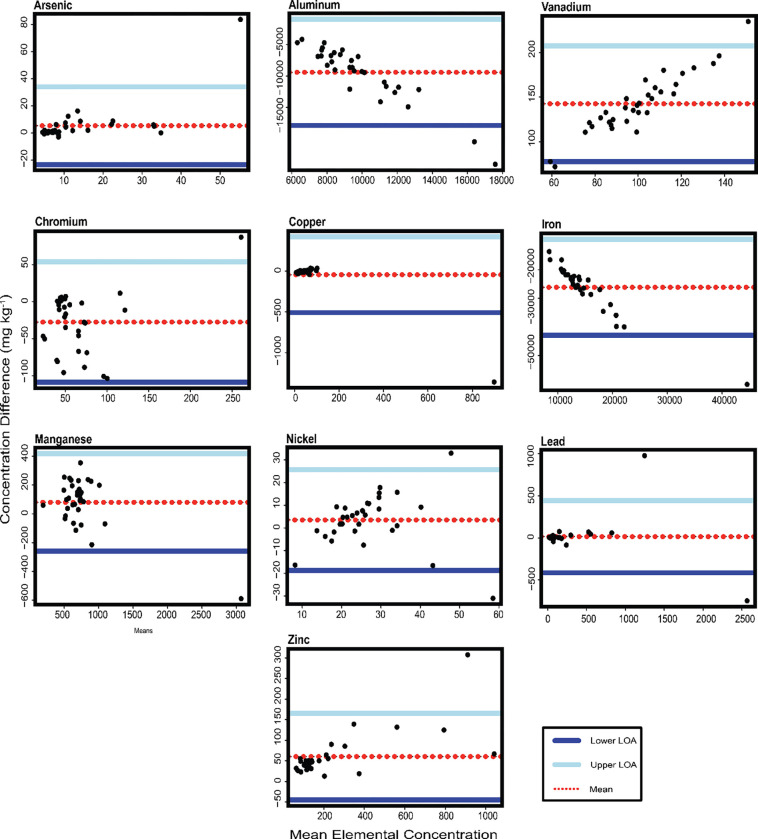
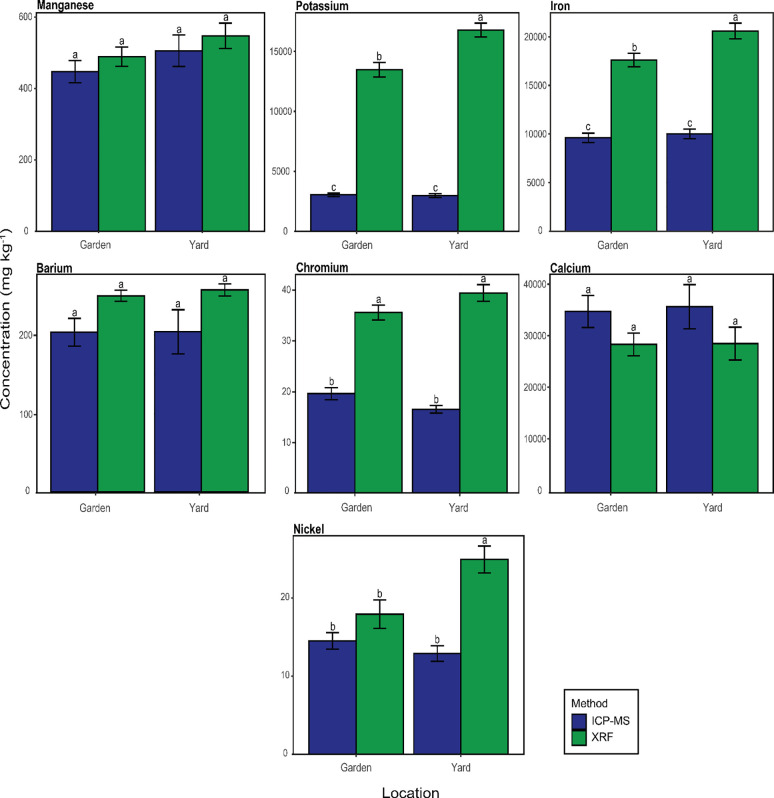
Environmental Justice (EJ) communities may experience barriers that can prevent soil monitoring efforts and knowledge transfer. To address this gap, this study compared two analytical methods: portable X-ray Fluorescence Spectroscopy (pXRF, less time and costs) and Inductively Coupled Plasma Mass Spectrometry (ICP-MS, "gold standard"). Surface soil samples were collected from yards and gardens in three counties in Arizona, USA (N=124) and public areas in Troy, New York, USA (N=33). Statistical calculations, i.e., two-sample t-tests, Bland-Altman plots, and a two-way ANOVA indicated no significant difference for As, Ba, Ca, Cu, Mn, Pb, and Zn concentrations except for Ba in the two-sample t-test. Iron, Ni, Cr, and K were statistically different for Arizona soils and V, Ni, Fe and Al concentrations were statistically different for New York soils. To assess the degree of contamination, a pollution load index (PLI), enrichment factors (EF), and geo-accumulation index () were calculated for both methods using U.S. Geological Survey soils data. The PLI were >1, indicating pollution across the two states. Between pXRF and ICP-MS, the and EF in Arizona had similar degree of soil contamination for most elements except Zn in garden and Pb in yard, respectively. In New York, the of As, Cu, and Zn differed by an order of magnitude between the two methods. The results of this study demonstrate that pXRF is a reliable method for the inexpensive and rapid analysis of As, Ba, Ca, Cu, Mn, Pb, and Zn. Thus, EJ communities may use pXRF to screen large numbers of soil samples for several environmentally relevant contaminants to protect environmental public health.
环境正义(EJ)社区可能会遇到阻碍土壤监测工作和知识传播的障碍。为了填补这一空白,本研究比较了两种分析方法:便携式X射线荧光光谱法(pXRF,耗时少、成本低)和电感耦合等离子体质谱法(ICP-MS,“金标准”)。从美国亚利桑那州三个县的庭院和花园(N = 124)以及美国纽约州特洛伊市的公共区域(N = 33)采集了表层土壤样本。统计计算,即双样本t检验、布兰德 - 奥特曼图和双向方差分析表明,除双样本t检验中的钡元素外,砷、钡、钙、铜、锰、铅和锌的浓度没有显著差异。亚利桑那州土壤中的铁、镍、铬和钾在统计学上存在差异,纽约州土壤中的钒、镍、铁和铝浓度在统计学上存在差异。为了评估污染程度,使用美国地质调查局的土壤数据为两种方法计算了污染负荷指数(PLI)、富集因子(EF)和地累积指数()。PLI大于1,表明这两个州都存在污染。在pXRF和ICP-MS之间,亚利桑那州除花园中的锌元素和庭院中的铅元素外,大多数元素的地累积指数和富集因子的土壤污染程度相似。在纽约州,两种方法之间砷、铜和锌的地累积指数相差一个数量级。本研究结果表明,pXRF是一种可靠的方法,可用于廉价、快速地分析砷、钡、钙、铜、锰、铅和锌。因此,环境正义社区可以使用pXRF对大量土壤样本进行几种与环境相关污染物的筛查,以保护环境公共健康。