Abdel Moniem Hebatallah, Yao Zong Yang, Abdallah Alwasella, Chen Guo-Hong
Animal wealth development department, Faculty of veterinary medicine, Suez Canal University, Ismailia, 41611, Egypt.
Animal breeding and genetics department, Animal Science and Technology College, Yangzhou University, Yangzhou 225009, China.
Asian-Australas J Anim Sci. 2019 Nov 1;32(11):1664-1672. doi: 10.5713/ajas.18.0589. Epub 2019 Jan 2.
This study aimed to measure genetic diversity and to determine the relationships among fourteen goose breeds.
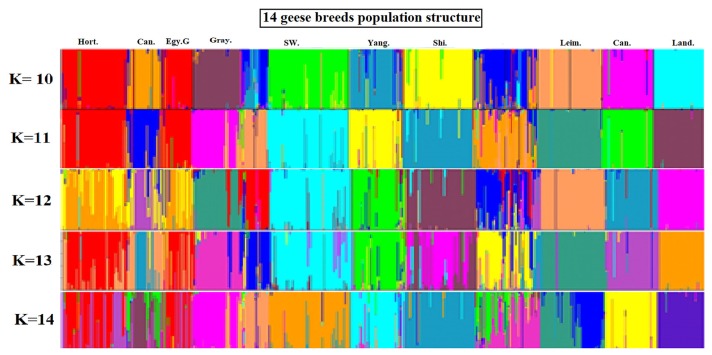
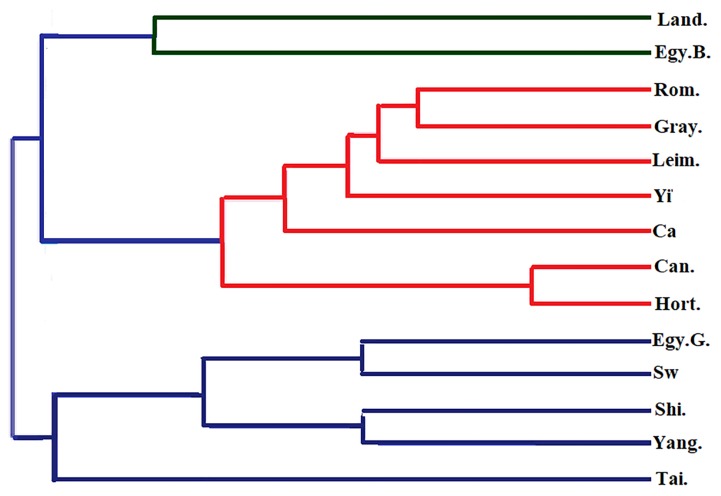
microsatellite markers were isolated from the genomic DNA of geese based on previous literature. The DNA segments, including short tandem repeats, were tested for their diversity among fourteen populations of geese. The diversity was tested on both breeds and loci level and by mean of unweighted pair group method with arithmetic mean (UPGMA) and structure program, phylogenetic tree and population structure were tested.
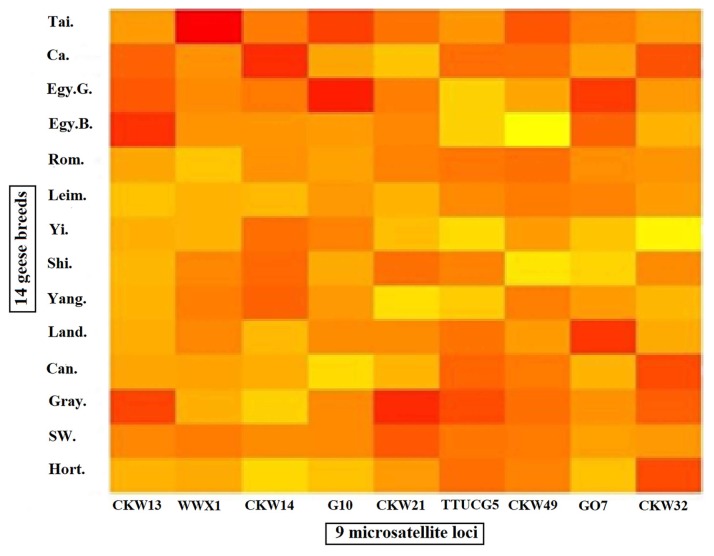
A total of 108 distinct alleles (1%) were observed across the fourteen breeds, with 36 out of the 108 alleles (33.2%) being unique to only one breed. Genetic parameters were measured per the 14 breeds and the 9 loci. Medium to high heterozygosity was reported with high effective numbers of alleles (Ne). Polymorphic Information Contents (PIC) of the screened loci was found to be highly polymorphic for eleven breeds; while 3 breeds were reported moderately polymorphic. Breeding coefficient (FIS) ranged from -0.033 to 0.358, and the pair wise genetic differentiation (FST) ranged from 0.01 to 0.36 across the fourteen breeds; for the 9 loci Ho, He and Ne were same as the breeds parameters, PIC of the screened loci reported 6 loci highly polymorphic and 3 loci to be medium polymorphic, and FIS ranged from -0.113 to 0.368. In addition, genetic distance estimate revealed a close genetic distance between Can. and Hort. breeds by 0.04, and the highest distance was between Tai. and Gray. breed by 0.54.
Cluster analyses were made, and they revealed that goose breeds had hybridized frequently, resulting in a loss of genetic distinctiveness for some breeds.
本研究旨在测量14个鹅品种的遗传多样性并确定它们之间的关系。
基于先前文献从鹅的基因组DNA中分离微卫星标记。对包括短串联重复序列在内的DNA片段在14个鹅种群中进行多样性检测。在品种和基因座水平上进行多样性检测,并通过算术平均非加权对组法(UPGMA)和结构程序进行分析,测试系统发育树和种群结构。
在14个品种中总共观察到108个不同的等位基因(1%),其中108个等位基因中的36个(33.2%)仅在一个品种中独特存在。针对14个品种和9个基因座测量了遗传参数。据报道,等位基因有效数(Ne)较高,杂合度从中等到高。发现筛选出的基因座的多态信息含量(PIC)对于11个品种具有高度多态性;而有3个品种被报道为中度多态。育种系数(FIS)范围为-0.033至0.358,14个品种间的成对遗传分化(FST)范围为0.01至0.36;对于9个基因座,观察杂合度(Ho)、期望杂合度(He)和等位基因有效数(Ne)与品种参数相同,筛选出的基因座的PIC显示6个基因座具有高度多态性,3个基因座为中度多态,FIS范围为-0.113至0.368。此外,遗传距离估计显示,加拿大鹅和霍顿鹅品种之间的遗传距离较近,为0.04,而最高距离是台湾鹅和灰鹅品种之间的,为0.54。
进行了聚类分析,结果显示鹅品种频繁杂交,导致一些品种的遗传独特性丧失。