Bolton David A E, Baggett Charlie C, Mitton Chase A, Harper Sara A, Richardson James K
Department of Kinesiology and Health Science, Utah State University, Logan, UT 84322, USA.
Sorenson Center for Clinical Excellence, Utah State University, Logan, UT 84322, USA.
Brain Sci. 2023 Oct 21;13(10):1488. doi: 10.3390/brainsci13101488.
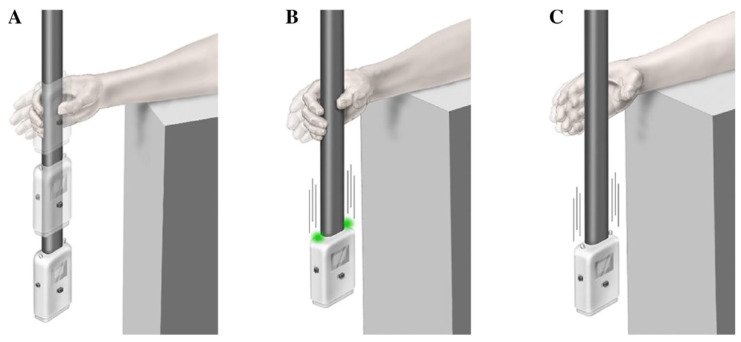
Stepping to recover balance is an important way we avoid falling. However, when faced with obstacles in the step path, we must adapt such reactions. Physical obstructions are typically detected through vision, which then cues step modification. The present study describes a novel method to assess visually prompted step inhibition in a reactive balance context. In our task, participants recovered balance by quickly stepping after being released from a supported forward lean. On rare trials, however, an obstacle blocked the stepping path. The timing of vision relative to postural perturbation was controlled using occlusion goggles to regulate task difficulty. Furthermore, we explored step suppression in our balance task related to inhibitory capacity measured at the hand using a clinically feasible handheld device (ReacStick). Our results showed that ReacStick and step outcomes were significantly correlated in terms of successful inhibition (r = 0.57) and overall reaction accuracy (r = 0.76). This study presents a novel method for assessing rapid inhibition in a dynamic postural context, a capacity that appears to be a necessary prerequisite to a subsequent adaptive strategy. Moreover, this capacity is significantly related to ReacStick performance, suggesting a potential clinical translation.
通过迈步来恢复平衡是我们避免摔倒的重要方式。然而,当在迈步路径中遇到障碍物时,我们必须调整这种反应。身体障碍物通常通过视觉检测到,然后视觉会提示对迈步进行调整。本研究描述了一种在反应性平衡情境中评估视觉提示的迈步抑制的新方法。在我们的任务中,参与者在从支撑的前倾姿势被释放后通过快速迈步来恢复平衡。然而,在极少数试验中,一个障碍物会阻挡迈步路径。使用遮挡护目镜控制视觉相对于姿势扰动的时间,以调节任务难度。此外,我们在平衡任务中探索了与使用临床可行的手持设备(反应棒)在手部测量的抑制能力相关的迈步抑制。我们的结果表明,在成功抑制(r = 0.57)和总体反应准确性(r = 0.76)方面,反应棒和迈步结果显著相关。本研究提出了一种在动态姿势情境中评估快速抑制的新方法,这种能力似乎是后续适应性策略的必要先决条件。此外,这种能力与反应棒性能显著相关,表明具有潜在的临床应用价值。