Vacca Mariacarolina, Spanetta Matteo, Ballesio Andrea, Fernandes Mariana, Placidi Fabio, Izzi Francesca, Lombardo Caterina, Mercuri Nicola Biagio, Laganà Giuseppina, Liguori Claudio
Department of Psychology, Sapienza University of Rome, 00185 Rome, Italy.
Santa M. Della Stella Hospital, 05018 Orvieto, Italy.
J Clin Med. 2023 Oct 11;12(20):6467. doi: 10.3390/jcm12206467.
Emotional impulsivity has been found to be relevant in explaining the association between sleep problems and depressive symptoms, suggesting the potential role of impulsivity as a key underlying mechanism of this link. The objective of this study was to take a preliminary step in understanding the mediating role of impulsivity in the relation between excessive daytime sleepiness (EDS) and depression in patients with obstructive sleep apnea syndrome (OSAS) and to compare psychological and demographic characteristics between different levels of daytime sleepiness.
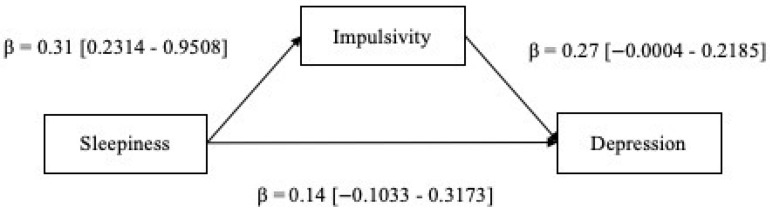
A total of 138 patients with OSAS underwent polygraphic cardiorespiratory monitoring and completed a series of questionnaires investigating perceived sleepiness, depression, impulsivity, and other psychological characteristics. A mediational model was tested in order to assess whether impulsivity mediated the relation between sleepiness and depressive symptoms while controlling for the effects of age, sex, BMI, and oxygen saturation parameters.
the mediation model showed that there was a significant indirect effect of impulsivity in the sleepiness-depression link (αβ = 0.084 [0.0243-0.1617]).
The here-presented results showed that the sleepiness-depression link is not direct as previous studies asserted, but instead it may be better explained by impulsivity. Research and practical implications are discussed.
研究发现情绪冲动在解释睡眠问题与抑郁症状之间的关联时具有相关性,这表明冲动性可能是该联系的关键潜在机制。本研究的目的是初步了解冲动性在阻塞性睡眠呼吸暂停综合征(OSAS)患者日间过度嗜睡(EDS)与抑郁之间关系中的中介作用,并比较不同程度日间嗜睡患者的心理和人口统计学特征。
共有138例OSAS患者接受了多导心肺监测,并完成了一系列问卷调查,以调查感知到的嗜睡、抑郁、冲动性及其他心理特征。测试了一个中介模型,以评估在控制年龄、性别、体重指数和血氧饱和度参数影响的同时,冲动性是否介导了嗜睡与抑郁症状之间的关系。
中介模型显示,冲动性在嗜睡-抑郁联系中存在显著的间接效应(αβ = 0.084 [0.0243 - 0.1617])。
本研究结果表明,嗜睡-抑郁联系并非如先前研究所断言的那样是直接的,而是可能更好地由冲动性来解释。文中讨论了研究和实际意义。