Barison Andrea, Ricci Fabrizio, Pavon Anna Giulia, Muscogiuri Giuseppe, Bisaccia Giandomenico, Camastra Giovanni, De Lazzari Manuel, Lanzillo Chiara, Raguso Mario, Monti Lorenzo, Vargiu Sara, Pedrotti Patrizia, Piacenti Marcello, Todiere Giancarlo, Pontone Gianluca, Indolfi Ciro, Dellegrottaglie Santo, Lombardi Massimo, Schwitter Juerg, Aquaro Giovanni Donato
Fondazione Toscana Gabriele Monasterio, 56127 Pisa, Italy.
Life Science Institute, Scuola Superiore Sant'Anna, 56127 Pisa, Italy.
J Clin Med. 2023 Oct 22;12(20):6673. doi: 10.3390/jcm12206673.
Most recent cardiac implantable electronic devices (CIEDs) can safely undergo a cardiovascular magnetic resonance (CMR) scan under certain conditions, but metal artifacts may degrade image quality. The aim of this study was to assess the overall diagnostic yield of CMR and the extent of metal artifacts in a multicenter, multivendor study on CIED patients referred for CMR.
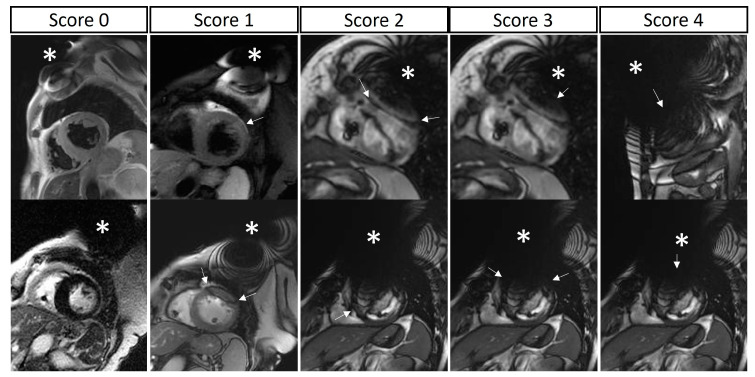
We analyzed 309 CMR scans from 292 patients (age 57 ± 16 years, 219 male) with an MR-conditional pacemaker ( = 122), defibrillator (n = 149), or loop recorder (n = 38); CMR scans were performed in 10 centers from 2012 to 2020; MR-unsafe implants were excluded. Clinical and device parameters were recorded before and after the CMR scan. A visual analysis of metal artifacts was performed for each sequence on a segmental basis, based on a 5-point artifact score.
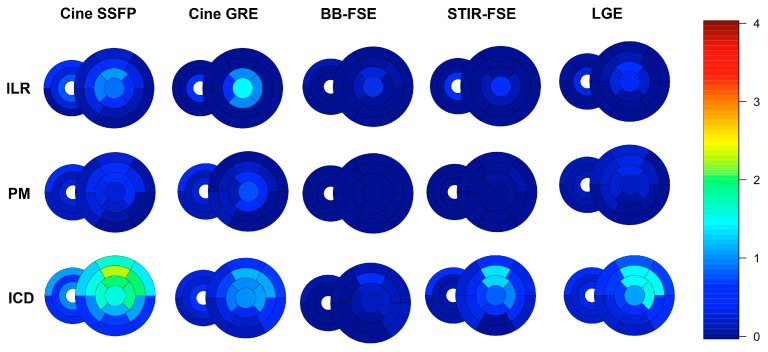
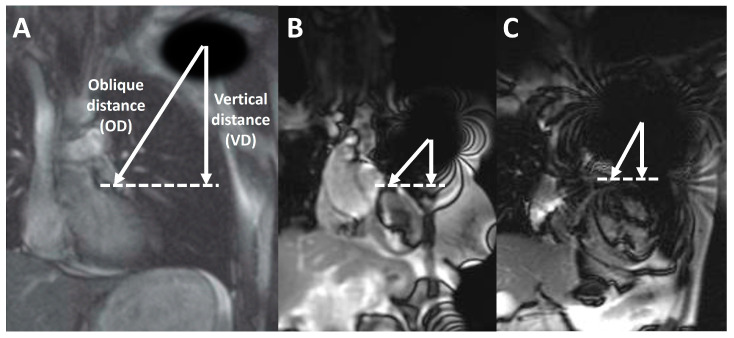
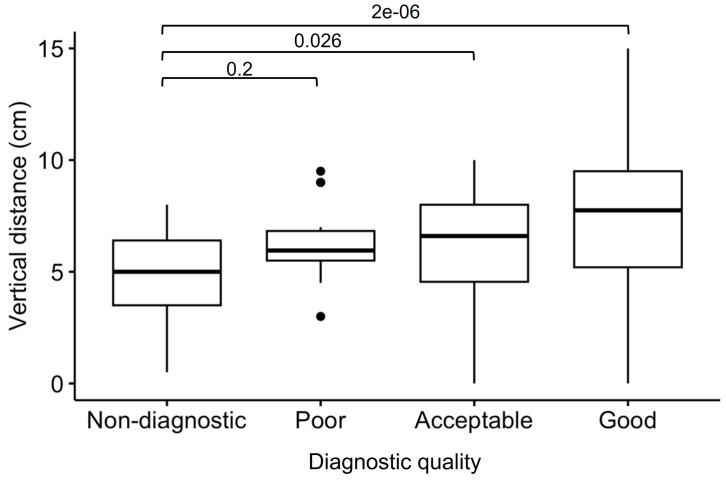
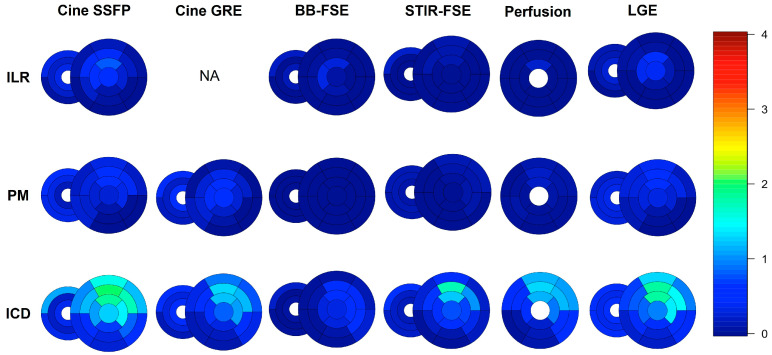
The vast majority of CMR scans (n = 255, 83%) were completely performed, while only 32 (10%) were interrupted soon after the first sequences and 22 (7%) were only partly acquired; CMR quality was non-diagnostic in 34 (11%) scans, poor (<1/3 sequences were diagnostic) in 25 (8%), or acceptable (1/3 to 2/3 sequences were diagnostic) in 40 (13%), while most scans (n = 201, 68%) were of overall good quality. No adverse event or device malfunctioning occurred, and only nonsignificant changes in device parameters were recorded. The most affected sequences were SSFP (median score 0.32 [interquartile range 0.07-0.91]), followed by GRE (0.18 [0.02-0.59]) and LGE (0.14 [0.02-0.55]). ICDs induced more artifacts (median score in SSFP images 0.87 [0.50-1.46]) than PMs (0.11 [0.03-0.28]) or ILRs (0.11 [0.00-0.56]). Moreover, most artifacts were located in the anterior, anteroseptal, anterolateral, and apical segments of the LV and in the outflow tract of the RV.
CMR is a versatile imaging technique, with a high safety profile and overall good image quality even in patients with MR-conditional CIEDs. Several strategies are now available to optimize image quality, substantially enhancing overall diagnostic yield.
大多数最新的心脏植入式电子设备(CIED)在某些条件下可安全地进行心血管磁共振(CMR)扫描,但金属伪影可能会降低图像质量。本研究的目的是在一项针对因CMR检查而转诊的CIED患者的多中心、多厂家研究中,评估CMR的总体诊断率以及金属伪影的程度。
我们分析了来自292例患者(年龄57±16岁,男性219例)的309次CMR扫描,这些患者植入了磁共振兼容起搏器(n = 122)、除颤器(n = 149)或环路记录器(n = 38);2012年至2020年期间在10个中心进行了CMR扫描;排除了磁共振不安全的植入物。在CMR扫描前后记录临床和设备参数。基于5分伪影评分,对每个序列按节段进行金属伪影的视觉分析。
绝大多数CMR扫描(n = 255,83%)完整完成,而只有32次(10%)在首个序列后不久中断,22次(7%)仅部分采集;34次(11%)扫描的CMR质量无法诊断,25次(8%)较差(<1/3序列可诊断),40次(13%)可接受(1/3至2/3序列可诊断),而大多数扫描(n = 201,68%)总体质量良好。未发生不良事件或设备故障,仅记录到设备参数的非显著性变化。受影响最严重的序列是稳态自由进动序列(SSFP,中位数评分0.32 [四分位间距0.07 - 0.91]),其次是梯度回波序列(GRE,0.18 [0.02 - 0.59])和延迟强化序列(LGE,0.14 [0.02 - 0.55])。植入式心脏除颤器(ICD)比起搏器(PM)或植入式环路记录器(ILR)产生更多伪影(SSFP图像中的中位数评分0.87 [0.50 - 1.46]对比0.11 [0.03 - 0.28]和0.11 [0.00 - 0.56])。此外,大多数伪影位于左心室的前壁、前间隔、前侧壁和心尖节段以及右心室流出道。
CMR是一种多功能成像技术,即使在植入磁共振兼容CIED的患者中也具有高安全性和总体良好的图像质量。现在有几种策略可用于优化图像质量,从而大幅提高总体诊断率。