Gao Xiangli, Xu Datao, Li Fengfeng, Baker Julien S, Li Jiao, Gu Yaodong
Faculty of Sports Science, Ningbo University, Ningbo 315211, China.
Faculty of Engineering, University of Pannonia, 8201 Veszprem, Hungary.
Bioengineering (Basel). 2023 Sep 25;10(10):1128. doi: 10.3390/bioengineering10101128.
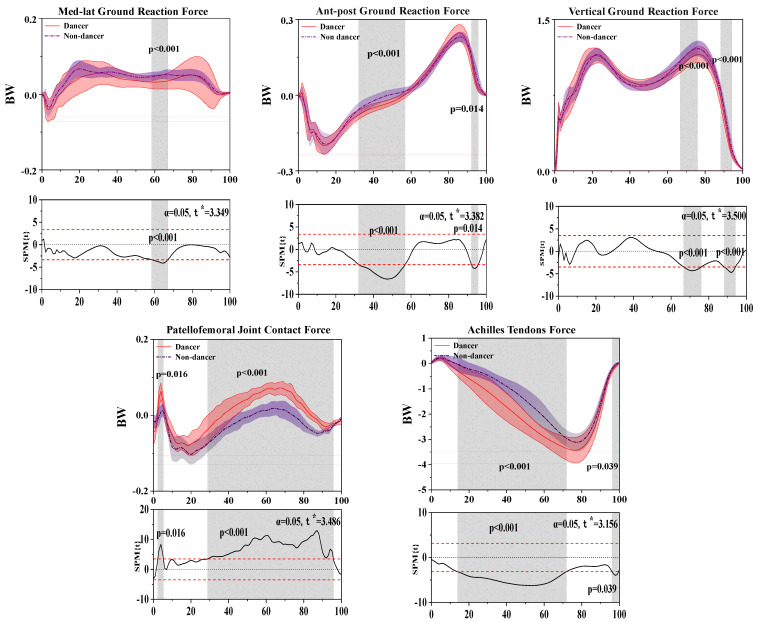
Latin dance involves fundamental walking steps, integral to the dance process. While resembling daily walking, Latin dance demands higher balance levels, necessitating body adjustments by dancers. These adaptations affect dancers' gait biomechanics, prompting our study on gait differences between Latin dancers (LDs) and non-dancers (NDs). We enlisted 21 female Latin dancers and 21 subjects based on specific criteria. Participants executed walking tasks, with an independent sample -test for 1-dimensional statistical parameter mapping (SPM 1d) analyzing stance phase variations between LDs and NDs. Notably, significant differences in ankle and hip external rotation were evident during the 16.43-29.47% ( = 0.015) and 86.35-100% ( = 0.014) stance phase. Moreover, pronounced distinctions in rectus Achilles tendon force (ATF) (12.83-13.10%, = 0.049; 15.89-80.19%, < 0.001) and Patellofemoral joint contact force (PTF) (15.85-18.31%, = 0.039; 21.14-24.71%, = 0.030) during stance were noted between LDs (Latin dancers) and NDs (Non-dancers). The study revealed dancers' enhanced balance attributed to external ankle rotation for dance stability, coupled with augmented Achilles tendon and patellofemoral joint strength from prolonged practice. Moreover, integrating suitable Latin dance into rehabilitation may benefit those with internal rotation gait issues.
拉丁舞包含基本的行走步伐,这是舞蹈过程不可或缺的一部分。虽然拉丁舞的行走步伐与日常行走相似,但它对平衡能力的要求更高,舞者需要对身体进行调整。这些调整会影响舞者的步态生物力学,促使我们对拉丁舞舞者(LDs)和非舞者(NDs)之间的步态差异展开研究。我们根据特定标准招募了21名女性拉丁舞舞者和21名受试者。参与者执行行走任务,采用一维统计参数映射(SPM 1d)的独立样本t检验来分析拉丁舞舞者和非舞者在站立期的差异。值得注意的是,在站立期的16.43 - 29.47%(p = 0.015)和86.35 - 100%(p = 0.014)阶段,踝关节和髋关节的外旋存在显著差异。此外,在站立期,拉丁舞舞者(LDs)和非舞者(NDs)之间的跟腱直肌力量(ATF)(12.83 - 13.10%,p = 0.049;15.89 - 80.19%,p < 0.001)和髌股关节接触力(PTF)(15.85 - 18.31%,p = 0.039;21.14 - 24.71%,p = 0.030)也存在明显差异。该研究表明,舞者通过外旋踝关节增强平衡以保持舞蹈稳定性,同时由于长期练习,跟腱和髌股关节力量增强。此外,将合适的拉丁舞融入康复训练可能会使那些存在内旋步态问题的人受益。