School of Pharmaceutical Sciences, Zhengzhou University, Zhengzhou 450001, China.
Laboratory of Synthetic Biology, School of Pharmaceutical Sciences, Zhengzhou University, Zhengzhou 450001, China.
Molecules. 2023 Oct 19;28(20):7173. doi: 10.3390/molecules28207173.
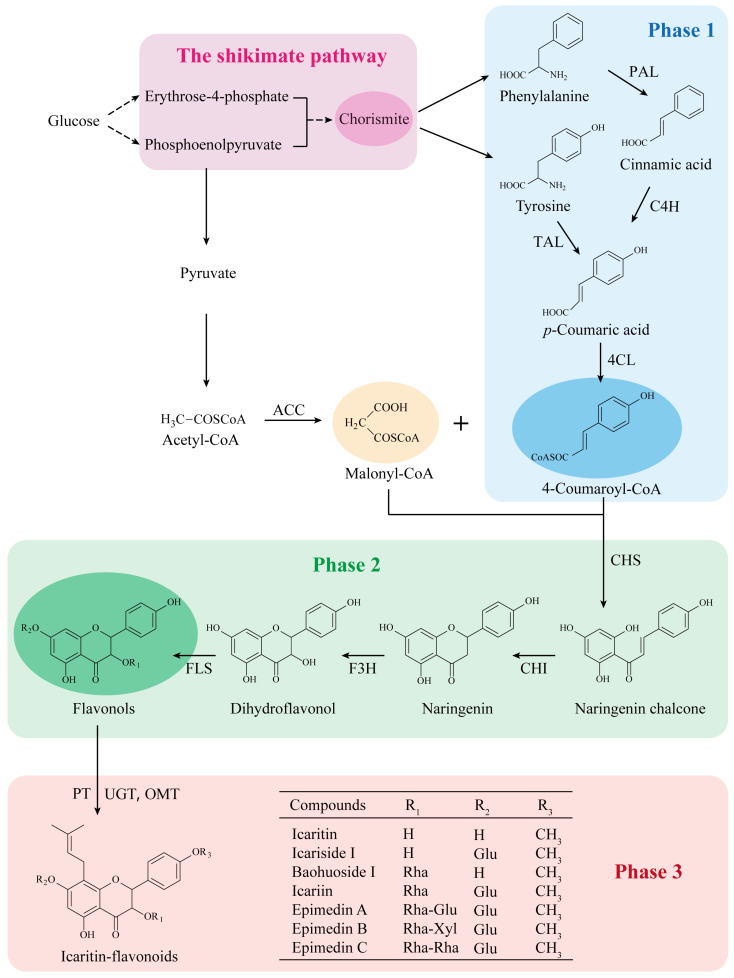
is a classical Chinese herbal medicine, which has been used extensively to treat various diseases, such as sexual dysfunction, osteoporosis, cancer, rheumatoid arthritis, and brain diseases. Flavonoids, such as icariin, baohuoside I, icaritin, and epimedin C, are the main active ingredients with diverse pharmacological activities. Currently, most flavonoids are extracted from plants, but this method cannot meet the increasing market demand. Biotransformation strategies promised huge potential for increasing the contents of high-value flavonoids, which would promote the full use of the herb. Complete biosynthesis of major flavonoids by microbial cell factories would enable industrial-scale production of flavonoids. This review summarizes the structures, pharmacological activities, and biosynthesis pathways in the plant, as well as the extraction methods of major flavonoids, and advancements in the biotransformation and complete microbial synthesis of flavonoids, which would provide valuable insights for future studies on herb usage and the production of flavonoids.
淫羊藿是一种经典的中草药,已被广泛用于治疗各种疾病,如性功能障碍、骨质疏松症、癌症、类风湿性关节炎和脑部疾病。黄酮类化合物,如淫羊藿苷、宝藿苷 I、朝藿定 C 和朝藿定 B,是具有多种药理活性的主要活性成分。目前,大多数黄酮类化合物是从植物中提取的,但这种方法无法满足日益增长的市场需求。生物转化策略有望通过提高高价值黄酮类化合物的含量来增加其潜力,从而促进该草药的充分利用。通过微生物细胞工厂来实现主要黄酮类化合物的全生物合成,将能够实现黄酮类化合物的工业规模生产。本文综述了淫羊藿中的黄酮类化合物的结构、药理活性和生物合成途径,以及主要黄酮类化合物的提取方法,以及黄酮类化合物的生物转化和全微生物合成的进展,这将为未来对淫羊藿的使用和黄酮类化合物的生产的研究提供有价值的见解。