Department of Experimental Biology and Biotechnology, Institute of Natural Sciences and Mathematics, Ural Federal University, Ekaterinburg 620002, Russia.
Int J Mol Sci. 2023 Oct 13;24(20):15129. doi: 10.3390/ijms242015129.
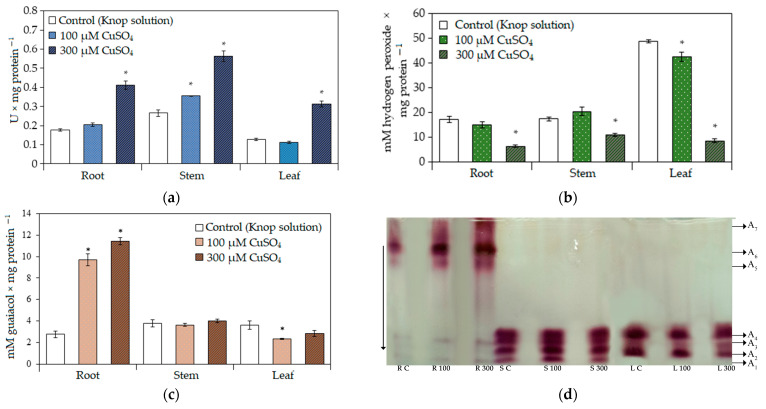
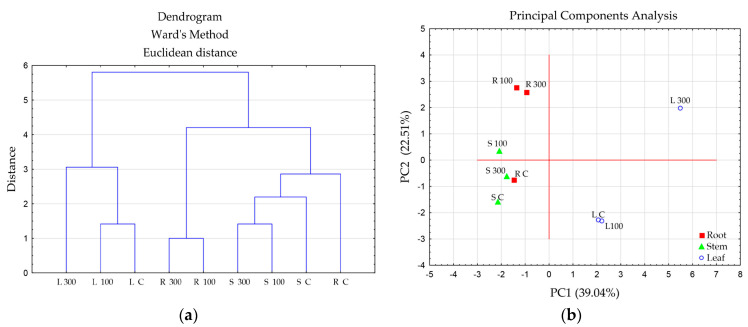
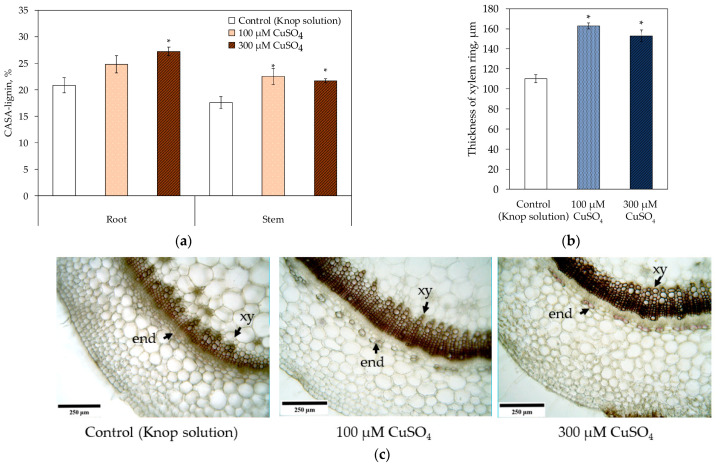
Metabolic changes under stress are often studied in short-term experiments, revealing rapid responses in gene expression, enzyme activity, and the amount of antioxidants. In a long-term experiment, it is possible to identify adaptive changes in both primary and secondary metabolism. In this study, we characterized the physiological state of tobacco plants and assessed the amount and spectrum of phenolic compounds and the lignification of axial organs under excess copper stress in a long-term experiment (40 days). Plants were treated with 100 and 300 μM CuSO, as well as a control (Knop solution). Copper accumulation, the size and anatomical structure of organs, stress markers, and the activity of antioxidant enzymes were studied. Lignin content was determined with the cysteine-assisted sulfuric method (CASA), and the metabolite profile and phenolic spectrum were determined with UHPLC-MS and thin-layer chromatography (TLC). Cu mainly accumulated in the roots and, to a lesser extent, in the shoots. Copper sulfate (100 μM) slightly stimulated stem and leaf growth. A higher concentration (300 μM) caused oxidative stress; HO content, superoxide dismutase (SOD), and guaiacol peroxidase (GPOX) activity increased in roots, and malondialdehyde (MDA) increased in all organs. The deposition of lignin increased in the roots and stems compared with the control. The content of free phenolics, which could be used as substrates for lignification, declined. The proportions of ferulic, cinnamic, and -coumaric acids in the hydrolysate of bound phenolics were higher, and they tended toward additional lignification. The metabolic profile changed in both roots and stems at both concentrations, and changed in leaves only at a concentration of 300 μM. Thus, changes in the phenolic spectrum and the enhanced lignification of cell walls in the metaxylem of axial (root and stem) organs in tobacco can be considered important metabolic responses to stress caused by excess CuSO.
在应激下的代谢变化通常在短期实验中进行研究,揭示了基因表达、酶活性和抗氧化剂数量的快速响应。在长期实验中,可以识别主要和次要代谢中的适应性变化。在这项研究中,我们描述了烟草植物的生理状态,并评估了在过量铜胁迫下(40 天)长期实验中轴向器官的酚类化合物的数量和光谱以及木质化程度。用 100 和 300 μM 的 CuSO4 以及对照(Knop 溶液)处理植物。研究了铜积累、器官的大小和解剖结构、应激标志物以及抗氧化酶的活性。用半胱氨酸辅助硫酸法(CASA)测定木质素含量,用 UHPLC-MS 和薄层色谱(TLC)测定代谢物谱和酚类光谱。铜主要积累在根中,在一定程度上也积累在茎中。硫酸铜(100 μM)轻微刺激茎和叶的生长。较高浓度(300 μM)引起氧化应激;根中 HO 含量、超氧化物歧化酶(SOD)和愈创木酚过氧化物酶(GPOX)活性增加,所有器官中丙二醛(MDA)增加。与对照相比,根和茎中的木质素沉积增加。可作为木质化底物的游离酚类含量下降。结合酚水解产物中阿魏酸、肉桂酸和 -香豆酸的比例较高,并且倾向于额外的木质化。两种浓度下,根和茎的代谢谱都发生了变化,而仅在 300 μM 浓度下,叶片发生了变化。因此,烟草轴向(根和茎)器官木质部中酚类光谱的变化和细胞壁的增强木质化可以被认为是对过量 CuSO4 引起的应激的重要代谢反应。