Institute for Multidisciplinary Research, Department of Life Science, University of Belgrade, Kneza Višeslava 1, 11030 Belgrade, Serbia.
Department of Analytical Chemistry, Faculty of Chemistry, University of Belgrade, 11158 Belgrade, Serbia.
Int J Mol Sci. 2023 Oct 19;24(20):15350. doi: 10.3390/ijms242015350.
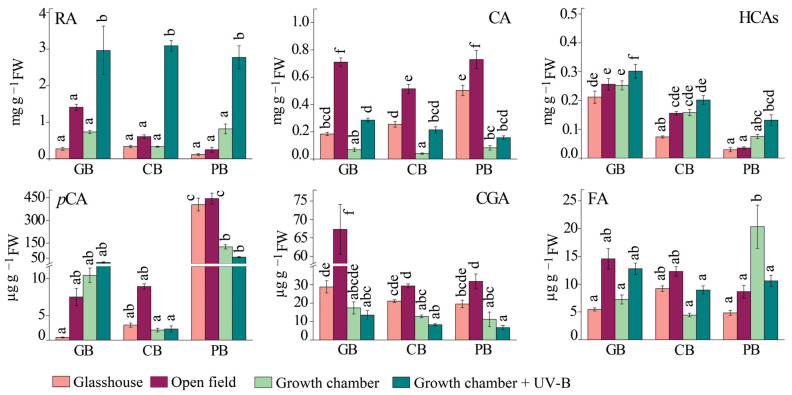
Three basil plant varieties ( var. Genovese, × , and var. ) were grown under moderate light (about 300 µmol photons m s) in a glasshouse or growth chamber and then either transferred to an open field (average daily dose: 29.2 kJ m d) or additionally exposed to UV-B irradiation in a growth chamber (29.16 kJ m d), to reveal the variety-specific and light-specific acclimation responses. Total antioxidant capacity (TAC), phenolic profile, ascorbate content, and class III peroxidase (POD) activity were used to determine the antioxidant status of leaves under all four light regimes. Exposure to high solar irradiation at the open field resulted in an increase in TAC, total hydroxycinnamic acids (HCAs, especially caffeic acid), flavonoids, and epidermal UV-absorbing substances in all three varieties, as well as a two-fold increase in the leaf dry/fresh weight ratio. The supplemental UV-B irradiation induced preferential accumulation of HCAs (rosmarinic acid) over flavonoids, increased TAC and POD activity, but decreased the ascorbate content in the leaves, and inhibited the accumulation of epidermal flavonoids in all basil varieties. Furthermore, characteristic leaf curling and UV-B-induced inhibition of plant growth were observed in all basil varieties, while a pro-oxidant effect of UV-B was indicated with HO accumulation in the leaves and spotty leaf browning. The extent of these morphological changes, and oxidative damage depended on the basil cultivar, implies a genotype-specific tolerance mechanism to high doses of UV-B irradiation.
三种罗勒植物品种(var. Genovese、× 和 var. )在适度光照(约 300 µmol 光子 m s)下在温室或生长室中生长,然后要么转移到开阔地(平均日剂量:29.2 kJ m d),要么在生长室中额外暴露于 UV-B 辐射下(29.16 kJ m d),以揭示品种特异性和光特异性的适应反应。总抗氧化能力(TAC)、酚类谱、抗坏血酸含量和 III 类过氧化物酶(POD)活性用于确定所有四种光照条件下叶片的抗氧化状态。在开阔地暴露于高太阳辐射下,导致 TAC、总羟基肉桂酸(HCAs,特别是咖啡酸)、类黄酮和表皮 UV 吸收物质在所有三种品种中增加,以及叶片干/鲜重比增加一倍。补充的 UV-B 辐射诱导 HCAs(迷迭香酸)优先积累而不是类黄酮,增加 TAC 和 POD 活性,但降低叶片中的抗坏血酸含量,并抑制所有罗勒品种表皮类黄酮的积累。此外,所有罗勒品种都观察到特征性的叶片卷曲和 UV-B 诱导的植物生长抑制,而 HO 在叶片中的积累和点状叶片褐变表明 UV-B 具有促氧化剂作用。这些形态变化和氧化损伤的程度取决于罗勒品种,暗示了对高剂量 UV-B 辐射的特定基因型耐受机制。