Çelik Sadettin
Department of Forestry, Genç Vocational School, University of Bingol, Bingol 12500, Turkey.
Life (Basel). 2023 Oct 16;13(10):2067. doi: 10.3390/life13102067.
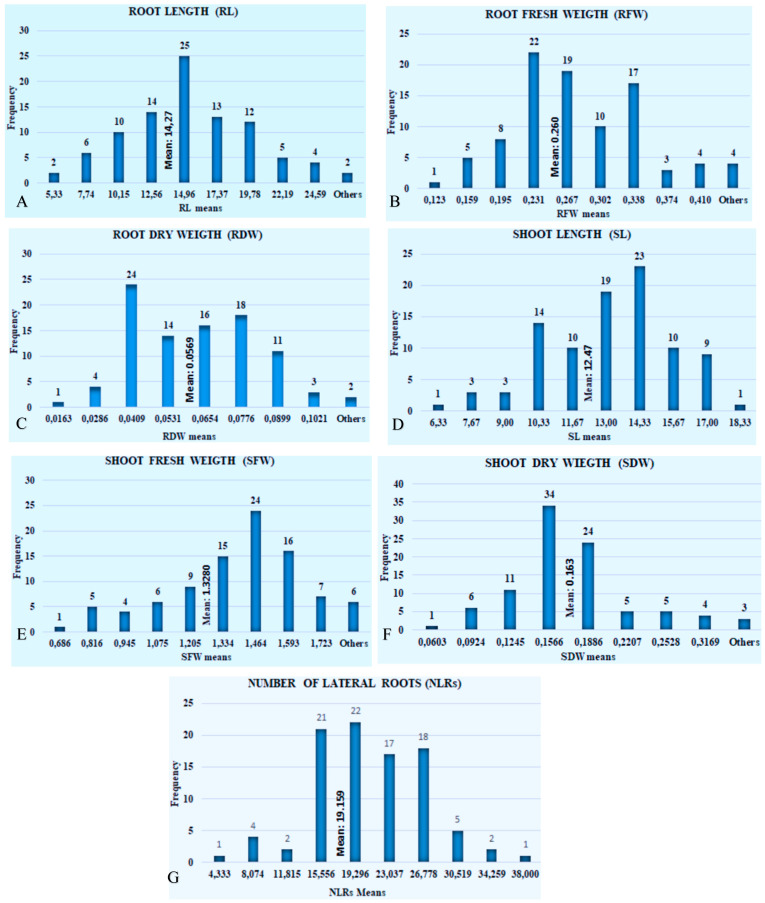
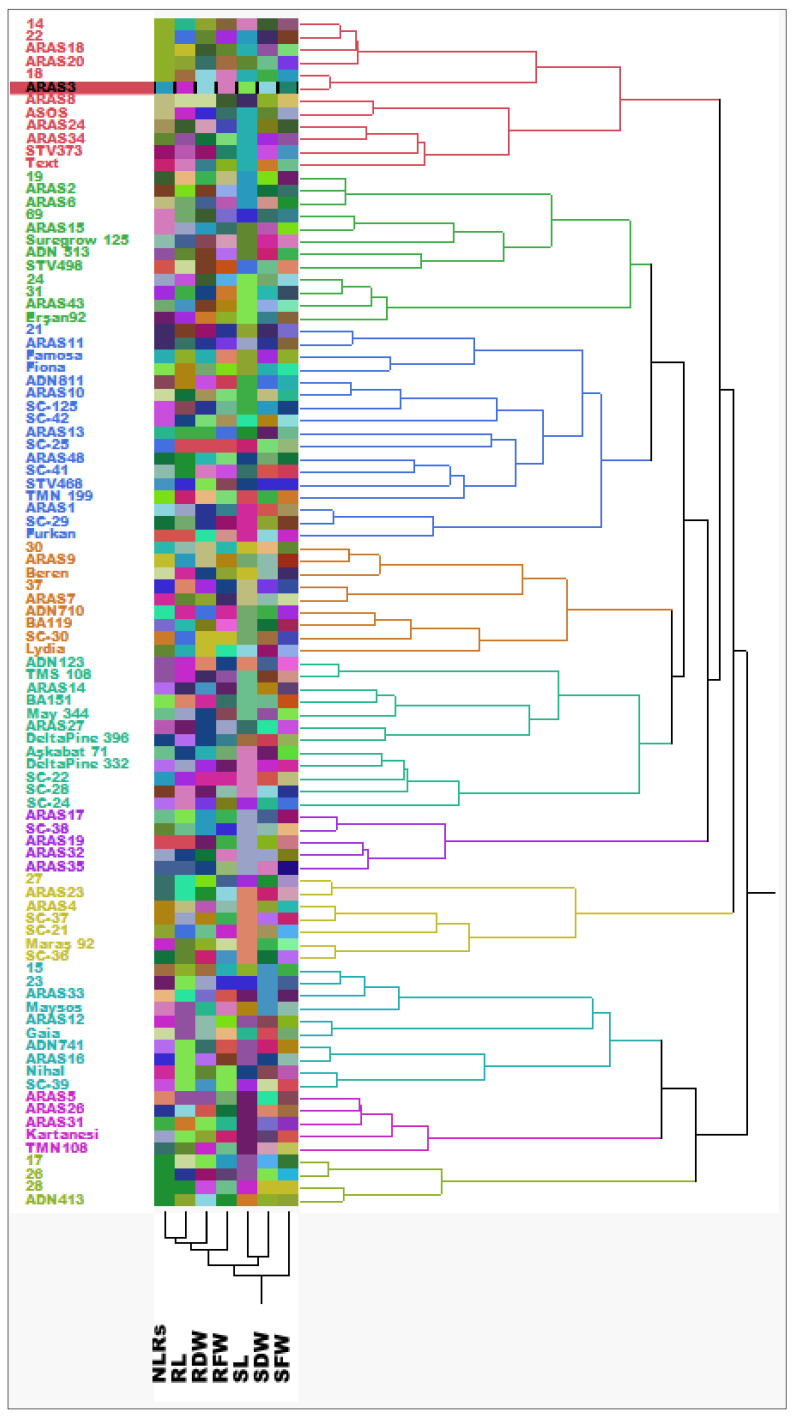
The cotton plant is important since it provides raw materials for various industry branches. Even though cotton is generally drought-tolerant, it is affected negatively by long-term drought stress. The trial was conducted according to the applied experimental design as a completely randomized design (CRD) with three replications to determine a panel of 93 cotton genotypes' genotypic responses against drought under controlled conditions in 2022. All genotypes were watered with 80 mL of water (100% irrigation, field capacity) until three true leaves appeared, and then water stress was applied at a limited irrigation of 75% (60 mL), 50% (40 mL), and 25% (20 mL) of the field capacity. After the trial terminated at 52 days, the cv. G56, G44, G5, and G86 in RL; G1, G56, G44, G86, G51, and G88 in RFW; advanced line G5, followed by the cv. G56, advanced line G44, G75, and the cv. G90 in RDW; G44, followed by G86, the cv. G56, and elite lines G13 and G5 in NLRs were observed as drought-tolerant genotypes, respectively, while G35, G15, G26, G67, and G56 in SL; G15, G52, G60, G31, and G68 in SFW; G35, G52, G57, G41, and G60 in SDW show the highest drought tolerance means, respectively. In conclusion, the commercial varieties with high means in roots, namely G86, G56, G88, and G90, and the genotypes G67, G20, G60, and G57 showing tolerance in shoots, are suggested to be potential parent plants for developing cotton varieties resistant to drought. Using the cultivars found tolerant in the current study as parents in a drought-tolerant variety development marker-assisted selection (MAS) plant breeding program will increase the chance of success in reaching the target after genetic diversity analyses are performed. On the other hand, it is highly recommended to continue the plant breeding program with the G44, G30, G19, G1, G5, G75, G35, G15, G52, G29, and G76 genotypes, which show high tolerance in both root and shoot systems.
棉花植株很重要,因为它为各个工业部门提供原材料。尽管棉花一般耐旱,但长期干旱胁迫会对其产生负面影响。该试验按照应用的实验设计,采用完全随机设计(CRD),重复三次,于2022年在可控条件下确定93个棉花基因型对干旱的基因型反应。所有基因型在三片真叶出现前均浇80毫升水(100%灌溉,田间持水量),之后分别以田间持水量的75%(60毫升)、50%(40毫升)和25%(20毫升)进行有限灌溉来施加水分胁迫。试验在52天后结束,结果显示,在根长(RL)方面,cv. G56、G44、G5和G86表现耐旱;在根鲜重(RFW)方面,G1、G56、G44、G86、G51和G88表现耐旱;在地上部干重(RDW)方面,先进品系G5,其次是cv. G56、先进品系G44、G75和cv. G90表现耐旱;在坏死叶率(NLRs)方面,G44,其次是G86、cv. G56以及优良品系G13和G5表现耐旱。而在茎长(SL)方面,G35、G15、G26、G67和G56;在茎鲜重(SFW)方面,G15、G52、G60、G31和G68;在茎干重(SDW)方面,G35、G52、G57、G41和G60分别表现出最高的耐旱均值。总之,根性状均值较高的商业品种,即G86、G56、G88和G90,以及在地上部表现出耐受性的基因型G67、G20、G60和G57,被认为是培育耐旱棉花品种的潜在亲本植株。在耐旱品种开发的标记辅助选择(MAS)植物育种计划中,将本研究中发现的耐旱品种用作亲本,在进行遗传多样性分析后,将增加实现目标的成功几率。另一方面,强烈建议继续对G44、G30、G19、G1、G5、G75、G35、G15、G52、G29和G76基因型进行植物育种计划,这些基因型在根和地上部系统中均表现出高耐受性。