Zahid Zobia, Khan Muhammad Kashif Riaz, Hameed Amjad, Akhtar Muhammad, Ditta Allah, Hassan Hafiz Mumtaz, Farid Ghulam
Plant Breeding and Genetics Division, Nuclear Institute for Agriculture and Biology, Faisalabad, Pakistan.
NIAB-C, Pakistan Institute of Engineering and Applied Science Nilore, Islamabad, Pakistan.
Front Plant Sci. 2021 Mar 12;12:627107. doi: 10.3389/fpls.2021.627107. eCollection 2021.
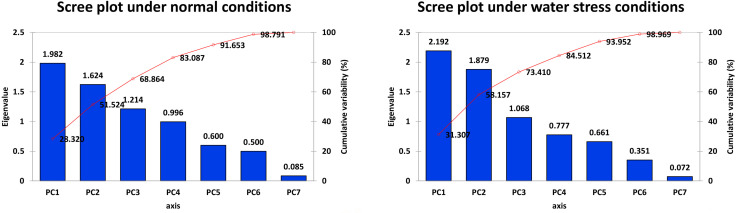
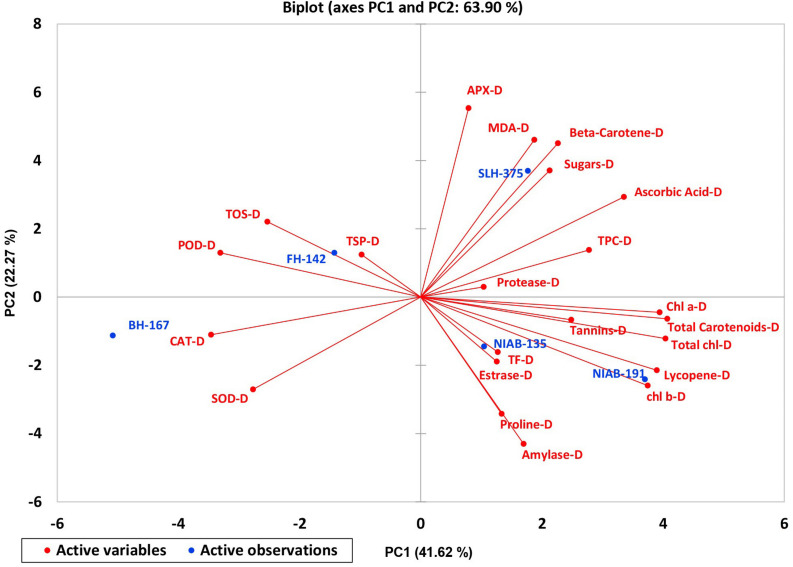
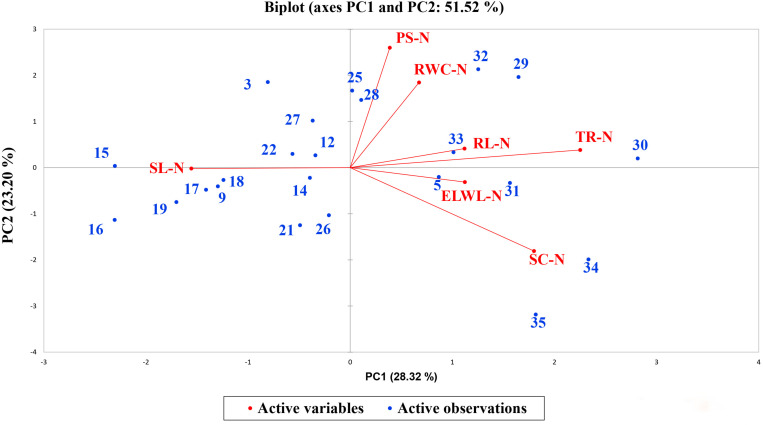
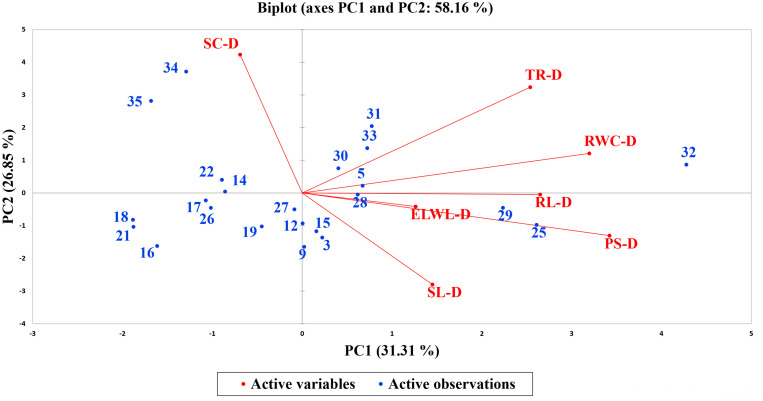
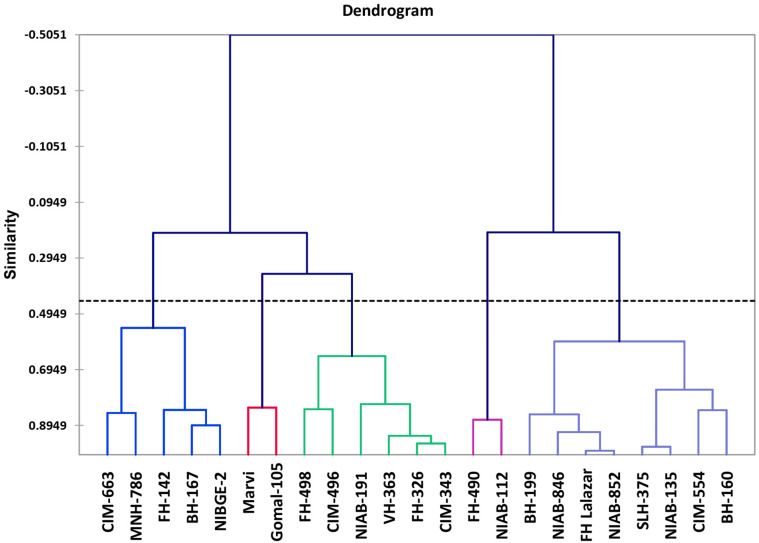
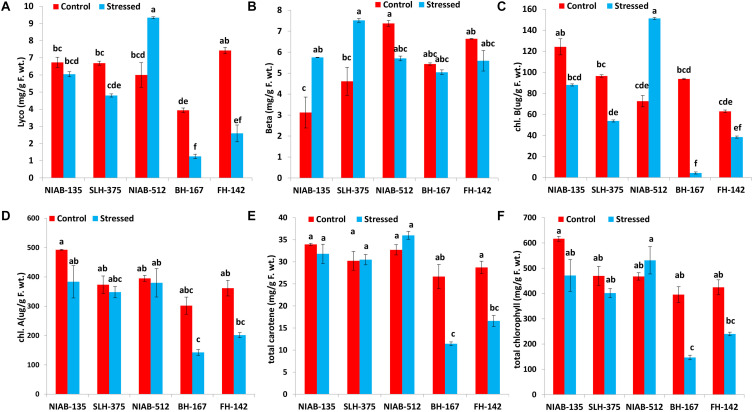
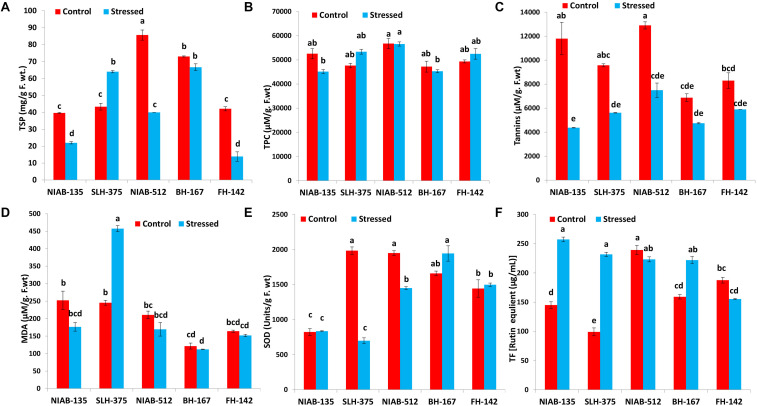
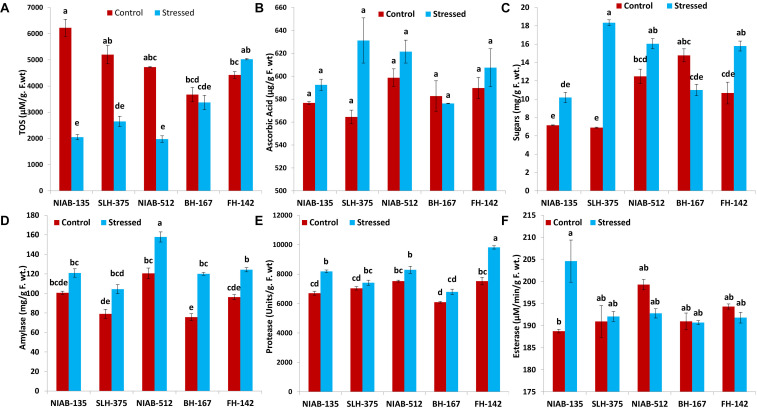
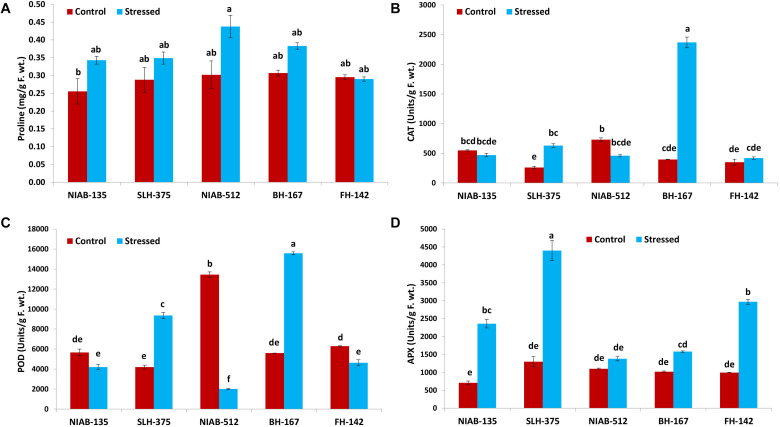
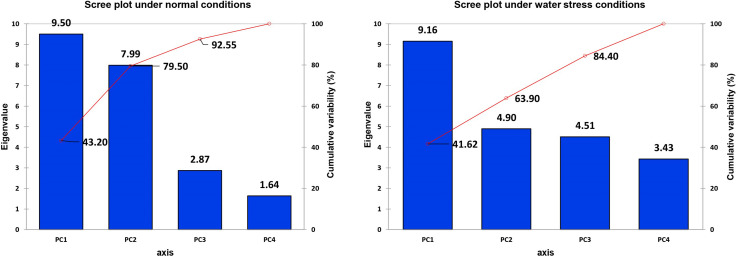
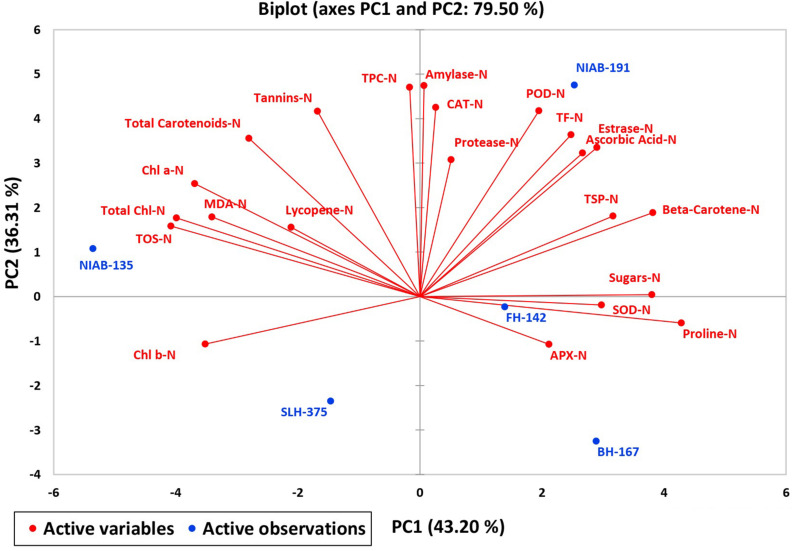
Cotton is an important fiber and cash crop. Extreme water scarceness affects the growth, quality, and productivity of cotton. Water shortage has threatened the future scenario for cotton growers, so it is imperative to devise a solution to this problem. In this research, we have tried to machinate a solution for it. 23 genotypes have been screened out against drought tolerance at the seedling stage by evaluating the morphological, physiological, and biochemical traits in a triplicate completely randomized design plot experiment with two water regimes [50 and 100% field capacity]. Genotypic differences for all the morphological and physiological traits revealed highly significant differences except transpiration rate (TR). Moreover, the interaction between genotype and water regime (G × W) was highly significant for root length (RL, 5.163), shoot length (SL, 11.751), excised leaf water loss (ELWL, 0.041), and stomatal conductance (SC, 7.406). A positively strong correlation was found in TR with relative water content (RWC; 0.510) and SC (0.584) and RWC with photosynthesis (0.452) under drought conditions. A negative correlation was found in SC with SL (-0.428) and photosynthesis (-0.446). Traits like RL, SL, SC, photosynthesis, proline, catalase, and malondialdehyde were visible indicators, which can differentiate drought-tolerant genotypes from the susceptible ones. A wide range of diversity was found in all the morpho-physiological traits with the cumulative variance of four principal components (PCs) 83.09% and three PCs 73.41% under normal and water-stressed conditions, respectively, as per the principal component analysis. Hence, selection criteria can be established on the aforementioned traits for the development of drought-tolerant cultivars. Moreover, it was found that out of 23 experimental varieties, NIAB-135, NIAB-512, and CIM-554 could be used to devise breeding strategies for improving drought tolerance in cotton.
棉花是一种重要的纤维作物和经济作物。极端缺水会影响棉花的生长、品质和产量。缺水威胁着棉花种植者的未来前景,因此必须找到解决这一问题的办法。在本研究中,我们试图为此设计一个解决方案。通过在两种水分条件[50%和100%田间持水量]下的完全随机区组设计重复试验中评估形态、生理和生化性状,在苗期筛选出了23个耐旱基因型。除蒸腾速率(TR)外,所有形态和生理性状的基因型差异均显示出极显著差异。此外,基因型与水分条件(G×W)之间的交互作用对根长(RL,5.163)、茎长(SL,11.751)、离体叶片失水率(ELWL,0.041)和气孔导度(SC,7.406)具有极显著影响。在干旱条件下,TR与相对含水量(RWC;0.510)和SC(0.584)呈强正相关,RWC与光合作用(0.452)呈正相关。SC与SL(-0.428)和光合作用(-0.446)呈负相关。RL、SL、SC、光合作用、脯氨酸、过氧化氢酶和丙二醛等性状是可见指标,可区分耐旱基因型和敏感基因型。根据主成分分析,在正常和水分胁迫条件下,所有形态生理性状均存在广泛的多样性,四个主成分(PCs)的累积方差分别为83.09%和三个PCs的累积方差为73.41%。因此,可以根据上述性状建立选择标准,以培育耐旱品种。此外,研究发现,在23个试验品种中,NIAB-135、NIAB-512和CIM-554可用于制定提高棉花耐旱性的育种策略。