Sichanova Mariana, Geneva Maria, Petrova Maria, Miladinova-Georgieva Kamelia, Kirova Elisaveta, Nedev Trendafil, Tsekova Daniela, Ivanova Viktoria, Trendafilova Antoaneta
Institute of Plant Physiology and Genetics, Bulgarian Academy of Sciences, Acad. G. Bonchev Street, Bldg. 21, 1113 Sofia, Bulgaria.
Department of Organic Chemistry, University of Chemical Technology and Metallurgy, 8"St. Kl. Ohridski" Blvd, 1756 Sofia, Bulgaria.
Plants (Basel). 2023 Oct 14;12(20):3574. doi: 10.3390/plants12203574.
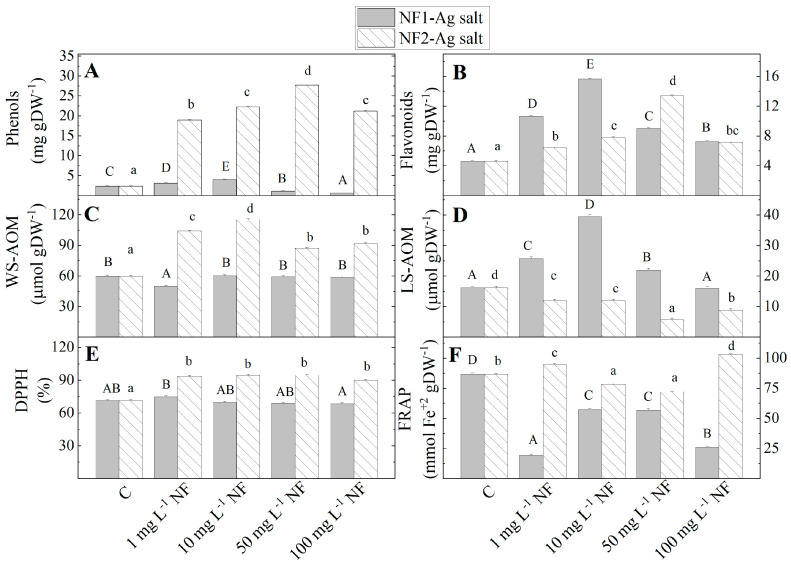
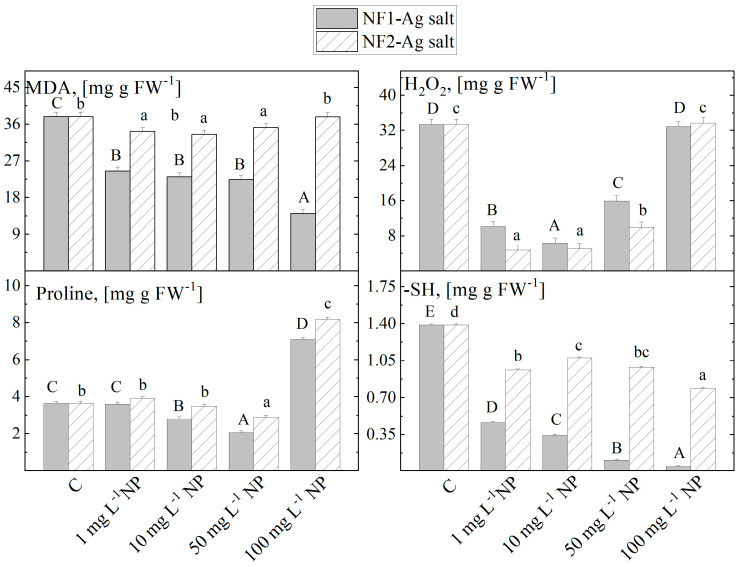
The use of nanomaterials in biotechnology for the in vitro propagation of medical plants and the accumulation of certain biologically active metabolites is becoming an efficient strategy. This study aimed to evaluate the influence of the concentration (0, 1, 10, 50, and 100 mg L) of two types of nanofibers on the growth characteristics, the antioxidant status, and the production of steviol glycosides in micropropagated Bert. plantlets. The nanofibers were synthesized by aspartic acid derivatives (L-Asp) Ag salts self-organized into nanofibers with two different molecular structures: monomeric, containing one residue of L-Asp with one hydrophilic head which bonds one Ag ion (NF1-Ag salt); and dimeric, containing two residues of L-Asp with two hydrophilic heads which bond two Ag ions (NF2-Ag salt). An increase in the shoots from the explants' number and length, biomass accumulation, and micropropagation rate was achieved in the plants treated with the NF1-Ag salt in concentrations from 1 to 50 mg L after 30 days of in vitro proliferation compared to the NF2-Ag salt. In contrast, the plants grown on MS media supplemented with NF2-Ag salt exhibited an increase in the level of stevioside, rebaudioside A, and mono- (CQA) and dicaffeoylquinic (DCQA) acids as compared to the NF1-Ag salt.
在生物技术中使用纳米材料进行药用植物的离体繁殖以及某些生物活性代谢物的积累正成为一种有效的策略。本研究旨在评估两种类型的纳米纤维浓度(0、1、10、50和100 mg/L)对微繁殖的甜叶菊植株生长特性、抗氧化状态以及甜菊糖苷产量的影响。这些纳米纤维由天冬氨酸衍生物(L-Asp)银盐自组装成具有两种不同分子结构的纳米纤维:单体型,含有一个L-Asp残基和一个与一个银离子结合的亲水头(NF1-Ag盐);二聚体型,含有两个L-Asp残基和两个与两个银离子结合的亲水头(NF2-Ag盐)。与NF2-Ag盐相比,在体外增殖30天后,用浓度为1至50 mg/L的NF1-Ag盐处理的植株,外植体的芽数、芽长度、生物量积累和微繁殖率均有所增加。相反,与NF1-Ag盐相比,在添加NF2-Ag盐的MS培养基上生长的植株,甜菊糖苷、莱鲍迪苷A以及单咖啡酰奎宁酸(CQA)和二咖啡酰奎宁酸(DCQA)的含量有所增加。