Department of Neurology, Cheeloo College of Medicine, Shandong Provincial Hospital, Shandong University, No. 324 Jingwuweiqi Road, Jinan, 250021, Shandong, People's Republic of China.
Department of Neurology, Shandong Provincial Hospital affiliated to Shandong First Medical University, Jinan, Shandong, People's Republic of China.
Aging Clin Exp Res. 2023 Nov;35(11):2821-2829. doi: 10.1007/s40520-023-02576-8. Epub 2023 Oct 29.
Emerging evidence has linked elevated resting heart rate (RHR) with poor cognitive function in older adults, but the mechanisms underlying their association are poorly understood.
This population-based cross-sectional study included 4510 dementia-free participants (age ≥ 65 years; 56.9% females; 38.3% no formal education) in the baseline examination of the Multidomain Interventions to Delay Dementia and Disability in Rural China study. Of these, 1,386 had data on serum proinflammatory cytokines and adhesion molecules. RHR was measured using 12-lead electrocardiograph. We used the Mini-Mental State Examination (MMSE) and a neuropsychological test battery to assess cognitive function. Data were analyzed using the general linear and restricted cubic splines models.
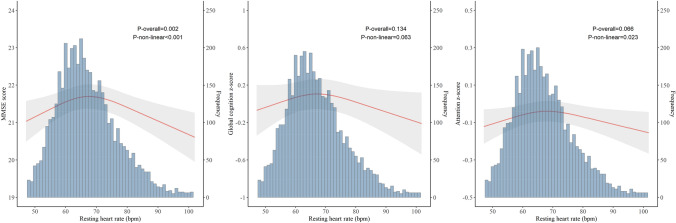
People with high RHR were more likely to have cardiometabolic diseases and worse cognitive function (p < 0.05). There was an inverted J-shaped association of RHR with MMSE and attention scores. Having RHR ≥ 80 bpm (vs. 60-69 bpm) was significantly associated with the multivariable-adjusted β coefficients of - 0.58 [95% confidence interval (CI), - 1.00, - 0.16] for MMSE score and - 0.08 (- 0.15, - 0.01) for attention score. In the serum biomarker subsample, RHR was linearly associated with serum interleukin-6 (IL-6) (β coefficient = 0.19; 95%CI 0.14, 0.24), IL-8 (0.08; 0.02, 0.13), IL-10 (0.09; 0.04, 0.15), tumor necrosis factor-α (0.06; 0.01, 0.11), monocyte chemotactic protein-1 (0.09; 0.04, 0.15), intercellular adhesion molecule-1 (0.16; 0.11, 0.22), and vascular cell adhesion molecule-1 (0.11; 0.06, 0.16).
There is an inverted J-shaped association of RHR with attention and global cognition. Poor cognitive function and high RHR may be linked through systemic low-grade inflammation and endothelial injury.
越来越多的证据表明,静息心率(RHR)升高与老年人认知功能下降有关,但两者之间的关联机制尚不清楚。
本研究为基于人群的横断面研究,纳入了中国农村多领域干预延缓痴呆和残疾研究基线检查中无痴呆的 4510 名参与者(年龄≥65 岁;56.9%为女性;38.3%未接受过正规教育)。其中 1386 名参与者有血清促炎细胞因子和黏附分子的数据。RHR 使用 12 导联心电图测量。我们使用简易精神状态检查(MMSE)和神经心理学测试组合来评估认知功能。使用一般线性和限制立方样条模型进行数据分析。
RHR 较高的人更有可能患有心血管代谢疾病和认知功能更差(p<0.05)。RHR 与 MMSE 和注意力评分呈倒 J 形关联。RHR≥80bpm(vs. 60-69bpm)与 MMSE 评分的多变量调整β系数显著相关,为-0.58(95%置信区间[CI]:-1.00,-0.16),与注意力评分的为-0.08(-0.15,-0.01)。在血清生物标志物亚样本中,RHR 与血清白细胞介素-6(IL-6)(β系数=0.19;95%CI 0.14,0.24)、IL-8(0.08;0.02,0.13)、IL-10(0.09;0.04,0.15)、肿瘤坏死因子-α(0.06;0.01,0.11)、单核细胞趋化蛋白-1(0.09;0.04,0.15)、细胞间黏附分子-1(0.16;0.11,0.22)和血管细胞黏附分子-1(0.11;0.06,0.16)呈线性相关。
RHR 与注意力和整体认知呈倒 J 形关联。认知功能差和 RHR 升高可能与全身低度炎症和内皮损伤有关。