Digital Epidemiology Laboratory, Digital Futures, University of Cincinnati, Cincinnati, OH, USA
Digital Epidemiology Laboratory, Digital Futures, University of Cincinnati, Cincinnati, OH, USA.
BMJ Glob Health. 2023 Oct;8(10). doi: 10.1136/bmjgh-2023-012629.
In sub-Saharan Africa, HIV/AIDS remains a leading cause of death. The UNAIDS established the '95-95-95' targets to improve HIV care continuum outcomes. Using geospatial data from the Zambia Population-based HIV Impact Assessment (ZAMPHIA), this study aims to investigate geospatial patterns in the '95-95-95' indicators and individual-level determinants that impede HIV care continuum in vulnerable communities, providing insights into the factors associated with gaps.
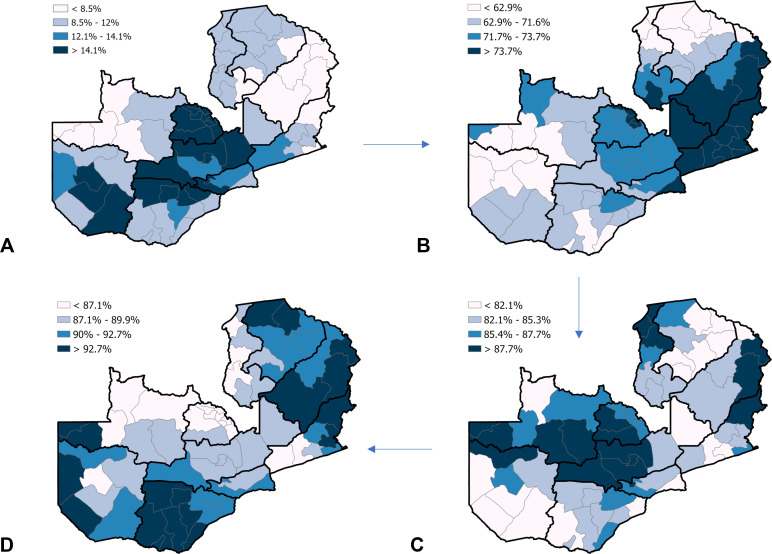
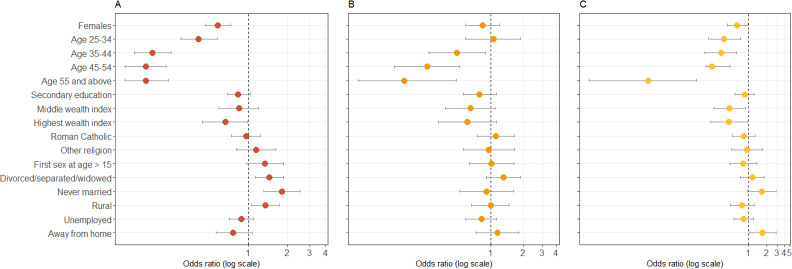
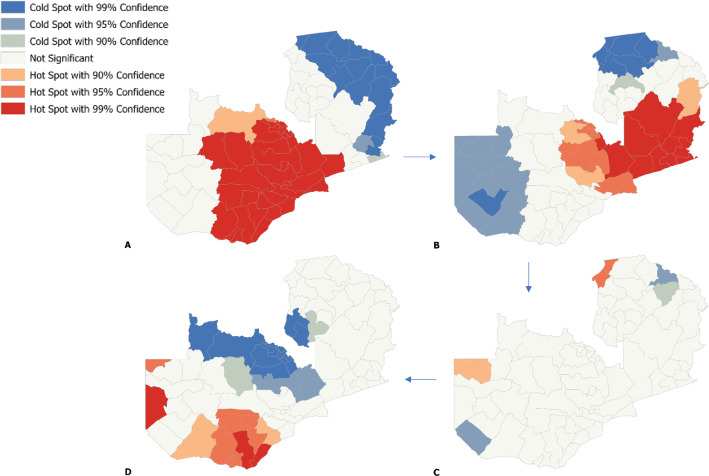
This study used data from the 2016 ZAMPHIA to investigate the geospatial distribution and individual-level determinants of engagement across the HIV care continuum in Zambia. Gaussian kernel interpolation and optimised hotspot analysis were used to identify geospatial patterns in the HIV care continuum, while geospatial k-means clustering was used to partition areas into clusters. The study also assessed healthcare availability, access and social determinants of healthcare utilisation. Multiple logistic regression models were used to examine the association between selected sociodemographic and behavioural covariates and the three main outcomes of study.
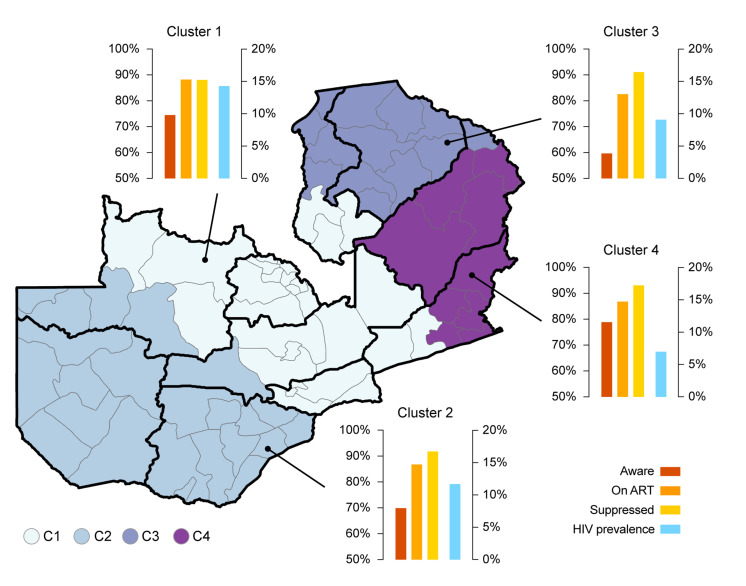
Varied progress towards the '95-95-95' targets were observed in different regions of Zambia. Each '95' displayed a unique geographical pattern, independent of HIV prevalence, resulting in four distinct geographical clusters. Factors associated with gaps in the '95s' include younger age, male sex, and low wealth, with younger individuals having higher odds of not being on antiretroviral therapy and having detectable viral loads.
Our study revealed significant spatial heterogeneity in the HIV care continuum in Zambia, with different regions exhibiting unique geographical patterns and levels of performance in the '95-95-95' targets, highlighting the need for geospatial tailored interventions to address the specific needs of different subnational regions. These findings underscore the importance of addressing differential regional gaps in HIV diagnosis, enhancing community-level factors and developing innovative strategies to improve local HIV care continuum outcomes.
在撒哈拉以南非洲地区,艾滋病毒/艾滋病仍然是导致死亡的主要原因。艾滋病规划署制定了“95-95-95”目标,以改善艾滋病毒护理连续体的结果。本研究利用来自赞比亚基于人口的艾滋病毒影响评估(ZAMPHIA)的地理空间数据,旨在研究“95-95-95”指标的地理空间模式以及阻碍脆弱社区艾滋病毒护理连续体的个体层面决定因素,深入了解与差距相关的因素。
本研究使用 2016 年 ZAMPHIA 的数据,调查了赞比亚艾滋病毒护理连续体中参与情况的地理空间分布和个体层面决定因素。使用高斯核插值和优化热点分析来识别艾滋病毒护理连续体的地理空间模式,而地理空间 K-均值聚类则用于将区域划分为聚类。该研究还评估了医疗保健的可及性、获得情况以及医疗保健利用的社会决定因素。使用多变量逻辑回归模型来研究选定的社会人口学和行为因素与研究的三个主要结果之间的关联。
在赞比亚的不同地区,朝着“95-95-95”目标取得了不同程度的进展。每个“95”都显示出独特的地理模式,与艾滋病毒流行率无关,从而形成了四个不同的地理集群。与“95”差距相关的因素包括年龄较小、男性和低财富,年龄较小的个体接受抗逆转录病毒治疗和检测到病毒载量的可能性更高。
我们的研究揭示了赞比亚艾滋病毒护理连续体存在显著的空间异质性,不同地区在“95-95-95”目标中表现出独特的地理模式和水平,这凸显了需要进行地理空间定制干预,以满足不同次国家区域的具体需求。这些发现强调了在艾滋病毒诊断方面解决不同地区差距、增强社区层面因素以及制定创新战略以改善当地艾滋病毒护理连续体结果的重要性。