Center of Human and Molecular Biology (ZHMB), Institute of Virology, Saarland University, Homburg/Saar, Germany.
Department of Obstetrics and Gynecology, Saarland University Medical Center, Homburg/Saar, Germany.
Mol Oncol. 2024 Sep;18(9):2157-2178. doi: 10.1002/1878-0261.13546. Epub 2023 Nov 16.
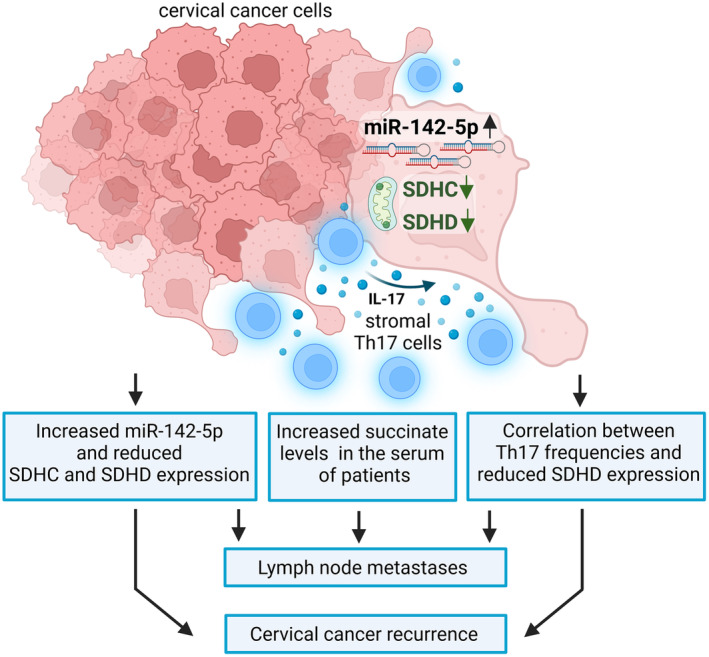
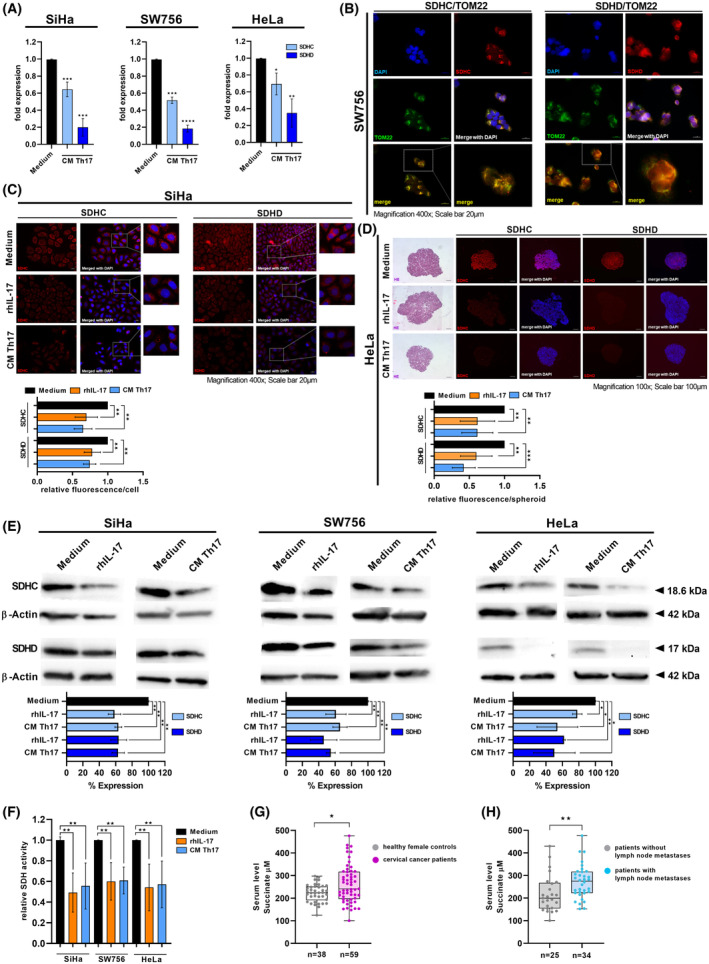
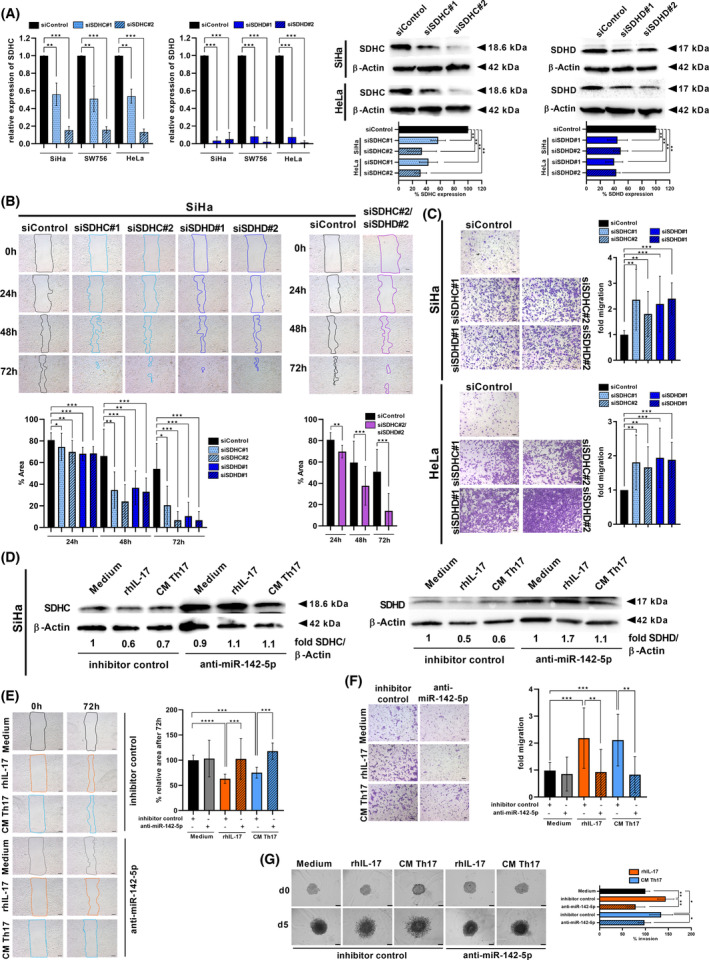
During cervical carcinogenesis, T-helper (Th)-17 cells accumulate in the peripheral blood and tumor tissues of cancer patients. We previously demonstrated that Th17 cells are associated with therapy resistance as well as cervical cancer metastases and relapse; however, the underlying Th17-driven mechanisms are not fully understood. Here, using microarrays, we found that Th17 cells induced an epithelial-to-mesenchymal transition (EMT) phenotype of cervical cancer cells and promoted migration and invasion of 2D cultures and 3D spheroids via induction of microRNA miR-142-5p. As the responsible mechanism, we identified the subunits C and D of the succinate dehydrogenase (SDH) complex as new targets of miR-142-5p and provided evidence that Th17-miR-142-5p-dependent reduced expression of SDHC and SDHD mediated enhanced migration and invasion of cancer cells using small interfering RNAs (siRNAs) for SDHC and SDHD, and miR-142-5p inhibitors. Consistently, patients exhibited high levels of succinate in their serum associated with lymph node metastases and diminished expression of SDHD in patient biopsies correlated with increased numbers of Th17 cells. Correspondingly, a combination of weak or negative SDHD expression and a ratio of Th17/CD4 T cells > 43.90% in situ was associated with reduced recurrence-free survival. In summary, we unraveled a previously unknown molecular mechanism by which Th17 cells promote cervical cancer progression and suggest evaluation of Th17 cells as a potential target for immunotherapy in cervical cancer.
在宫颈癌的发生过程中,辅助性 T 细胞(Th)17 细胞在癌症患者的外周血和肿瘤组织中积累。我们之前的研究表明,Th17 细胞与治疗抵抗以及宫颈癌转移和复发有关;然而,其潜在的 Th17 驱动机制尚不完全清楚。在这里,我们使用微阵列发现 Th17 细胞诱导宫颈癌细胞发生上皮间质转化(EMT)表型,并通过诱导 microRNA miR-142-5p 促进 2D 培养物和 3D 球体的迁移和侵袭。作为负责的机制,我们鉴定出琥珀酸脱氢酶(SDH)复合物的亚基 C 和 D 是 miR-142-5p 的新靶点,并提供了证据表明,通过使用针对 SDHC 和 SDHD 的小干扰 RNA(siRNA)以及 miR-142-5p 抑制剂,Th17-miR-142-5p 依赖性降低 SDHC 和 SDHD 的表达可介导癌细胞的迁移和侵袭增强。一致地,患者的血清中琥珀酸水平较高,与淋巴结转移有关,患者活检中 SDHD 的表达降低与 Th17 细胞数量增加有关。相应地,SDHD 表达弱或阴性和 Th17/CD4 T 细胞比值 > 43.90%的组合与无复发生存率降低相关。总之,我们揭示了 Th17 细胞促进宫颈癌进展的一个以前未知的分子机制,并提出将 Th17 细胞评估为宫颈癌免疫治疗的潜在靶点。