Bilucaglia Marco, Duma Gian Marco, Mento Giovanni, Semenzato Luca, Tressoldi Patrizio E
Behavior and BrainLab, IULM, Milan, Italy.
Department of Developmental and Social Psychology (DPSS), Università degli Studi di Padova, Padova, Italy.
F1000Res. 2021 Oct 13;9:173. doi: 10.12688/f1000research.22202.3. eCollection 2020.
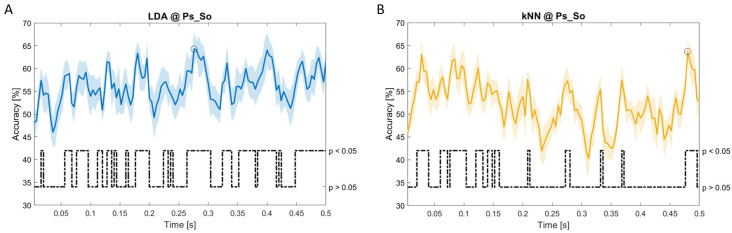
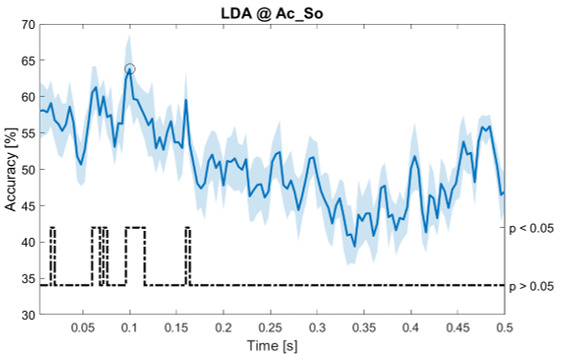
Machine learning approaches have been fruitfully applied to several neurophysiological signal classification problems. Considering the relevance of emotion in human cognition and behaviour, an important application of machine learning has been found in the field of emotion identification based on neurophysiological activity. Nonetheless, there is high variability in results in the literature depending on the neuronal activity measurement, the signal features and the classifier type. The present work aims to provide new methodological insight into machine learning applied to emotion identification based on electrophysiological brain activity. For this reason, we analysed previously recorded EEG activity measured while emotional stimuli, high and low arousal (auditory and visual) were provided to a group of healthy participants. Our target signal to classify was the pre-stimulus onset brain activity. Classification performance of three different classifiers (LDA, SVM and kNN) was compared using both spectral and temporal features. Furthermore, we also contrasted the performance of static and dynamic (time evolving) approaches. The best static feature-classifier combination was the SVM with spectral features (51.8%), followed by LDA with spectral features (51.4%) and kNN with temporal features (51%). The best dynamic feature classifier combination was the SVM with temporal features (63.8%), followed by kNN with temporal features (63.70%) and LDA with temporal features (63.68%). The results show a clear increase in classification accuracy with temporal dynamic features.
机器学习方法已成功应用于多个神经生理信号分类问题。考虑到情绪在人类认知和行为中的相关性,机器学习在基于神经生理活动的情绪识别领域有了重要应用。尽管如此,根据神经元活动测量、信号特征和分类器类型的不同,文献中的结果存在很大差异。本研究旨在为基于脑电生理活动的情绪识别中的机器学习提供新的方法学见解。因此,我们分析了之前记录的脑电图活动,这些活动是在向一组健康参与者提供高、低唤醒(听觉和视觉)情绪刺激时测量的。我们要分类的目标信号是刺激前开始的脑活动。使用频谱和时间特征比较了三种不同分类器(线性判别分析、支持向量机和k近邻)的分类性能。此外,我们还对比了静态和动态(随时间演变)方法的性能。最佳的静态特征 - 分类器组合是具有频谱特征的支持向量机(51.8%),其次是具有频谱特征的线性判别分析(51.4%)和具有时间特征的k近邻(51%)。最佳的动态特征分类器组合是具有时间特征的支持向量机(63.8%),其次是具有时间特征的k近邻(63.70%)和具有时间特征的线性判别分析(63.68%)。结果表明,使用时间动态特征时分类准确率有明显提高。