Ganabady Kavya, Contessi Negrini Nicola, Scherba Jacob C, Nitschke Brandon M, Alexander Morgan R, Vining Kyle H, Grunlan Melissa A, Mooney David J, Celiz Adam D
Department of Bioengineering, Imperial College London, London W12 0BZ, U.K.
Wyss Institute for Biologically Inspired Engineering and Harvard John A. Paulson School of Engineering and Applied Sciences, Harvard University, Cambridge, Massachusetts 02138, United States.
ACS Appl Mater Interfaces. 2023 Oct 31;15(44):50908-15. doi: 10.1021/acsami.3c12072.
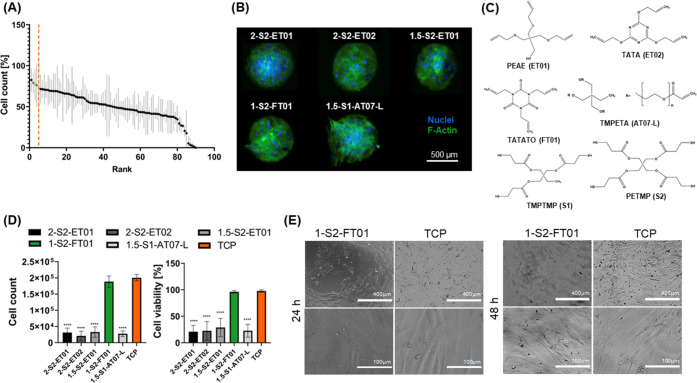
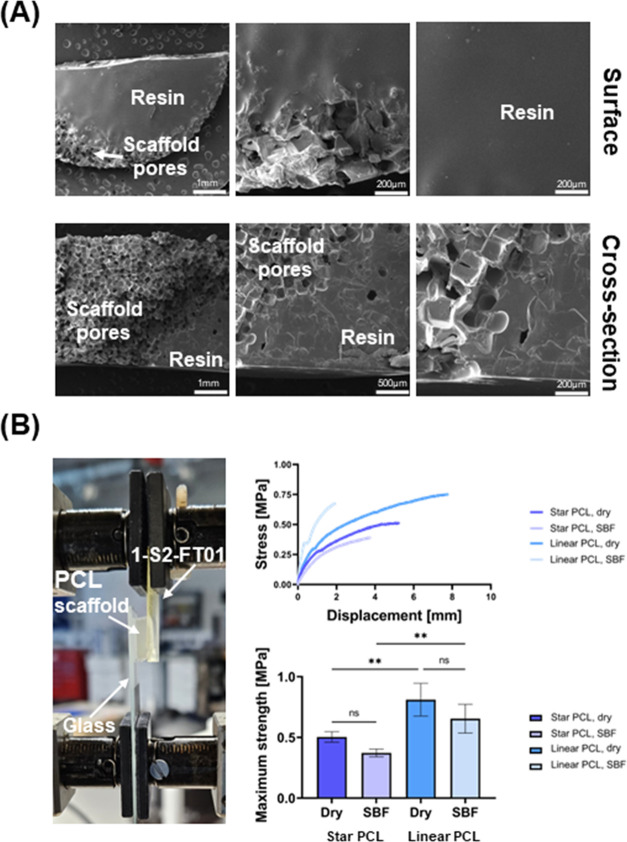
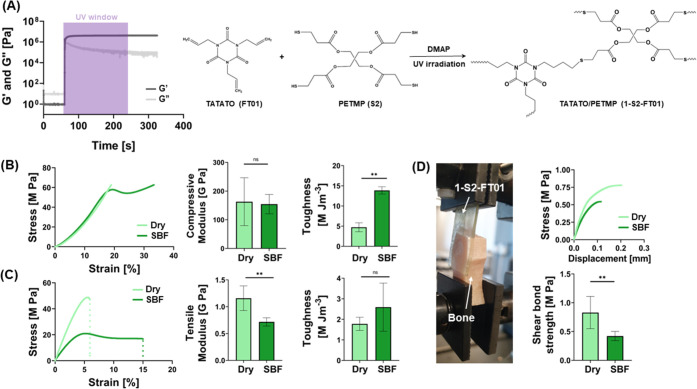
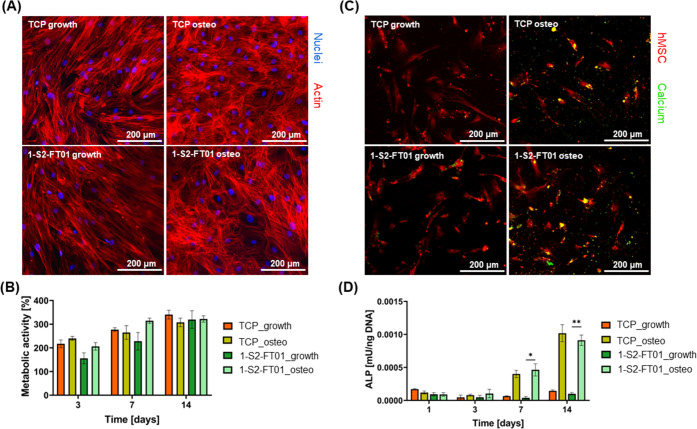
Metal surgical pins and screws are employed in millions of orthopedic surgical procedures every year worldwide, but their usability is limited in the case of complex, comminuted fractures or in surgeries on smaller bones. Therefore, replacing such implants with a bone adhesive material has long been considered an attractive option. However, synthesizing a biocompatible bone adhesive with a high bond strength that is simple to apply presents many challenges. To rapidly identify candidate polymers for a biocompatible bone adhesive, we employed a high-throughput screening strategy to assess human mesenchymal stromal cell (hMSC) adhesion toward a library of polymers synthesized via thiol-ene click chemistry. We chose thiol-ene click chemistry because multifunctional monomers can be rapidly cured via ultraviolet (UV) light while minimizing residual monomer, and it provides a scalable manufacturing process for candidate polymers identified from a high-throughput screen. This screening methodology identified a copolymer (1-S2-FT01) composed of the monomers 1,3,5-triallyl-1,3,5-triazine-2,4,6(1,3,5)-trione (TATATO) and pentaerythritol tetrakis (3-mercaptopropionate) (PETMP), which supported highest hMSC adhesion across a library of 90 polymers. The identified copolymer (1-S2-FT01) exhibited favorable compressive and tensile properties compared to existing commercial bone adhesives and adhered to bone with adhesion strengths similar to commercially available bone glues such as Histoacryl. Furthermore, this cytocompatible polymer supported osteogenic differentiation of hMSCs and could adhere 3D porous polymer scaffolds to the bone tissue, making this polymer an ideal candidate as an alternative bone adhesive with broad utility in orthopedic surgery.
金属外科用钉和螺钉每年在全球数百万例骨科手术中使用,但在复杂粉碎性骨折或小骨手术中,其适用性有限。因此,长期以来,用骨黏合材料替代此类植入物一直被视为一个有吸引力的选择。然而,合成一种具有高黏合强度且易于应用的生物相容性骨黏合剂面临诸多挑战。为了快速识别生物相容性骨黏合剂的候选聚合物,我们采用了高通量筛选策略,以评估人间充质基质细胞(hMSC)对通过硫醇-烯点击化学合成的聚合物库的黏附情况。我们选择硫醇-烯点击化学是因为多功能单体可通过紫外线(UV)光快速固化,同时将残留单体降至最低,并且它为从高通量筛选中鉴定出的候选聚合物提供了可扩展的制造工艺。这种筛选方法鉴定出一种由单体1,3,5-三烯丙基-1,3,5-三嗪-2,4,6(1,3,5)-三酮(TATATO)和季戊四醇四(3-巯基丙酸酯)(PETMP)组成的共聚物(1-S2-FT01),在90种聚合物库中,该共聚物对hMSC的黏附性最强。与现有的商业骨黏合剂相比,鉴定出的共聚物(1-S2-FT01)表现出良好的压缩和拉伸性能,并且与诸如Histoacryl等市售骨胶的黏附强度相似,能黏附于骨。此外,这种具有细胞相容性的聚合物支持hMSC的成骨分化,并且可以将3D多孔聚合物支架黏附到骨组织上,使得这种聚合物成为在骨科手术中具有广泛用途的替代骨黏合剂的理想候选物。